

How can we support peacebuilders to improve their practice?
- Explored challenges and opportunities for peace in the context of war and militarism.
- Accessed support, resources, and tools to support pro-peace and anti-war efforts.
- Benefited from capacity building and networking opportunities.
- Shared knowledge, experiences, and practices on a broad range of peace and war topics across diverse contexts, disciplines, and sectors.
- Designed, implemented, and evaluated interventions aimed at making a direct positve impact on issues of peace and security.
- Gained experience integrating education, research, activism, and advocacy work.
- Engaged in work that integrates the inner and outer dimensions of peace and positive change work.
- Showcased and celebrated their learnings and actions to an international audience.
- Explored ideas to upscale their work in the interests of sustainability through follow-up actions.
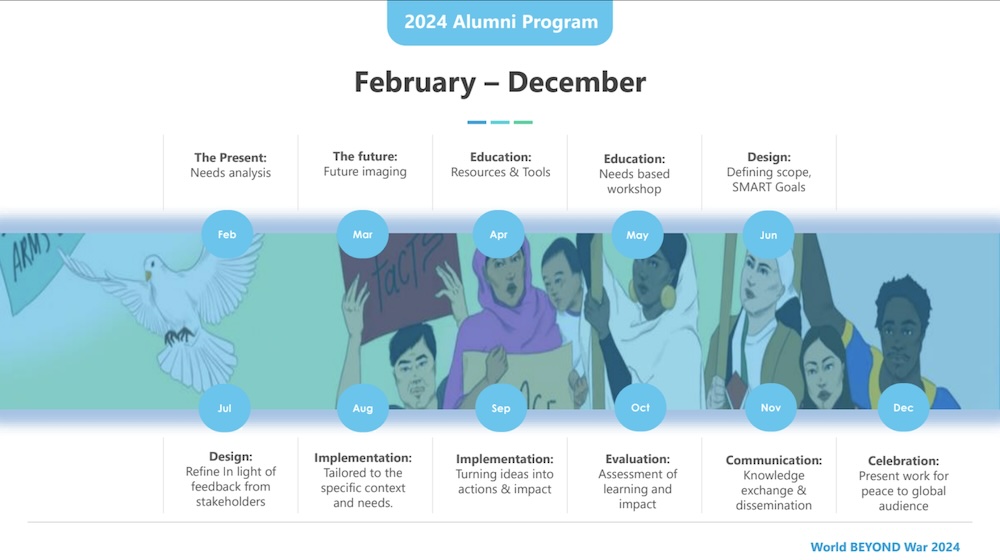
Phase 1 of the program (February-May) focused on understanding the current situation and capacity-building opportunities, while Phase 2 (June-December) emphasised the design, implementation, evaluation, and communication of interventions. As with WBW’s work in general, these interventions took various forms, involving education, activism, and/or communication strategies. Examples included educational events, training sessions and workshops, the creation of tools, resources, and materials, awareness campaigns, dialogues, advocacy, public information initiatives, and artistic expressions such as music, dance, theatre, and visual arts. Interventions were context-specific, grounded in a needs analysis, and could be large or small in scale.
Throughout the program, WBW provided support and infrastructure while conducting its own inquiry to explore new ways to better support alumni in improving their practices by combining participatory inquiry and action in support of pro-peace and anti-war leadership.
Why should I apply to join the program?
By the end of the program, participants are expected to:
- Deepen understandings of broader peace and anti-war issues, while building skills and experiences applicable to their professional work and daily life (Education).
- Apply the skills and knowledge acquired to address real-world challenges (Action).
- Articulate their learning and actions clearly and concisely to raise awareness about the importance of pro-peace and anti-war efforts, whilst demonstrating practical application of program learnings and innovations (Communication).
- Gain access to global networking opprtunities, cross-cultural experiences, and develop new or existing relationships (Connections).
A certificate was issued to participants who completed all program requirements, serving as evidence of their learning and contributions to the field. Participants also gained access to award-winning resources, tools, and frameworks, including a complementary PDF version of our seminal book, A Global Security System: An Alternative to War (AGSS).
Eligibility
The program was open to all World BEYOND War (WBW) alumni at no cost. To apply, participants were required to have enrolled in one or more of WBW’s courses or programs. To be considered for selection, applicants needed to commit to the following requirements:
- Actively participate in the program, from start to finish.
- Dedicate a minimum of four hours per month to the program.
- Attend at least 7 out of the 10 monthly online sessions, each lasting 1.5 hours, throughout the year (See below for details of dates and times).
- Design, implement, evaluate, and communicate a peacebuilding intervention – whether individually or as a group, depending on the context.
- Produce a report reflecting on the process and outcomes of your intervention, including lessons learned, implications, and recommendations.
- Complete a personal reflection capturing program experiences and learning.
Registration closed after reaching 30 participants, with slots assigned on a first-come, first-served basis. The alumni came from different backgrounds, generations, and contexts, representing diverse sectors such as civil society, academia, government, and the private sector. The goal was to assemble a cohort reflecting the diversity within the WBW alumni network.
When?
Online sessions took place at 16:00 GMT (UK Time) for one and a half hours on the last Thursday of each month for 10 months: February 22, March 28, April 25, May 30, June 27, July 25, August 29, September 26, October 31, and November 28.
The program concluded with a public celebration event on Saturday, December 21. Final reports were due by December 31, 2024, with certificates issued one month thereafter.
Where?
Zoom (details were shared upon registration).
This unique program was available to up to 30 participants and was expected to be in high demand. Early registration was encouraged to secure a spot. WBW looked forward to working with participants in what was designed as a transformative learning experience.
How can I apply join the program?
If you are ready to engage in a year-long developmental journey, working alongside others to learn more about an issue that you care about and then build your capacities and networks to take action to address this issue, please submit your application to the WBW Alumni Program here.
Application Deadline: Sunday, 18 February, 2024
Accepted applicants will receive further information by Monday, 19 February, 2024!
Who can I contact if I have further questions?
If you have any questions, feel free to reach out to Phill Gittins at education@worldbeyondwar.org