By Marc Eliot Stein, World BEYOND War, May 23, 2025
The following is a complete transcript of this month’s episode of the World BEYOND War podcast. Thanks to Danaka Katovich of CODEPINK for speaking to World BEYOND War about the state of antiwar activism around the world today.
MARC: Welcome to episode 72 of The World BEYOND War Podcast. I’m Marc Eliot Stein, and we’re in the month of May 2025. You know, there’s no peace organization in the world like CODEPINK. I have so much respect for CODEPINK, led by courageous, unstoppable women all over the world. A few of these activists have visited this podcast – Ariel Gold, Jodie Evans, Medea Benjamin – and today I’m really glad to bring on a guest, Danaka Katovich, who’s very important because she’s currently National Co-Director of CODEPINK, and there’s a whole lot going on for CODEPINK and every progressive movement right now. So, Danaka, welcome to the show.
DANAKA: Thank you so much for having me.
MARC: Thank you for being here. So, we are going to get right into some major stuff that’s going on, including a boat attack in the Mediterranean Sea, being massively slandered by Senators. But before we get to the heavy stuff, tell me about who you are. I’ve seen some of your articles online. Who are you, how did you get started? How did you find your way to CODEPINK? And what are you doing these days?
DANAKA: Yeah, thank you. Well, I am 25. I’ve been with CODEPINK since I was 20, on the national staff, but organizing in the anti-war movement before that. I think I started with CODEPINK working on the Yemen War Powers Resolution, which was Congress trying to reclaim its war powers that belonged to them under the Constitution, and the US was participating in a war on Yemen without congressional approval. So, I was working on that part time, and then doing youth outreach at CODEPINK right before I graduated from DePaul University. I was getting my bachelor’s in political science. Before that, I was with Peace Action. As a student organizer, I started the Chicago Peace Action Chapter at DePaul University.
And I think I found my way to the Peace Movement specifically, because I think there were a couple of things in the first few years of my life. My brother was deployed to the war in Iraq. And, you know, he was, like, largely absent for the first few years of my life, because it was born in 1999. And so, all my first few memories don’t really include him. So, I think that was, like, my first, like, awareness of war and what it does to families. And we’re very, very lucky he came home, but he still deals with, you know, a lot of trauma, PTSD, and that sort of thing. And, you know, he has a hard time using his VA benefits, or getting access to VA benefits, because they’ll fund the wars, but they won’t fund the people that they send to fight them once they come home.
So, you know, I’ve been well aware of that for my entire life, but also what kind of sprung me to political action instead of just awareness was in 2014, my mom was our only working parent. I have a disabled brother, a chronically ill father, and my mom suddenly died of cancer, so we lost our health insurance, because her work was how we had our health insurance. So, I was uninsured or underinsured for a very long time, and you see these headlines about, at the time, like, probably $500, $600 billion, the Pentagon budget, and you also see politicians flaunting it. This is the richest country in the world, and I couldn’t understand why my family couldn’t have, like, readily available access to health insurance. And, we had, like, a decent amount of resources, so if we were going through that, you know, I could only wonder what was happening to families with less resources than our own. So, I think that made me very aware, and the contradiction between war spending and the lives people live here in the United States were made very clear to me.
MARC: Wow. I am curious, you know, because you mentioned your brother’s experience, how does he feel about your peace activism?
DANAKA: Yeah, he’s definitely very supportive.
I think for his own reasons, he, you know, he supports Veterans for Peace and AboutFace and that kind of thing. He’s not really involved in it himself, but when I do talk to him about his experience, it’s very much so, like, I was lied to, and so many of my friends are dead, and so many of his friends have, like, committed suicide upon returning home because of lack of access to support, and that sort of thing. And he knows, like, none of it ever needed to happen, and they were there because of lies, and I think he’s very acutely aware of it. So, he definitely supports my work, although he’s not super involved himself.
MARC: Tell me about your work with Yemen, and the reason that I’m glad we can talk about this is I’ve never done an episode focused on Yemen. There’s always another war going on in the last years, and I feel somewhat ignorant of Yemen myself. What can our listeners understand?
DANAKA: Yeah, I think a lot of people are playing catch up on the situation in Yemen because it does have really long roots. And I’ve seen the tone shift just in my work at CODEPINK in the last five, six years. So it’s been really interesting and fascinating to see people shift on it. One thing I like to start from is in 2019, it was pretty politically, as a Democrat in Congress, you could not politically support US involvement in Yemen in 2019. Which is interesting. I think not a lot of people know that.
So right now, as it stands, I mean, the US has stopped bombing Yemen as of this week, I think. But when they were attacking Yemen in recent news, it was because the Houthis who control, I think, 90% of the populated areas in Yemen, and have a governing coalition that doesn’t, it’s not just the Houthis, it’s like a bunch of political parties that run the Houthi-led government. They put a blockade on the Red Sea, right? And when it comes to major disruption to world trade, yes, absolutely. And it is because of the Houthis access in Yemen to the Red Sea that the war in Yemen started in the first place, years and years ago.
MARC: I didn’t know that. Okay.
DANAKA: Yeah. So because they were afraid that, I mean, the US and Saudi Arabia were afraid that the Houthis would do something like this, probably, you know, it is their border, the Red Sea, and so they do have direct access to it. And so the Houthis said, I don’t think they attacked any US ships this time around. They said they would only attack Israeli ships, or ships bound for Israel. So they did this with the singular demand: stop the genocide in Gaza, and we will stop blockading the Red Sea.
MARC: Seems like a pretty simple demand to me.
DANAKA: Yeah. But let’s go back in time, right? This is not the first time the US has attacked Yemen or been involved in attacks on Yemen. I mean, it goes back to early as the war on terror, but I won’t bring us back that far. Yemen was a, I’ll just say briefly, Yemen was a hot site for US drone warfare during the war on terror. High profile killings of two American citizens, Abdulrahman Anwar al-Awlaki, who was a 16 year old boy at the time in Yemen, born in Colorado, USA, and in Yemen visiting his family when he was killed by the Obama administration. And then the Trump administration killed the dad’s other daughter as well in his first term long history in Yemen.
But as it relates to the war that started in 2014, 2015 in Yemen, it was right after the Arab Spring is like one thing started getting hot, right? And the Houthi movement … were taking over Yemen. And at the time there was a–
MARC: 2011, is that right?
DANAKA: Yeah, the Arab Spring is around 2011. And then the war in Yemen started, I think, officially around 2014, 2015.
MARC: Okay, okay.
DANAKA: And it was at the time Yemen had sort of a puppet government that was backed by Saudi Arabia. And when the Houthis started to take over Yemen, Saudi Arabia exports lots of oil. They had a very vested interest in the Obama administration near Yemen and the Red Sea. And they knew if the Houthis took over Yemen, they would control the Obama administration. So they couldn’t risk that because of their oil exports, essentially. They started a bombing campaign on Yemen and a war on Yemen. It was Saudi Arabia and the UAE and it was fully backed by the United States. And what the US support looked like was, like we’re seeing with Israel now: massive shipments of weapons, to Saudi Arabia, fighter jets, bombs, all sorts of things.
One of the most egregious moments, I think, in the US backed part of the war was when Saudi Arabia used the US-made bomb to bomb a school bus of children who were on their way to a field trip. And it killed 40 kids and a number of adults as well. There are a lot of instances like that in the war in Yemen, but one really egregious thing that Trump actually stopped in his first term was mid-air refueling of Saudi jets, where, you know, if they were bombing Yemeni civilians, the US would refuel their jets so they could keep bombing Yemeni civilians. Trump stopped Yemeni refueling in his first term. In his first term was also when the war power resolution was passed in Congress. So going back to when I said it was like you couldn’t politically support the war in Yemen as a Democrat in Congress in 2019. It’s because virtually every Democrat supported the war power resolution to stop US involvement in the war. That means mid-air refueling offensive support, that sort of thing. So that’s like a brief history about US involvement in Yemen. And I think the interest in the Red Sea has been relevant throughout the course of everything in the last 10 years.
Well, what that makes me think of is the fact that the entire US, UK, European involvement in the Middle East began with the 1956 war over the shipping canals. You know, the Suez Canal crisis. And just to think that what’s going on right now is so much about shipping, so much about access.
I mean, the US has been pretty honest about its relationship with Israel – that it’s the only quote-unquote democracy in the Middle East. Therefore, it’s the only ally the US has in the Middle East outside, I guess, Saudi Arabia and a few Gulf countries. And it’s pretty strategic against, you know, US tensions with Iran and that sort of thing and also to protect their trade interests because the US is very dependent on the oils.
MARC: Yeah, true, true. Well, you know, as we speak, the so-called president of my so-called country Trump has been in Saudi Arabia, you know, and I would just like to remind everyone that Saudi Arabia is famous for very theatrically and publicly killing a journalist, a Washington Post journalist. They didn’t do it quietly like Putin kills journalists. They did in a very spectacular way to make the point that Saudi Arabia kills journalists. It kills Washington Post journalists, but that didn’t seem to stop Trump from being there and shaking their hands. Of course, Israel kills journalists at a shocking rate these days. So anyway. So much to talk about, Danaka.
DANAKA: Yeah.
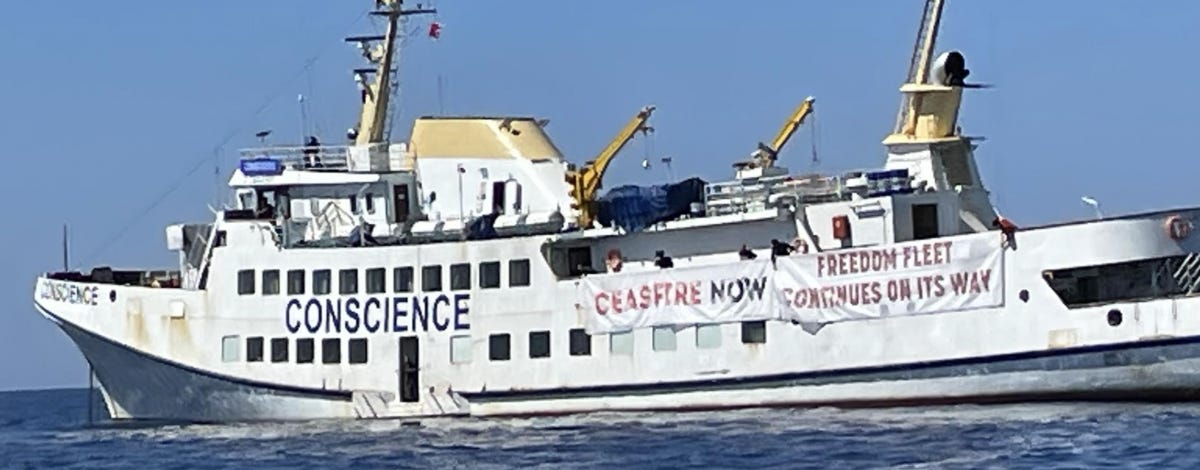
MARC: Let’s talk about the boat. I was absolutely shocked. Friends of World Beyond War like Ann Wright, Tighe Barry, you know, all I know is that their lives were endangered when a peaceful flotilla was actually attacked by military drones. That’s all I know. And that CODEPINK was at the center of this.
DANAKA: Yeah. So yeah, that night was crazy for me. So just to back up a little bit, there’s a Gaza Freedom Flotilla, which is essentially a fleet of civilians ships delivering or attempting to deliver food and other aid to the people of Gaza. There is a long history of Gaza Freedom Flotillas and actually exactly a year ago I was in Detroit with Ann Wright and I interviewed her about her time on the first Gaza Freedom Flotilla that was attacked where Israel shot at humanitarians with live bullets and killed I think 10 people and then arrested everyone else on board, including Ann. And it was I think for that anniversary was 14 years when I when I wrote that piece with Ann.
And then the night that the Flotilla was attacked this time. I got a text from Tighe that was just an order, it was like a text from the government in Malta to get everyone to the prime ministers. And I was like, what like what is this? I didn’t even know Tighe and Ann were in Malta at the time. And they were under a media blackout because they were I think going to leave Malta and embark on their way to Gaza the next morning.
MARC: So just for context, because you know, we have listeners all over the world who may not know this story. Malta is a small island nation in the middle of the Mediterranean.
DANAKA: Yeah, it’s a European country. Yeah, right.
MARC: And the reason Malta was involved is that the ship happened to be there or was the ship always there does a ship have a relationship with Malta, the boat?
DANAKA: So they were going to leave for Malta. At the time that the the ship was attacked, it was I believe about to dock in Malta at like late at night to pick people up. It was it was on its way to pick people up. It had people from the flotilla who would go on the flotilla on it. Like I think it was just the entire crew. And then everyone else was on land waiting for the boat to pick them up when I think CNN reported a Israeli military plane left Malta earlier that day, circled the ship for like hours, and then attacked it twice. CNN didn’t report that it attacked it – it said that it circled the ship and then flew back to Israel afterwards. So it was struck twice.
MARC: Can we just pause on “Israeli military plane”?
DANAKA: Yeah, that is a fact because I had heard that, but I don’t know. It was cited as so.
MARC: How is that possible? How I mean, I’m sounding very naive. You know, I know I’ve been in the antiwar movement a long time, but still I didn’t think that Israeli war planes could attack peace flotillas.
DANAKA: Yeah, I mean, especially in the middle of Europe. I was shocked by it because when the flotilla was attacked 15 years ago, it was getting closer to Gaza than it would have, that is my understanding. So CNN didn’t report that Israel attacked the ship. They reported that an Israeli military plane conveniently was in the area around the same time and then flew back. So there’s literally no one else who would have done it in my opinion. Israel has attacked flotillas before – with Americans on board, it doesn’t matter.
MARC: If I can, yeah, I think if I can this is kind of like what I was saying about when Saudi Arabia very theatrically killed a Washington Post journalist, I believe Israel wants it to be known that peace flotillas are no longer allowed on the open waters.
DANAKA: Absolutely. They’re not trying to hide.
MARC: They’re actually relying on – you know, I certainly don’t think we’re doing their bidding by yelling about this right now because we need to yell about this right now because I think most people I know are not aware. That Israel – I mean, I’m talking about not peace activists but people I know in the regular world – they are not aware that Israel would send a war plane to another country’s peaceful harbor and attack militarily a boat filled with peaceful peace activists.
DANAKA: Yep. It’s just a matter of talking about it more. Even my dad was like: well, hopefully, it was an accident. And I was like, what are you talking about, dad? I mean, flying to another country’s airspace thousands of miles away from yours and yeah, accidentally strike it twice.
MARC: I mean, you know, the worst is that like at the same time that we’re coping with this news, this new low in international relations, you know, a journalist, a hospital was bombed in Israel because a journalist was known to be getting medical care there. We are hitting new lows in humanity.
DANAKA: Yeah, and when I was with Ann interviewing her, Ann Wright, when I was interviewing her about the Freedom Flotilla getting attacked the first time a year ago, we were in Detroit. It was the same night that Israel bombed those tents in Rafah for the first time and videos of people burning alive were going viral. It was the same night. And I just remember thinking like this, this has to be it like this has to be the red line.
MARC: It’s just absurd to claim that CODEPINK or Ann Wright or other people on this boat were –
DANAKA: Oh, yeah, absolutely. We don’t support war on any side.
MARC: I would like to let people know that Ann Wright, you know, she was the military, I believe, you know, somewhat top brass who left the US military over the war in Iraq. You know, we’re talking about some very credible people who are involved in this boat attack. That’s who they – you know, that’s what they think of us peace activists, you know, and I do want, you know, I kind of want to know how this is landing at CODEPINK because it’s shocking – because at World BEYOND War it’s shocking.
That’s what they want to do with us. There’s no difference between CODEPINK and the World BEYOND War podcast politically, you know. So the only reason that they’re not droning me is I don’t have enough listens.
DANAKA: Yeah, I mean, I showed a video after the flotilla is attacked and I think the emphasis is like: Israel has killed Americans before. And I don’t think a lot of people understand that and I think, you know, if you talk people about Rachel Corrie or Shireen Abu Akleh, like Israel has repeatedly killed Americans, Israel killed Americans and other people who are trying to deliver aid to a starving population in Gaza, they tried doing it again because that’s how much they hate Palestinians. Anyone who cares about Palestinians at all is antithetical to Israel’s existence.
MARC: Anyone who recognizes that Palestinians are human beings.
DANAKA: Yeah, exactly.
MARC: Yeah. We are, we are really in a – I mean, the last episode of this podcast I felt was just bursting with sadness. But the same time, you know, it’s happening right now.
Let’s move on to talk about China because this is something that’s very … I’ve been wanting to speak to somebody from CODEPINK about this for a while.
DANAKA: Yeah.
MARC: CODEPINK has been attacked and slandered, it seems to me. Can we talk about that?
DANAKA: Yeah. I mean, it’s been a thing for about two years, two years ago, the New York Times came out with an article that had basically no facts in it and no actual link between CODEPINK and the Chinese Communist Party, but they alleged that we are funded by the Chinese Communist Party. We’re not. Just for the listeners, we are absolutely not. They would have shut us down by now if they actually believed that, but members of Congress, you know, Senator Tom Cotton, Senator Jim Banks of Indiana, they’ve regurgitated these lies in public and important Senate hearings because they’re both the head of separate Senate committees. That spiraled about a month ago, just out of control with other members of Congress regurgitating these lies, and media outlets regurgitating these lies that are absolutely not based on any fact whatsoever.
MARC: And I would also say they are trivial as well. They are like, even if it were true, you know, tell me if you if you see what I’m saying, like our government is completely funded by Israel. Every politician, funded by Israel. So why – if CODEPINK did, and CODEPINK doesn’t, I know CODEPINK doesn’t, but even if CODEPINK did, it would be a tiny tiny fraction of the amount that Israel funds US politicians. There is no law against it.
DANAKA: I mean, that’s what it is. It’s a big projection because all these members of Congress take so much money from AIPAC and the Israel lobby and others like the weapons lobby. They are paid to have their opinions so they project on to us that we must be paid to have our opinions too.
MARC: Right. And how much they take from the oil lobby! My God. I mean, when I hear these allegations, I’m glad CODEPINK fights back. But I’m like: to even recognize the validity of these allegations is to completely blind ourselves to the fact that buying the US, buying US politicians, is absolutely business as usual. And CODEPINK isn’t even politicians. These are not office holders. I really want to know why – I mean, when Israel’s money is just, you know, put out the red carpet for Israel’s money.
DANAKA: Yeah. I mean, I’m glad we’re not funded by any foreign governments because I think it brings out the validity. Unfortunately for them, I am just an American that has an opinion and that’s like everyone else at CODEPINK and who considers considers themselves a part of CODEPINKk. So, you know, it’s been kind of hilarious and ridiculous most of the time.
MARC: At the same time, it’s effective. It’s a fact. I mean, you and I know it’s ridiculous. I think it knows it’s ridiculous, but it’s scarily effective. To point the finger at “Chinese communists”.
DANAKA: Yeah. So, and you know, we do only realize that they’re doing it because we’re in their face all the time and being effective. And they directly tie it to our work for Palestine, sometimes more than our work on China, which is funny.
MARC: I agree. I agree. Yeah, because of course they are funded by Israel. I mean, take away Tom Cotton’s Israel funding. I don’t think you’ll have much funding left. You know, one reason I know Code Pink doesn’t take money from Chinese, the Chinese government, and neither does World BEYOND War is, I know how we live. I don’t think you’re getting well paid. And I’m, you know, we’re getting fairly paid for, you know, some of the hours we work and not all of them. I’ve been to the wonderful, beautiful CODEPINK house in Washington, DC. But it is not a mansion in Kalorama Heights. It’s a funky little …
DANAKA: You know, we did have to sell it. So …
MARC: Oh no, really?
DANAKA: Yeah.
MARC: Well, I’m honored that I once got to visit it. But in other words, CODEPINK, unlike all these foreign-funded think tanks, is not a wealthy org.
DANAKA: Yeah, exactly.
MARC: And we work hard for the money, which comes from small donors. And I’m speaking for both World Beyond War and CODEPINK.
DANAKA: Yeah, absolutely. But you know, it’s been, I think less people are buying it now than bought it two years ago. We have, CODEPINK is like a credible organization. We’ve had the same opinions on war for over 20 years. We don’t support wars no matter what.
MARC: And China would not be able to support that because China also is a military power. So yeah.
DANAKA: Yeah. And it’s just – if they’re actually aggravated about our position on China, our position on China is just that we support cooperation with two of the biggest powers that have nuclear weapons in the world. And we don’t think that we should be warmongering towards each other.
MARC: Well, and also one thing that I love that Jodie Evans especially has spoken for is how about some cultural interchange. Why do we treat China like they are on planet Neptune? You know, culturally. Why? Why is there a gigantic wall of suspicion and paranoia between our culture and their culture? Oh, I know why. Because of the war machine.
DANAKA: Yeah, absolutely.
MARC: But I think it’s such a shame, consider that this is a thriving growing civilization that’s been through its own historical traumas, as ours have. And that we could be making friends with them. So I love the phrase “China Is Not Our Enemy”. That is part of CODEPINK?
DANAKA: Yeah, yeah, the name of our China campaign is “China Is Not Our Enemy”.
MARC: So, do you work on all of these things? What are the kinds of things you do – besides, you know, dealing with ridiculous slanders and press?
DANAKA: Yeah, so I do a number of things because the national co-director, it’s like a mix of admin and campaign work and organizing work. And I keep in touch with our coalition partners and help run and facilitate all of our campaigns and advocacy work and educational programming. And also our regional organizing, which is just, I help oversee our chapters all around the Midwest, grow them, coach organizers, build vibrant CODEPINK communities all around. So it’s a lot of like interpersonal work, which is great. It’s a lot of thinking outside the box trying to figure out what ways, what new ways we can speak to power, especially since Congress has been absolutely useless at doing their job or listening to anyone in the past two years. So, yeah. I mean, most of my time is working on Palestine, sort of at the moment. It’s sort of what we need to be paying attention to.
MARC: I know CODEPINK does a lot of walking the halls of Congress.
DANAKA: Yeah.
MARC: Sometimes I worry that, you know, some of these activists will start being actually harmed in prison, you know, when, like when someone is dragged out of a hearing. That they will … I just feel there’s an increasing brutalization out there
DANAKA: Yeah. Before I saw Ann last May she was arrested in the Senate and she had like, like, oh my gosh, her hand looked so beaten up and bruised.
MARC: Ann Wright, you’re talking about.
DANAKA: Yeah.
MARC: So a seasoned US military veteran who left the armed forces on conscientious grounds was actually physically … I did see that actually.
DANAKA: And they arrested Ben Cohen of Ben and Jerry’s in Congress recently and, you know, they were yanking him around. It was crazy.
MARC: Well, we always say we’re courageous. I’m sort of just wondering, on a organizational basis, like do you feel the climate is changing? Do you feel that what organizations like CODEPINK and World BEYOND War – you know, we are similar – is our mandate changing? Do we even have a mandate?
DANAKA: Yeah, you know, I think one of my primary conversations I’ve been having with organizers and CODEPINK organizers specifically is about this, they’re scared, they’re freaked out. And I think just reminding them like: that’s the purpose of all of this. That was the purpose of arresting Mahmoud Khalil. That was the purpose of arresting all those students, brutalizing those students. All this looming repressive legislation and executive orders. The purpose is to shut us up.
MARC: Yeah.
DANAKA: And it’s just harder to resist fascism further down the line than this, then it will be right now. And I think it’s valid to be scared and and to feel frightened. But to hold that at the same time as this is sort of like our responsibility. We’re living in the belly of the beast. People all all over the world have resisted their governments at much scarier and unstable times than this. So, you know, just kind of like sitting with our responsibility. We are in America. We live in the country that’s fueling all these genocides and wars. And what’s our responsibility? If it’s just like, if I don’t want to resist this because I’m scared than like, what use am I on this earth ? That’s kind of my opinion on it.
MARC: Yeah. And we have each other for support, you know, if you get arrested, ou know that there will be people out there who notice you’re gone and will fight for you.
DANAKA: And that’s so important.
MARC: What sort of things inspire you? In terms of like books, music, philosophy, you know, in terms of your peace activism?
DANAKA: I mean, I think my philosophy … well, people who are listening can’t see it. But above me is a portrait of Kurt Vonnegut.
MARC: I did not notice that was Kurt Vonnegut!
DANAKA: Yeah.
MARC: Wow. So by the way, I heard him speak when I was in college, live.
DANAKA: That’s so cool.
MARC: Yeah.
DANAKA: Yeah. Definitely my favorite author.
MARC: “Cat’s Cradle”, “Slaughterhouse-Five”. What are your favorite books?
DANAKA: “Sirens of Titan” is my favorite by him. But obviously I read “Slaughterhouse-Five” in high school, that’s my first book by Kurt Vonnegut that I read. And it’s just like, he speaks so plainly about war. And I think it reminds people who get stuck in the weeds. It’s simpler. It doesn’t have to be so complicated. Like when people talk to me about China and they talk about like specific details about what’s going on in China. I think I go back to “I don’t think two countries that have nuclear weapons should be antagonizing each other to go to war.”
MARC: Yeah.
DANAKA: And that’s the only opinion I need. And like I think, you know, Kurt just writes so beautifully about war and militarism and they can speak so plainly.
MARC: It sticks to really basic messages like that.
DANAKA: Yeah.
MARC: Which, you know, people have different approaches. I tend, like I said, I tend to look for historical connections, you know, like the fact that the fact that the Houthi/Yemen war so much resembles the 1956 Egypt war. But at the same time, there’s something really important in the primal basic simple equations like: if you like human beings, you must be antiwar. Which Kurt Vonnegut was. He was my very first favorite writer, first ever, when I was 11 years old. “Breakfast of Champions”. What people should know in case they don’t: he was in World War II. First, he was from a German family, which must have given him a feeling of conflict as he was set to fight Germans in the Battle of the Bulge. And then he was captured in 1944 and imprisoned by Germans with his other troops in Dresden during one of the worst fire bombings ever, when the entire city of Dresden was destroyed. And that is the novel “Slaughterhouse-Five”.

DANAKA: I can’t recommend it enough. And if you are anywhere near Indianapolis, go to the Kurt Vonnegut museum. The whole second floor is dedicated is “Slaughterhouse-Five” and it is such a cool exhibit.
MARC: I’ve been there though I didn’t know they had a second floor I was there many years ago. I also invited them on this podcast, but they didn’t get back to me, so maybe you could help with that.
DANAKA: Oh yeah, I think I’ll be an Indianapolis sometimes soon, so.
MARC: I’m sure they’re busy, but I’d love to have them. He was a major, major pacifist. So that definitely helps me understand. I think we’ve covered a lot and I really want to thank you for, you know you’ve been so thorough in answering my wide range of questions from Yemen to Malta to, you know, China. So is there anything else that’s on your mind that you know you think is it would be interesting in the world of antiwar activism in this crazy time we’re living in?
DANAKA: By the time this comes out we would have just finished the People’s Assembly in Dayton, Ohio against NATO having its assembly in Dayton. We’re, you know, working with ANSWER Coalition and a few other groups to organize a protest and counter-summit in Dayton so that’ll just be out hopefully there’s like content from it circulating you could find it on CODEPINK.
MARC: We often have anti-NATO or shall I say #NoToNATO events in Washington DC and those have been some of our biggest events. I didn’t know they were going to Dayton maybe because they don’t want to come to DC again. Is this the Air Force base?
DANAKA: I don’t know, I think it’s in downtown Dayton because they’ve blocked off like a security perimeter.
MARC: Well, I’m glad that you told me and when will this be?
DANAKA: It’s on May 25th.
MARC: Do you personally get involved in actions or are you often you know the one coordinating?
DANAKA: Yeah, I mean, I’ll be at the one in Dayton.
MARC: For sure, stay safe and all – you know I’m sure you’ll be breaking the rules.
DANAKA: We’ll see.
MARC: Thank you so much, Danaka!
DANAKA: This has been really cool, thanks.
Musical excerpt for this episode: “Sirens of Titan” by Al Stewart.
The World BEYOND War Podcast page is here. All episodes are free and permanently available. Please subscribe and give us a good rating at any of the services below:
World BEYOND War Podcast on iTunes
World BEYOND War Podcast on Spotify
World BEYOND War Podcast RSS Feed