#NoWar2026 Conference: Beyond Borders
A Global Online Conference Unpacking How the War System Drives Displacement & Militarizes Borders
Friday, October 23 - Sunday, October 25, 2026 on Zoom
Join us on October 23-25 for #NoWar2026: Beyond Borders, World BEYOND War’s annual global conference hosted on Zoom.
War and militarism drive people from their homes, causing mass displacement. And the very same weapons companies profiting from war and conflict cash in when governments militarize borders and block the movement of people fleeing violence. Throughout three days of panels, workshops, and breakout rooms, the #NoWar2026 Conference will examine the interconnections of the war system, migration, and the border industry, with case studies from around the world.
#NoWar2026 will create a space for global dialogue among activists, organizers, researchers, and educators to share lived experiences, learn from each other, and strategize for a world beyond the violence of both war and borders.
#NoWar2026 Schedule
All sessions will be broadcast on Zoom. All times are listed in Eastern Daylight Time (EDT).
Friday, October 23, 2026
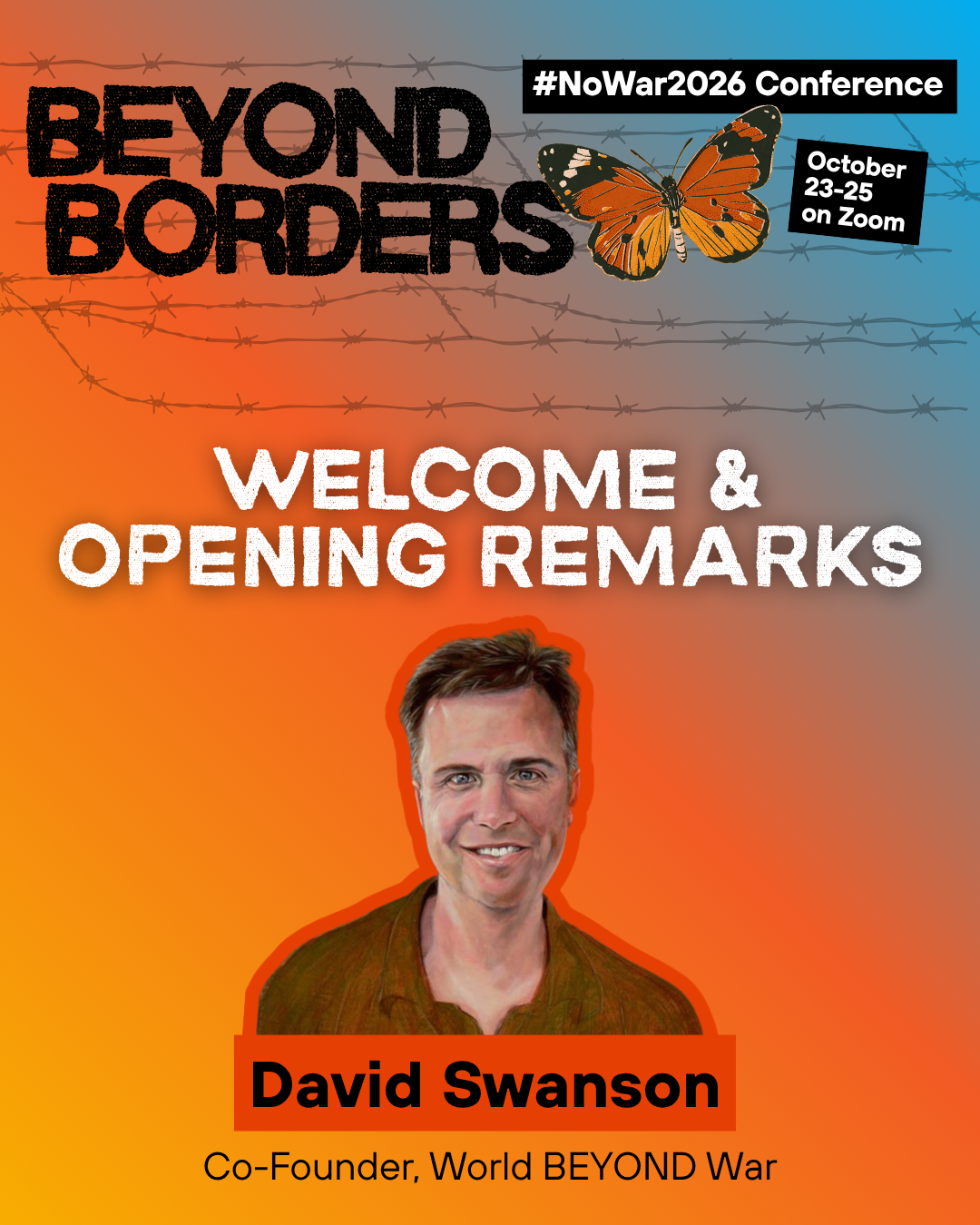
1:00pm-1:30pm EDT: Welcome & Opening Remarks from WBW’s Co-Founder and Executive Director David Swanson
World BEYOND War’s Co-Founder and Executive Director David Swanson will provide the opening remarks for the #NoWar2026 Conference, with an introduction to World BEYOND War’s mission and the conference theme.
1:30pm-2:30pm EDT: Reports from WBW Chapters Around the World
World BEYOND War Chapter Coordinators from around the world will share short updates about their educational programs and nonviolent activism campaigns towards war abolition. Moderated by WBW Vice President Liz Remmerswaal.
Featuring:
- Nazir Ahmad Yosufi, WBW Afghanistan Chapter
- Ronda Cooperstein, WBW Baltimore Chapter
- Joseph Essertier & Gerry Yokota, WBW Japan Chapter
- Maria Cernat, WBW Romania Chapter
- Charlotte Kalanbani, WBW Togo Chapter
- Faisal Ibrahim, WBW Toronto Chapter
- Luz Mireya Mena González, WBW Venezuela Chapter
2:30pm-2:45pm EDT: Break
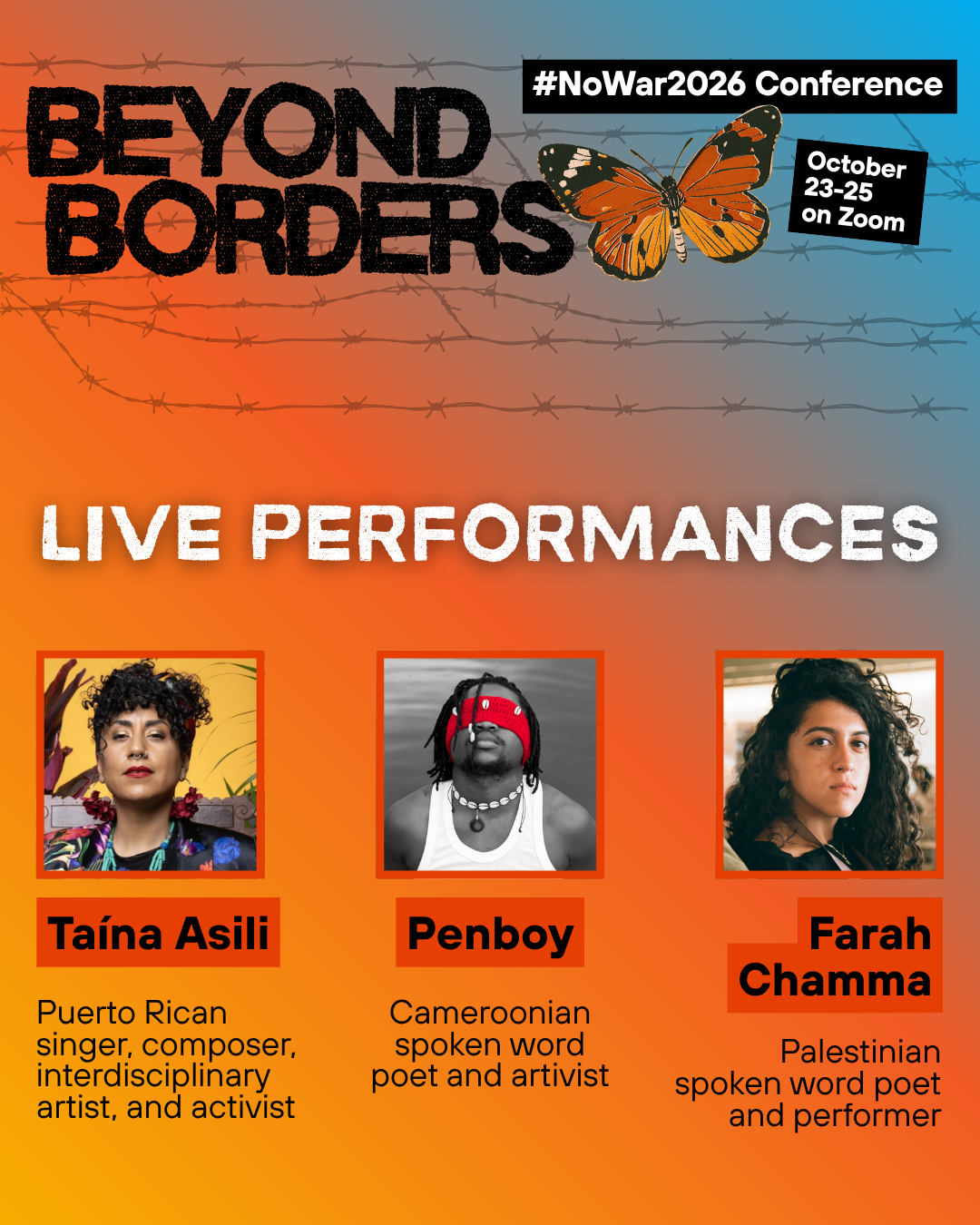
2:45pm-3:00pm EDT: Performance by Taína Asili
Featuring a live performance by Taína Asili, a dynamic singer, composer, interdisciplinary artist, and activist carrying on the tradition of her Puerto Rican ancestors, fusing past and present struggles into one soulful and defiant voice.
Session introduced by Gabriel Aguirre, WBW Latin America Organizer.
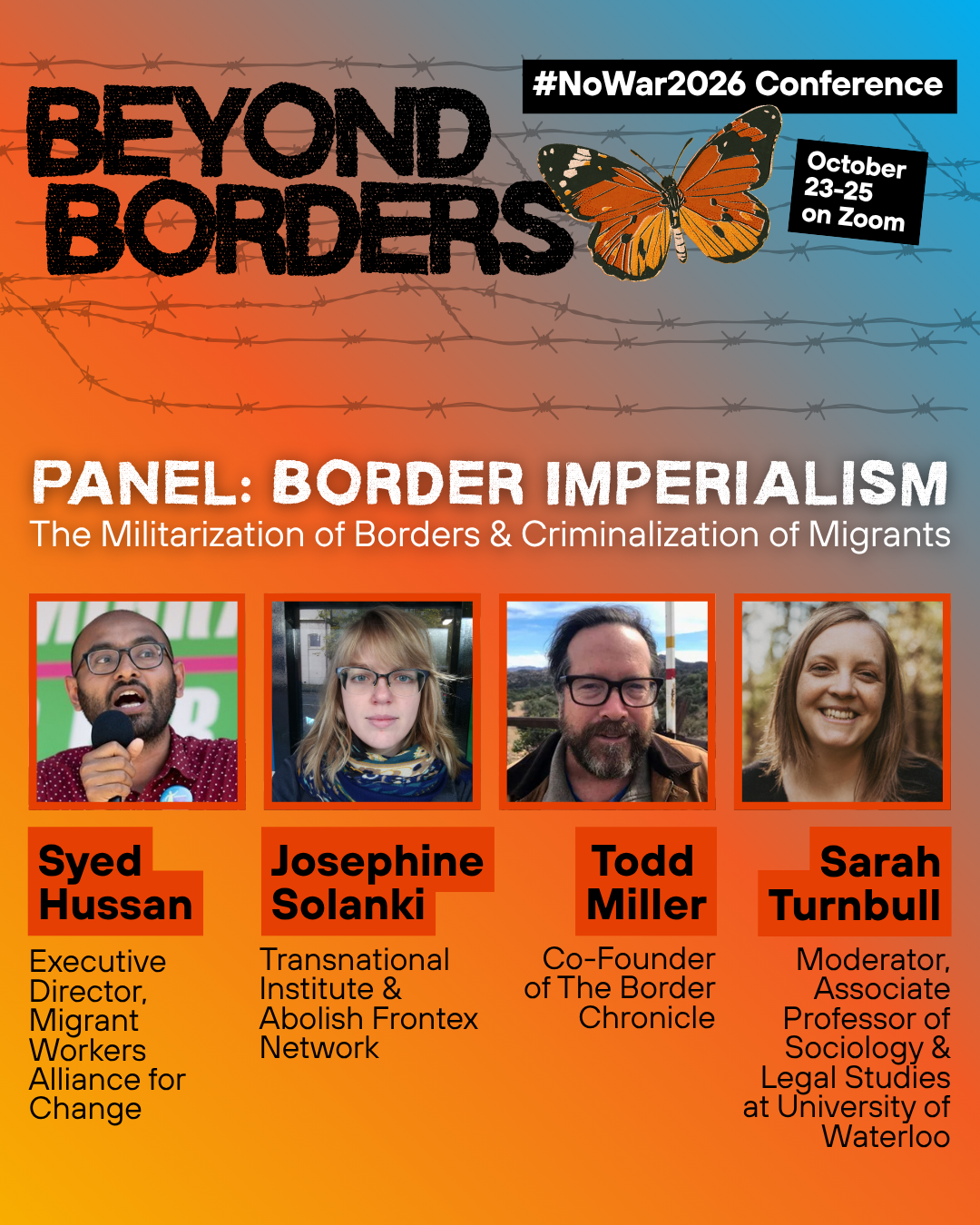
3:00pm-4:30pm EDT: Panel: Border Imperialism: The Militarization of Borders & Criminalization of Migrants
This session considers border control and its implications from the lens of border imperialism, which encourages us to think broadly about the various intersecting structures that enable and reproduce global apartheid. These structures include border militarization and the criminalization of migrants and migration. The panelists will speak to the general topic of border imperialism in relation to their professional and activist work on Frontex, border communities along the U.S.-Mexico border, and migrant rights and labour issues.
Featuring:
- Josephine Solanki, Transnational Institute
- Todd Miller, Co-Founder of The Border Chronicle
- Syed Hussan, Executive Director of the Migrant Workers Alliance for Change and a member of the Migrant Rights Network Secretariat
- Moderated by Dr. Sarah Turnbull, Associate Professor of Sociology and Legal Studies at the University of Waterloo (Canada)
Session introduced by WBW board member Robert Fantina.
4:30pm-5:00pm EDT: Breakout Rooms
Meet other conference participants from around the world and have a chance for networking and discussion.
Saturday, October 24, 2026
9:00am-9:15am EDT: Performance by Penboy
Featuring a live performance by Cameroonian spoken word poet and artivist Penboy. He is known for using his words to express his views on social and political issues, particularly the Anglophone crisis in his home country.
Session introduced by WBW Africa Organizer Guy Feugap.
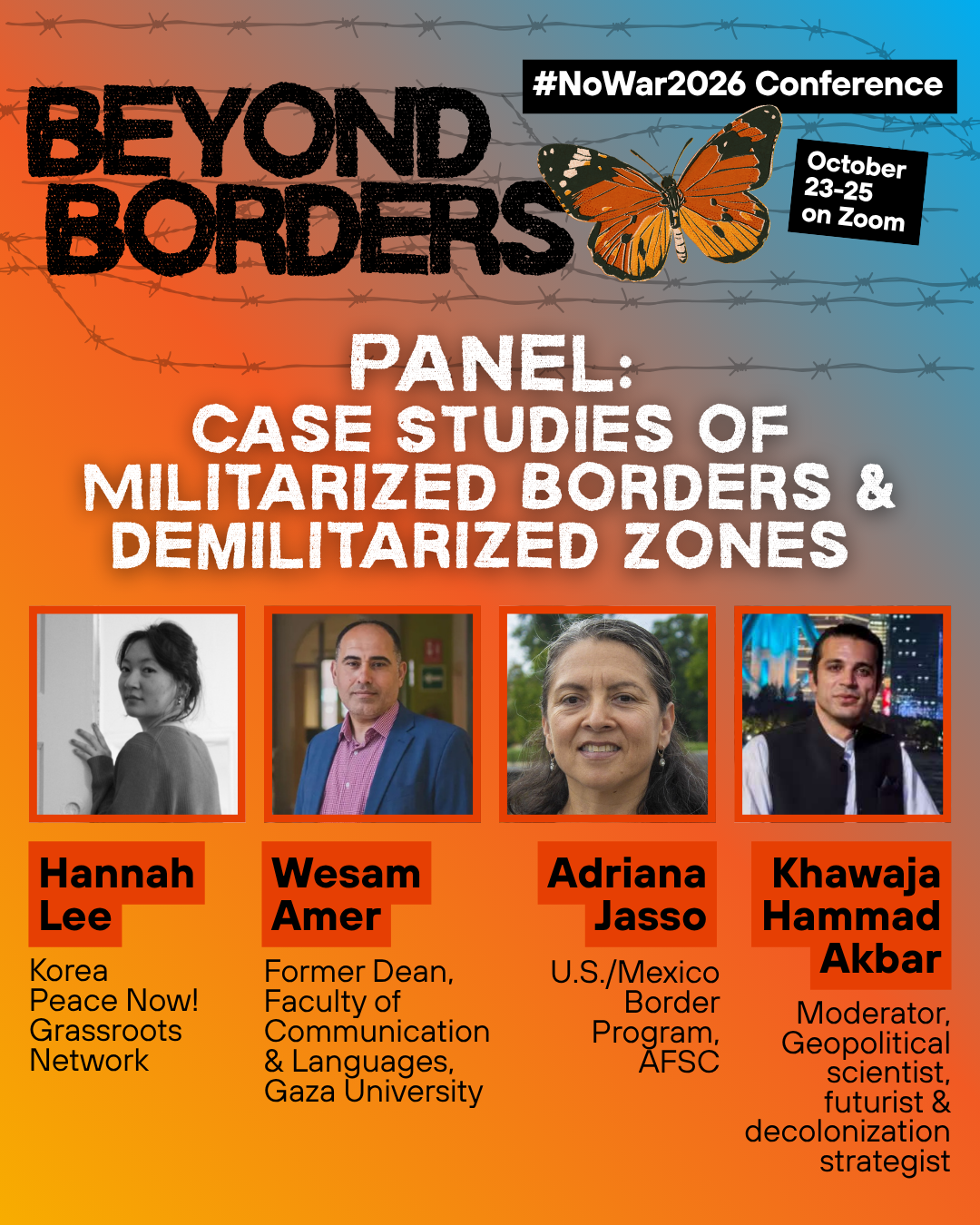
9:15am-10:30am EDT: Panel: Case Studies of Militarized Borders & Demilitarized Zones
This session will explore the relationship between militarization, imperialism, and border control through the lived, scholarly, and organizing experience of the panelists.
Rather than focusing only on the visible line on a map, the session will encourage discussion about the underlying histories and structures behind it: how empire, colonization, and ongoing military and economic power draw and sustain these borders, and how militarization ripples outward — into ecology, gender and human rights, and the daily lives of communities on either side, long after the original conflict that produced the border has faded from headlines.
The session will also look forward, asking what we can learn from Korea, Palestine, and the U.S.–Mexico border, and what scholars, organizers, communities, and governments can do to work toward demilitarization, self-determination, and a world with fewer walls.
Featuring:
- Hannah Lee, Coalition Building Committee Co-Coordinator at Korea Peace Now! Grassroots Network
- Dr. Wesam Amer, former Dean of the Faculty of Communication and Languages at Gaza University, CARA Fellow, and Visiting Professor, University of Cambridge
- Adriana Jasso, Program Coordinator for the U.S./Mexico Border Program of the American Friends Service Committee (AFSC)
- Moderated by Khawaja Hammad Akbar, a Pakistani geopolitical scientist, futurist, and decolonization strategist
Session introduced by WBW board member Robert Fantina.
10:30am-10:45am EDT: Break
10:45am-12:00pm EDT: Movement Dialogue: Connecting EU Military Budget and Borders
This is a hybrid session on Zoom and in-person in Amsterdam, Netherlands.
As European Union (EU) member states discuss the new Multiannual Financial Framework (MFF), it has become clear that an increase in military spending is one of the priorities. This also connects to the expanding of Frontex’s budget and mandate, with a proposed budget for the EU border guard agency of €11.9 billion, and continued support for border externalisation deals with third countries. This increase in military spending is connected to cuts in welfare, in the Netherlands as well as in most member states, affecting especially those living in precarity such as migrants. At the same time, new EU “remigration” laws and related policies are intensifying repression against migrants within Europe, with an increase in deportations and criminalisation of solidarity work.
These trends are not separate. The same companies that are pushing for increased military spending and arms production are also profiting off the border-industrial complex. It is therefore more important than ever for movements to come together, learn from each other’s struggles, and find ways to reinforce one another, standing in active solidarity with those most affected by the growing militarisation of our societies.
12:00pm-12:15pm EDT: Break
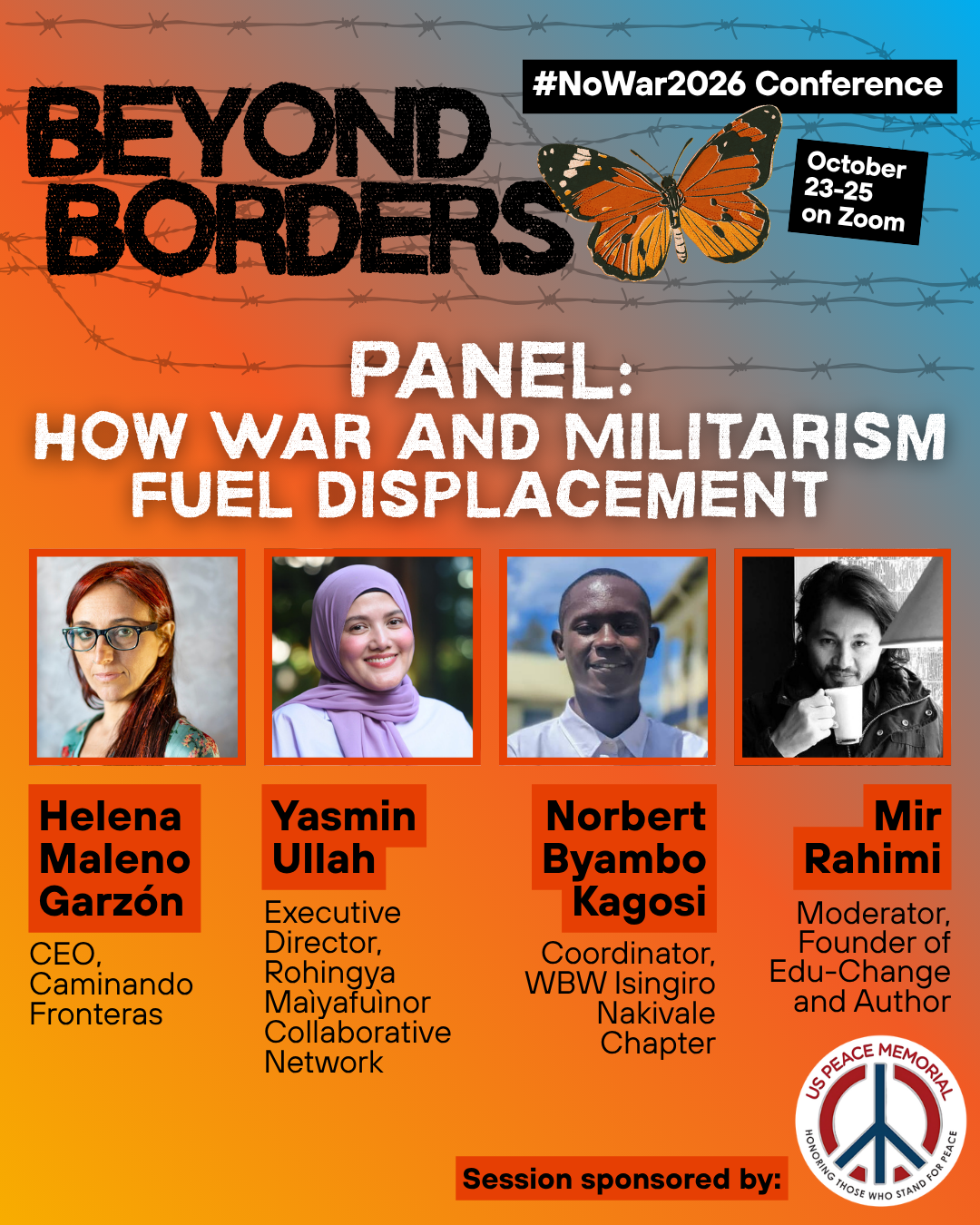
12:15pm-1:30pm EDT: Panel: How War and Militarism Fuel Displacement
This session will explore the relationship between war, militarism, and forced displacement through the lived, professional, and activist experiences of the panelists.
Rather than focusing only on the consequences of displacement, the session will encourage discussion about its underlying causes: how war and militarized responses uproot people, affect individuals and communities, and create consequences that can continue long after the immediate conflict has ended.
The session will also look forward, asking what we can learn from these experiences and what individuals, communities, civil society, and governments can do to prevent displacement, promote peace, and contribute to building a world beyond war.
This session is generously sponsored by Dr. Michael D. Knox and the US Peace Memorial Foundation.
Featuring:
- Helena Maleno Garzón, Founder and CEO of Caminando Fronteras (Walking Borders Collective)
- Yasmin Ullah, a Rohingya human rights activist and Executive Director of the Rohingya Maìyafuìnor Collaborative Network
- Norbert Byambo Kagosi, Coordinator of the Isingiro Nakivale chapter of World BEYOND War
- Moderated by Mir Rahimi, Founder of Edu-Change and author of Across Mountains, Land and Sea: One Boy’s Extraordinary Journey
Session introduced by Jhay de Jesus, WBW’s Asia Organizer.
1:30pm-2:00pm EDT: Breakout Rooms
Meet other conference participants from around the world and have a chance for networking and discussion.
Sunday, October 25, 2026
12:00pm-12:15pm EDT: Performance by Farah Chamma
Live performance by Palestinian poet and performer Farah Chamma.
Session introduced by Jonathan Solari, WBW’s Major Donor Liaison.
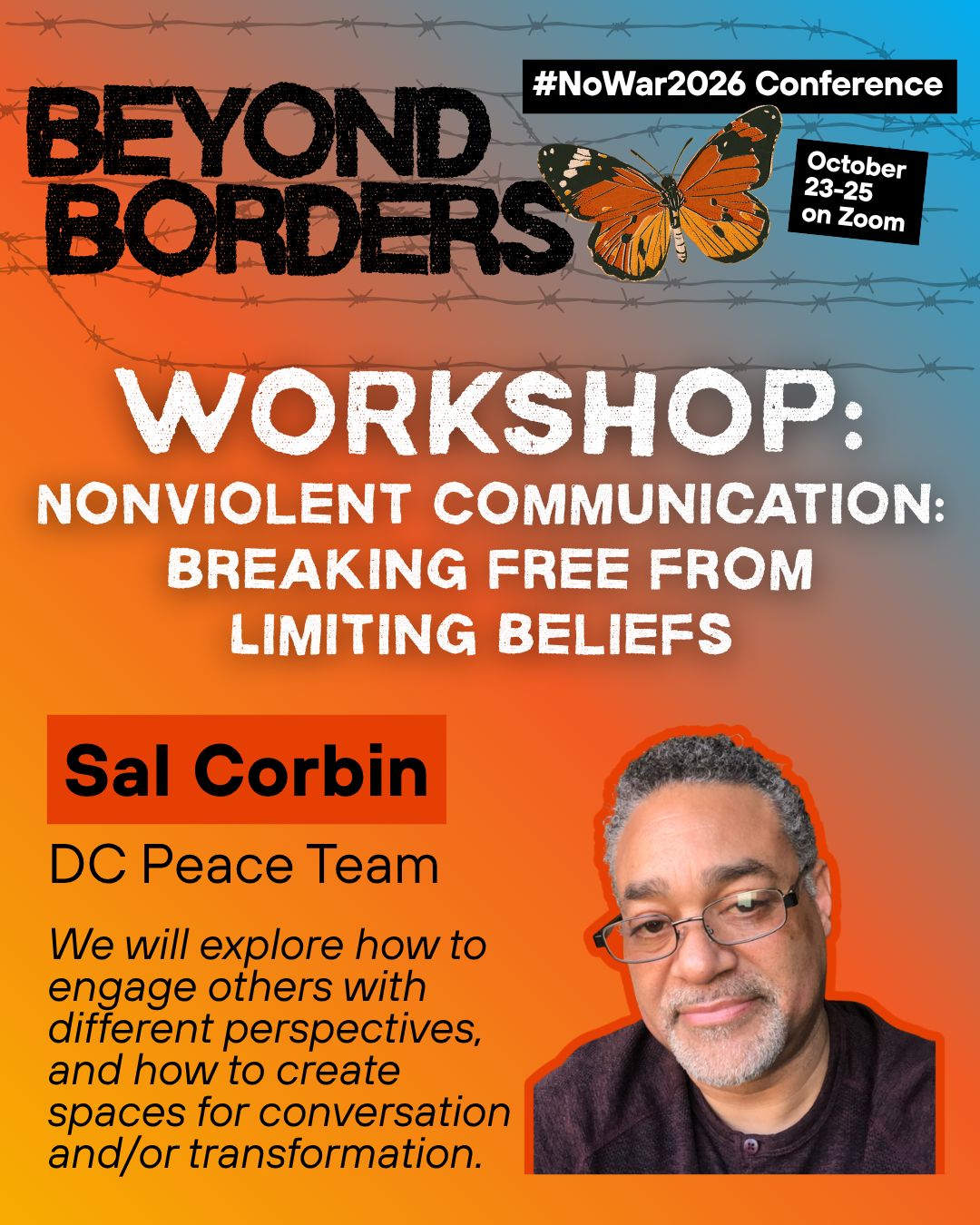
12:15pm-1:30pm EDT: Workshop: Nonviolent Communication: Breaking Free from Limiting Beliefs
Facilitator: Sal Corbin of DC Peace Team.
In the chaos of this world, do you ever feel stuck in judgments about a particular person or situation—and maybe even yourself? Can you imagine, for just a moment, what it might be like to create a bit of space from these limiting beliefs? In this session, we’ll apply principles and practices from Nonviolent Communication (NVC) to look underneath these limiting beliefs and tap into what matters most. We will explore how to engage, accept, and respect others with different perspectives, and how to create spaces for conversation and/or transformation—both for themselves and for creating a world more at peace.
Session introduced by John Reuwer, WBW Treasurer and Board Member.
1:30pm-1:45pm EDT: Break
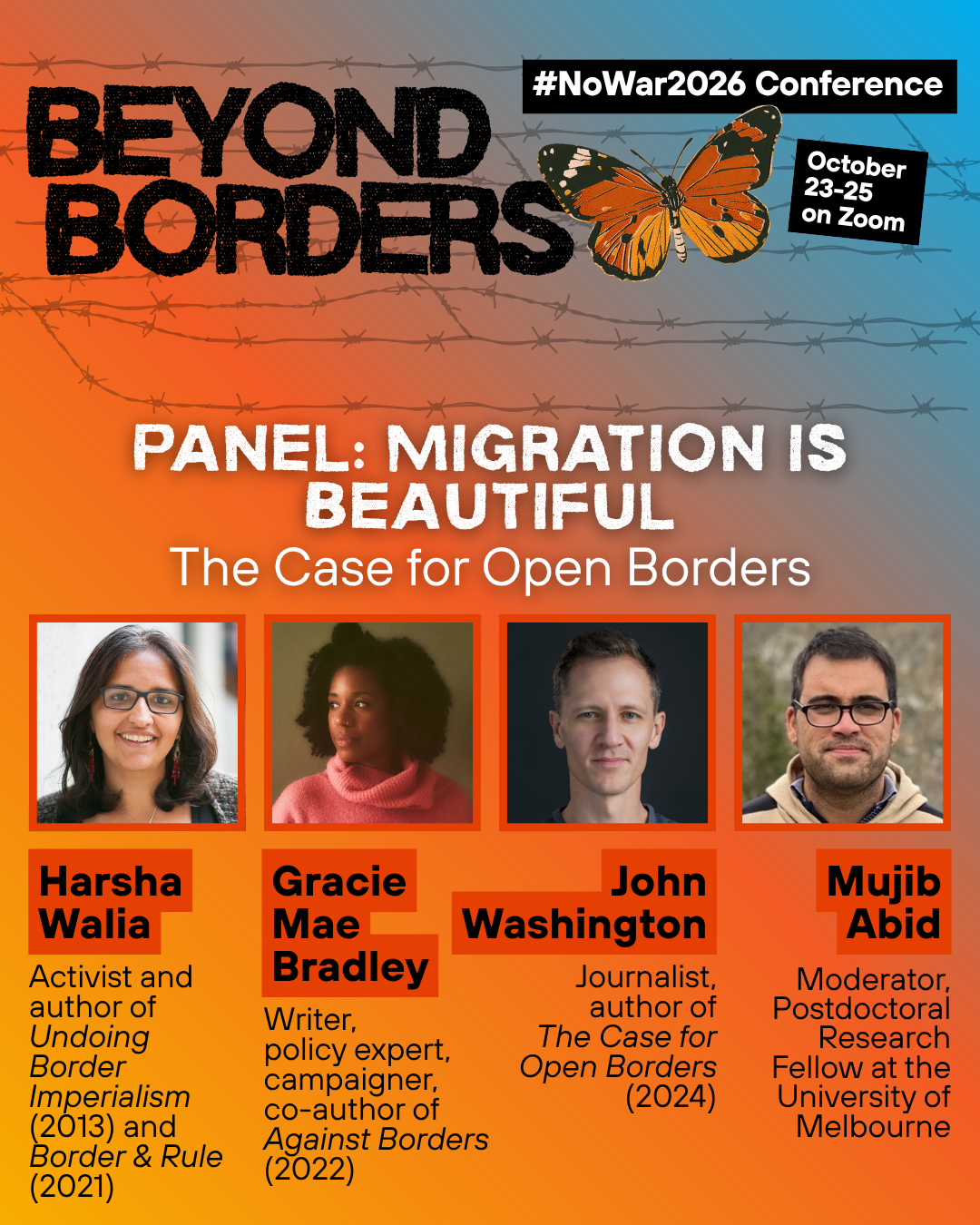
1:45pm-3:00pm EDT: Panel: Migration is Beautiful: The Case for Open Borders
The modern border is not simply a line separating one country from another. It is a political instrument, one shaped by empire, racial hierarchy, and a capitalist world system that has never distributed mobility equally. Borders allow wealth, weapons, and capital to circulate with remarkable freedom, while people displaced by war, coloniality, economic inequality, and climate change are detained, deported or denied safety and protection. The same powers that help produce displacement frequently reserve for themselves the authority to decide who may cross, who must remain, and where each person belongs.
Bringing together writers and leading advocates Gracie Mae Bradley, Harsha Walia, and John Washington, this panel will examine the case for moving beyond borders. Drawing on abolitionist, anti-colonial and human-centred perspectives, the panelists will explore how border regimes operate, whose interests they serve, and how they might be dismantled. Most importantly, the discussion will invite participants to imagine what a border-free world could look like.
To imagine a border-free world is not to erase place, culture, or community. It is to imagine political belonging freed from the accidents of birthplace, imperial cartography, and its imaginative geographies. What might become possible if people possessed both the freedom to move and the freedom to remain? What if migration were understood not as a threat to be contained, but as an enduring and beautiful expression of human life?
Featuring:
- Activist and writer Harsha Walia, author of Undoing Border Imperialism (2013) and Border and Rule: Global Migration, Capitalism, and the Rise of Racist Nationalism (2021)
- Writer, policy expert, and campaigner Gracie Mae Bradley, co-author of Against Borders (2022)
- Journalist John Washington, author of The Case for Open Borders (2024)
- Moderated by Dr Mujib Abid, an Afghan-Australian scholar of modern Afghan history, peace studies and political theory
Session introduced by WBW Canada Organizer Rachel Small.
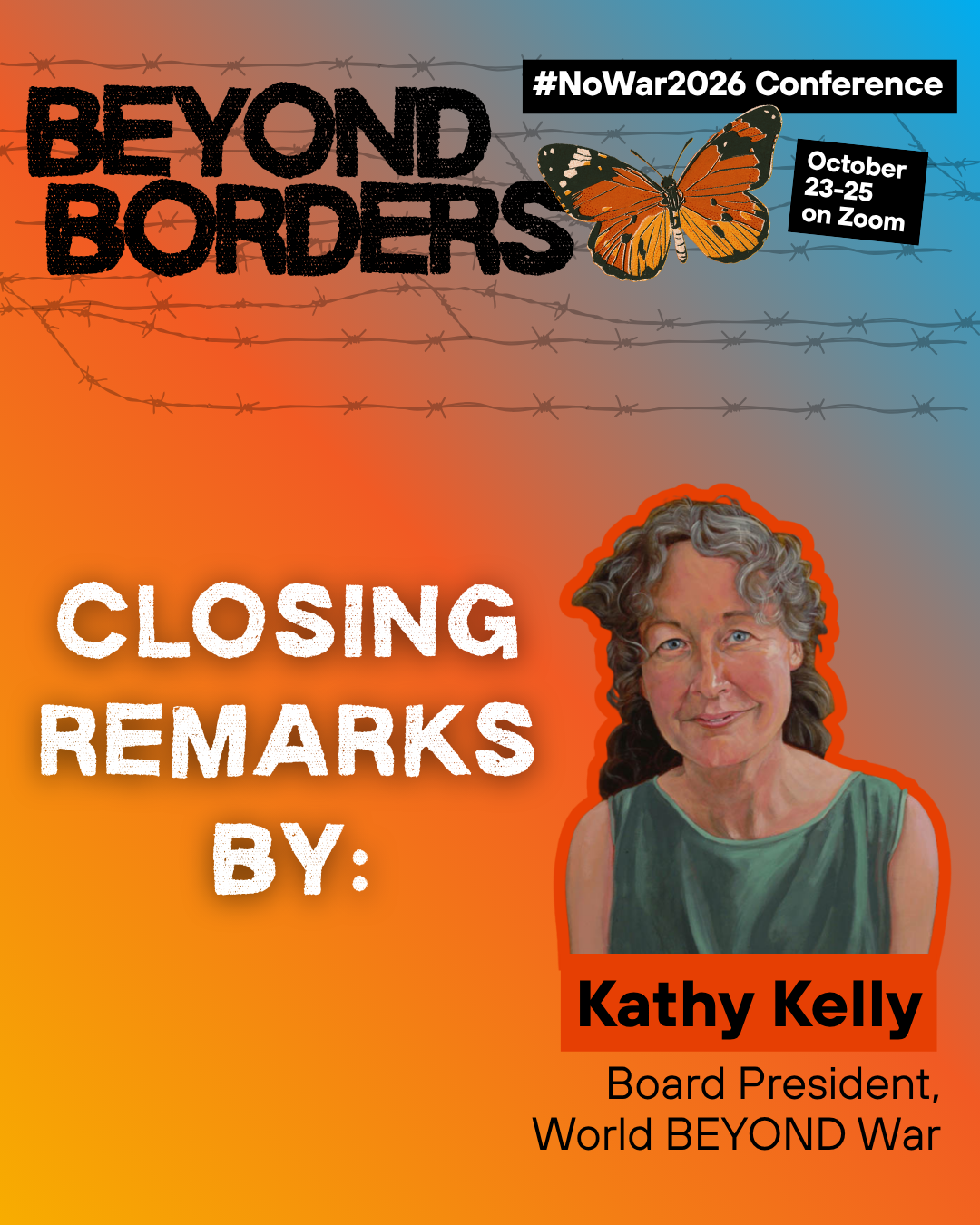
3:00pm-3:15pm EDT: Closing Words by WBW Board President Kathy Kelly
World BEYOND War’s Board President Kathy Kelly will offer closing words with key takeaways from the 3 days of sessions and next steps for continued engagement in the global nonviolent movement to end all war.
3:15pm-4:00pm EDT: Breakout Rooms
Meet other conference participants from around the world and have a chance for networking and discussion.
Sponsors & Endorsers
Individuals and organizations are invited to make a financial contribution to sponsor the conference. Sponsors receive perks, such as conference tickets, social media posts promoting the sponsor, and more. Sponsor here!
Alternatively, organizations are invited to endorse the conference, which does not require a financial contribution. Endorsers are listed on the conference website and are expected to help promote the event to their networks. Endorse here!
Sponsors
War Abolishers:
Peacemakers:
Supporters:
- Josette Wier
Endorsers
- 3D INITIATIVE FOR SUSTAINABLE DEVELOPMENT
- Acción Colectiva de Objetores y Objetoras de Conciencia (ACOOC)
- Addicted To War
- AGORA – Consultora Internacional
- Association “house of learning”
- Broome County Peace Action
- Broome County Veterans For Peace
- Campaign for International Cooperation and Disarmament (CICD)
- Centro de Amigos para la Paz
- Centro de Documentación en Derechos Humanos “Segundo Montes Mozo SJ” (CSMM)
- CODEPINK Greater Dallas
- Dallas Peace and Justice Center
- Elders for Peace
- Environmentalists Against War
- Find a Protest
- Forever Peace Now
- Fuerza Mundial
- Fundación La ruta de la Paz
- Germany in Dialog with the states of the Global South e.V.
- Green Party of New Jersey
- GRUPO DE INVESTIGACIÓN Y EDITORIAL KAVILANDO
- HOPE OF AFRICA (HOFA)
- International Organization for the Elimination of All Forms of Racial Discrimination (EAFORD)
- Just Peace Queensland Inc.
- Kaisa.Ka
- L.I. Alliance for Peaceful Alternatives
- Making Peace Vigil
- Military Law Task Force of the National Lawyers Guild
- Military Poisons
- Monterey Peace and Justice Center
- Mouvement Sénégalais de la paix. M.S.P
- Movement for the Abolition of War
- Northern New York Coalition
- Observatorio de Derechos Humanos de los Pueblos
- Observatorio por el Cierre de la Escuela de las Américas – Chile
- Ontario Palestinian Rights Association
- Opednews.com
- Organisation Camerounaise pour La Défense des Droits de l’Homme des Libertés et du Bien-être (ACADEHLIB)
- PAiZanas
- Pace e Bene/Campaign Nonviolence
- Palestine Just Trade
- Peace Action Education Fund
- Peace Alliance, National Department of Peacebuilding Committee
- Peace Coalition of Southern Illinois
- PeaceWorks
- Permaculture for Refugees
- RED INTERUNIVERSITARIA POR LA PAZ REDIPAZ
- Rehumanize International
- Rohi Foundation/Ndabuchiseh
- RootsAction
- Southern Anti-Racism Network
- South Sudanese Women Association in Uganda (SSWAIU)
- Syracuse Peace Council
- Tamkeen For Our Humanity Foundation
- The Canadian BDS Coalition and International BDS Allies
- The Peace Pad
- The Rising Together Theater Company
- Topanga Peace Alliance
- Transnational Institute
- Veterans For Peace Madison Wisconsin Clarence Kailin Ch. 25
- Witness Against Empire
- Western Washington Fellowship of Reconciliation
- WNC4PEACE
- Women for Peace – Finland
- Women’s International League for Peace & Freedom – Canada
- Women for Peace – Finland
- World Citizen Peace Ambassador Center
- World Peace Foundation