

Universities shape far more than academic knowledge. They shape leadership, values, and how societies understand conflict, security, and social responsibility. As such, universities can either reproduce cultures of competition, exclusion, and violence—or actively contribute to cultures of dialogue, cooperation, and peace. In 2025, World BEYOND War partnered with Universidad Católica Boliviana (UCB) in Bolivia to pilot a peace education initiative designed to strengthen student leadership and advance a culture of peace across the university community and beyond.
An integrated peace education initiative
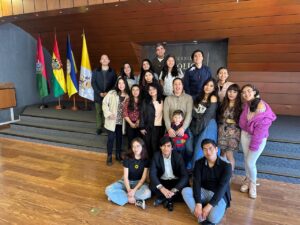
The initiative took place from April 7 to May 17, 2025, on UCB’s La Paz campus, engaging 29 undergraduate student leaders in an intensive, action-oriented learning process. Rather than functioning as a standalone course, the initiative was designed as an integrated program linking peace education, leadership development, and student-led action. Students from a wide range of academic programs participated, spanning psychology, marketing and digital media, social communication, engineering, business administration, and tourism management. Many participants held leadership roles within student unions, positioning them to apply learning directly within university governance and student life. The initiative brought together students, university staff and faculty, and local and international facilitators, creating a shared learning space rooted in dialogue, reflection, and practical engagement.
A university–community partnership
The project emerged in response to a clear institutional priority at UCB: strengthening peace-oriented student leadership and supporting young people to develop skills relevant to their academic, civic, and professional lives. At the same time, the initiative allowed World BEYOND War to experiment with university–community partnerships and more integrated, systems-aware approaches to peace education.
The initiative was spearheaded by Daniel Carlsen (World BEYOND War Bolivia Chapter member), in collaboration with Dr. Phill Gittins (Education Director, World BEYOND War), and developed through close cooperation with both university and community partners. The collaboration built on an existing relationship. Over the past 15 years, Dr. Phill Gittins has worked with UCB in different capacities, including teaching across multiple departments, contributing to peace education–related initiatives, and supporting and facilitating personal and professional development for psychology and psychotherapy students. University partners included Andrea Ruiz, Coordinator of the Conciliation Department at UCB, and Fernando Bustillos, Coordinator of the Pastoral Department at UCB. Their engagement was central to embedding the initiative within existing institutional structures and signaling university-level commitment to peace education. Community partners included Juan Pablo Álvarez and Iván Urgel from Rotary Achumani. Facilitation was delivered by Andrés Vargas, Fabiana Miranda, Daniel Carlsen, and Phill Gittins, combining local knowledge with international peace education experience.
From concept to practice: a student-led process
Initially proposed in 2022, the initiative evolved through sustained dialogue, redesign, and planning, including in-person meetings during Phill Gittins’ visit to Bolivia. Over time, the program developed a clearer emphasis on student leadership, institutional relevance, and practical application. A critical enabling factor was UCB’s decision, through its Pastoral Department, to offer scholarships to participants. This helped remove financial barriers, improve retention, and demonstrated that building a culture of peace requires more than individual enthusiasm—it requires institutional buy-in and resourcing. From the outset, the program sought to balance global peace education perspectives with culturally grounded, locally relevant approaches. Facilitation was intentionally accessible, rooted in students’ lived experiences in Bolivia, while introducing key ideas and tools from peace and conflict studies. The curriculum and learning design were informed by the Peace Education and Action for Impact (PEAI) model developed by World BEYOND War. While adapted to the Bolivian context, the UCB pilot drew on PEAI’s core emphasis on participatory learning, reflective practice, and youth-led action. The initiative also built on World BEYOND War’s broader experience collaborating with universities and academic partners in other contexts, including peace education work with university partners in the United States (click here for details) and with university and Rotary partners in Pakistan (click here for details).
A hybrid learning model: theory, leadership, and action
The initiative combined online and in-person sessions, structured around a sequence of modules delivered over several weeks. Each module ran over four days with 90-minute sessions, moving participants from foundational concepts through leadership development to project design and implementation. The modules were:
- Foundations for Building a Culture of Peace – Daniel Carlsen
- Personal Development within the Sphere of Peace – Andrés Vargas
- Leadership Skills in the Context of Peace Culture – Daniel Carlsen
- Tools for Creating a Culture of Peace – Phill Gittins
- Project Design – Daniel Carlsen and Fabiana Miranda
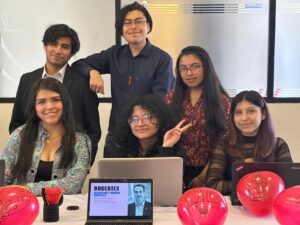
Students were not treated as passive recipients of knowledge. Instead, they were supported as co-creators and peer leaders. Participants worked in five interdisciplinary teams, each identifying a form of conflict, exclusion, or structural violence within the university and designing a practical peace project in response. The initiative has also been featured on the Rotary Showcase, highlighting its collaborative and action-oriented approach. https://spc.rotary.org/project?guid=A85426B6-35B5-483E-A4F5-EB04E917F21B
From learning to action: student peace projects
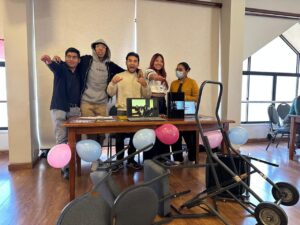
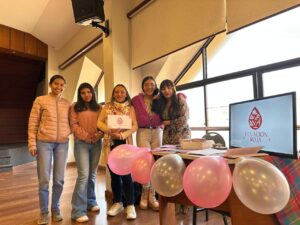
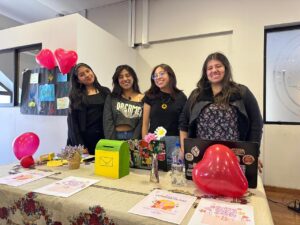
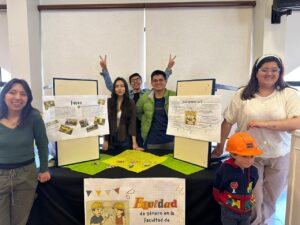
The program culminated in a public showcase held in the university auditorium. Each team created its own stand to present its project, explaining the issue addressed, the process followed, and the intended impact.
The five student-led projects included:
- Theatre of the Oppressed: The Chains That Bind Us
A performance-based project exploring how normalized micro-aggressions and machismo are reproduced, and how these dynamics affect all genders. - Gender Equality in the Faculty of Engineering
A structured dialogue examining how machismo persists through everyday actions and institutional omissions. - Communicating Peace: Faculty–Student Communication
Simulated scenarios analyzing whether communication practices foster a culture of peace or contribute to systemic violence. - Your Voice Builds
The creation of safe listening spaces for students, faculty, and administrative staff to share concerns, fears, and experiences. - Red Equation
Advocacy for secure, permanent access to menstrual hygiene products for female students, alongside institutional awareness-raising.
Results and impact
Monitoring, reflection, and feedback highlighted several key outcomes. Students reported a stronger understanding of peacebuilding concepts, increased confidence in collaborative and relational leadership, and a clearer sense of their capacity to create change within their environments. Participants emphasized the value of the program’s participatory structure, the credibility of the facilitation team, and the opportunity to apply peace education in real institutional contexts. Many also noted the importance of feeling connected to a wider global movement for peace education. As a concrete follow-up outcome, Rotary Achumani invited participants to establish Interact Club Achumani, citing the group’s leadership, initiative, and collective capacity as exceptional.
Student voices
“I appreciated how we were mixed across faculties and encouraged to step out of our comfort zones. It helped me see that conflict exists everywhere—including student councils—and that peaceful solutions really matter.”
— María Fernanda Cabrera, Biochemical and Bioprocess Engineering
“This course shaped how I see conflict and empathy. It influenced not only my academic life, but my worldview.”
— Alan Sanga, Psychology
“It helped me recognize that many of my past and future projects already center on peace—even when I did not name them that way.”
— Gabriela Stephanie Altamirano Begazo, Marketing and Digital Media
Learning, research, and future directions
Beyond leadership development, the initiative was designed as a learning process for all partners involved. Opportunities are being explored to co-author a piece documenting the pilot, capturing lessons learned, and sharing insights on university-based peace education. With support from Rotary Canada and Rotary Achumani, discussions are underway about expanding the initiative into Bolivia, Chile, and Peru during the 2026 cycle.
Reflections and lessons learned
Like many peace education initiatives, the pilot faced challenges. Recruitment required flexibility, and student workloads and timing shaped early participation. The shift to a scholarship-based model proved essential for engagement and retention, while the hybrid delivery format increased accessibility. Several broader lessons emerged:
- Building a culture of peace within a university requires institutional buy-in, not only the commitment of individual champions.
- Peace education is most effective when it operates at the systems level, influencing leadership development, student life, and institutional practices together.
- Striking the right balance between global peace education perspectives and culturally grounded, locally informed approaches enables learning from experiences beyond the local context while ensuring ownership, relevance, and long-term sustainability.
- Student-led, youth-centered approaches help transform peace education from an abstract idea into a lived, collective practice..
Together, these lessons point to what becomes possible when universities, civil society organizations, and community partners collaborate to support young people as peace leaders—starting on campus, and extending outward through action.