

In November 2024, World BEYOND War, the Centre for South Asian Studies (CSAS) at the University of the Punjab, Lahore, and the Rotary Club of Hyderabad Time (Rotary International District 3271) launched an innovative initiative to strengthen peace education efforts in Pakistan. This collaboration builds on the success of the Global Peace & Security: Navigating the Future international hybrid conference in June 2024 and years of partnership with members of the Rotary community.
The initiative took the form of a 6-week online course designed to provide a succinct introduction to peace education. Looking at key theories, themes, issues, and practices, and moving from a broad overview of peace education and anti-war efforts to regional perspectives from Africa, Asia, and Latin America, the course integrated theory, critical reflection, and practical application. It concluded with an end-of-project activity where students demonstrated their ability to connect theory, research, and practice to address real-world peacebuilding challenges.
Details of the six sessions are provided below.
Objectives
- Enhance access to and quality of peace education in Pakistan by fostering collaboration between academia and civil society.
- Connect and support collaboration between academia, civil society, and Rotary networks to foster shared learning, build trust, and mutual understanding.
- Co-create, test, and evaluate a new peace education model for engaging learners in peace and anti-war efforts, for broader adoption
Key Features
- Collaborative Learning: Established a community of practice uniting scholars, activists, students, and other civil society actors (including Local and global NGOs, Rotarians and Rotary Peace Fellows) promoting shared learning experiences and building trust and relationships between all involved.
- Global Perspectives: Featured facilitators from Africa, Asia, Latin America, and Europe contextualise learning within local needs and broader global perspectives.
- Theory-Practice Integration: bridged the gap between the study of peace as a topic and its real-world practical application.
- Interdisciplinary Approach: Drew fields such as peace and conflict studies, security studies, nonviolence, psychology, education, and social impact.
- Leveraging Best Practices: Incorporated frameworks, models, and practices from local contexts and globally recognised institutions such as the Institute for Economics and Peace and World BEYOND War to enhance learning and enable participants to engage with pro-peace and anti-war thinking and practice.
Impact Achieved
- Young People in Pakistan and Afghanistan: Were equipped with foundational knowledge, skills, and attitudes essential for promoting peace and opposing war. They were also provided opportunities to apply their learning and share their work with an international audience.
- The Centre for South Asian Studies (CSAS): Was supported in addressing gaps in provision in Pakistan, particularly within university settings, and contributed positively to peace education efforts in the country.
- Rotary in Pakistan: Enhanced Rotarians’ capacity in peace, education and youth work, engaging and empowering them to better cultivate young peace leaders.
- World BEYOND War: Successfully experimented with new and innovative ways to connect and support universities and civil society in promoting peace and anti-war efforts.
- The Broader Peacebuilding Community: Addressed a core challenge facing the international community: the difficulty universities and civil society face in working together to co-create, implement, and evaluate peace initiatives.
Long-Term Vision
This initiative makes a supportive contribution to the development of a more empowered peacebuilding community and a stronger youth, peace, and security (YPS) movement in Pakistan. It lays the groundwork for current and future work. This includes efforts to assemble a team in Pakistan to participate in the Peace Education and Action for Impact initiative, starting in February 2025.
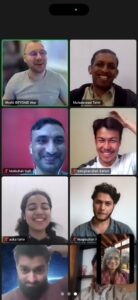 |
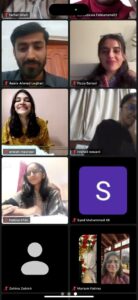 |
Summary of Sessions
Week 1: Introduction to Peace Education
Click here to access the Session 1 Recording
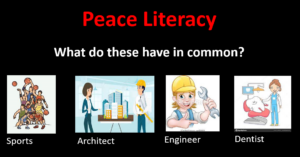
Facilitated by Dr. Phill Gittins (WBW Education Director and Rotary Peace Fellow), this session set the scene for the initiative as a whole, discussing the broader rationale and vision for the work. He then shifted focus to the session’s core by introducing the fundamentals of peace education, covering what it is, why it matters, and how it can be implemented. We then explored definitions and understandings of peace, violence, and conflict. Key concepts such as negative and positive peace, direct, structural, and cultural violence, and the ABC triangle were introduced, alongside a reflection on the state of peace and war around the world.
 |
 |
Week 2: Regional Perspective: Africa
Click here to access the Session 2 Recording
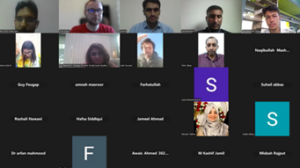
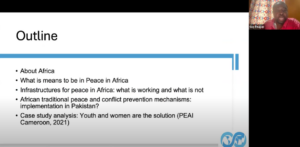
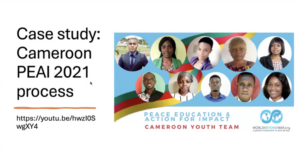
Led by Guy Feugap (Africa Organizer of WBW, Cameroon), this session examined the meaning of peace in Africa, highlighting both successful and lacking infrastructures for peace. African traditional mechanisms for peace and conflict prevention were discussed, with an emphasis on their potential applicability in Pakistan. A case study from Cameroon – part of the Peace Education and Action for Impact (PEAI) initiative – was included to show practical ways in which youth and women can be/are supported to address peace and conflict issues in the country.
 |
 |
Week 3: Regional Perspective: Asia
Click here to access the Session 3 Recording
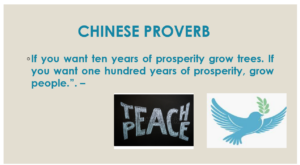
Facilitated by Dr. Naheed S. Goraya, Director for Centre for South Asian Studies (CSAS), University of the Punjab, Pakistan and Rotary Peace Fellow, this session focused on constraints to peace education in Pakistan and the lessons that could be learned from other contexts including Finland. Participants reflected on the potential for improvement in Pakistan’s peace education through shared strategies. The session concluded with the Chinese proverb, “If you want ten years of prosperity, grow trees. If you want one hundred years of prosperity, grow people,” highlighting the importance of investing in education to grow people and cultivate peace.
 |
 |
Week 4: Regional Perspective: Latin America
Click here to access the Session 4 Recording
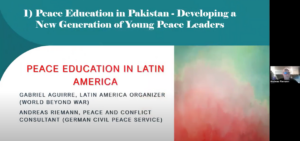
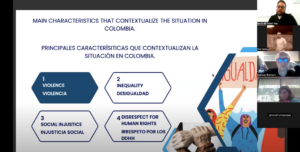
Gabriel Aguirre (WBW Latin America Organizer) & Andreas Riemann (Peace and Conflict Consultant at AGIAMONDO and Rotary Peace fellow) guided this session, exploring peace education theory and anti-war efforts in Latin America. The session drew insights from key thinkers like Adolfo Pérez Esquivel, Paulo Freire, and Rigoberta Menchú, and highlighted legislative and policy initiatives such as the “Cátedrade la Paz“ (Chair of Peace) established under Law 1732 (2014). Other programs like the National Human Rights Education Plan (PLANETDH) and Education Program for the Exercise of Human Rights (EDUDERECHOS) were discussed as examples of embedding peace education in policy and practice.
 |
 |
Week 5: Designing a Peace Education Initiative
Click here to access the Session 5 Recording
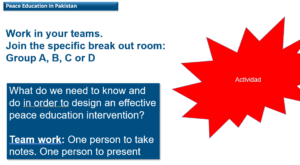
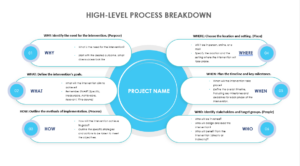
Dr. Phill Gittins facilitated this session, focusing on the practicalities of designing and implementing peace education projects. Students explored frameworks, models, and tools to guide the design and evaluation of initiatives, addressing key questions about the why, what, when, where, who, and how of peace education. The session equipped participants to carry out interventions in general but also supported them to prepare accordingly for their presentations in week 6.
 |
 |
Week 6: Final Presentations and Outcome Sharing
Click here to access the Session 6 Recording
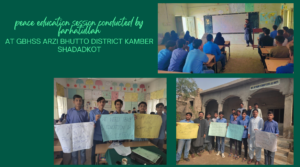
Dr. Phill Gittins led the concluding session, which showcased five peace project presentations. Four presentations came from student groups in Pakistan and Afghanistan, while the fifth was delivered by Fatoumata Sossia Djire, WBW, Mali, Chapter Coordinator, as part of her work for the 2024 WBW alumni program. This session highlighted participants’ ability to merge theory with practice, while also improving their presentation skills. The proposed projects were wide-ranging, including teacher training initiatives and the introduction of peace education into schools and university settings, all aimed at addressing gaps in current provisions and improving the prospects for peace and security in Pakistan.
 |
 |
 |
 |
 |
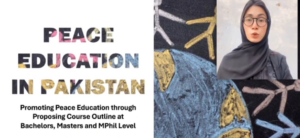 |
This presentation and video featured distinguished scholars and practitioners working on peace and security issues in Pakistan. These included:
- Dr. Moonis Ahmar: Profile Link
- Mr. Imtiaz Ali: Profile Link
- Dr. Samreen Bari Aamir: Profile Link
- Dr. Arif Khan: Profile Link
- Mr. Muhammad Amir Rana: Profile Link