

 By Marc Eliot Stein, November 29, 2024, World BEYOND War
On a cold night in November 2024 I challenged myself to put together all my thoughts – even the ones that are hardest to explain and put into words – about how the antiwar movement can shake off its discouragement and gather the courage we will need together to face the challenges all over the world today. – Marc
World BEYOND War Podcast: Episode 66 (Transcript)
Welcome to Episode 66 of the World Beyond War podcast. I’m Marc Eliot Stein, Technology Director of World Beyond War, a worldwide small donor-supported anti-war organization, speaking to you from Brooklyn, New York.
It’s a funny thing being part of an anti-war organization for the past seven years. Our cause is always the same, but the way people feel about us sure changes over time. I’m speaking as 2024 rolls to a close, and I noticed lately when I tell people I work for an anti-war nonprofit, they seem to immediately understand that I’m doing something important.
I’m not sure this was true a couple of years ago. Today, folks seem to realize how close we are to a single accident or misjudgment triggering a nuclear war. They see the genocide in Gaza, the escalation against Iran and China.
They realize that even if the world’s various rotten so-called leaders manage not to trigger a nuclear war by accident, they’re driving humanity off a cliff anyway by ignoring climate change. There’s a feeling of utter urgency in the air. There’s also a feeling of absurdity here in the USA, heightened by a depressing recent election between two rapidly pro-war parties offering nothing that voters want.
A small number of gullible but peace-loving American voters might still believe, as I speak these words today, that incoming so-called President Trump will do something good for world peace by stepping us back from our endless proxy war against Russia, since Trump is an opponent of NATO, the corrupt US-Western Europe alliance that did everything it could between 2014 and 2022 to escalate tensions between Ukraine and Russia until war finally erupted, supposedly on behalf of Ukrainian nationalists who wanted to recover Crimea, but really on behalf of oil corporations who were thrilled to stop Russia’s Nord Stream 2 pipeline and eliminate Russia as an energy supply competitor. Unfortunately, all evidence shows Trump’s opposition to NATO to be tactical and circumstantial, based entirely on which power blocks and fossil fuel corporations he likes to be bribed by. Trump’s opposition to NATO certainly does not stem from any actual aversion to war.
Sorry to bust that bubble, but anybody who believes Trump is anti-war is forgetting that he spent his first administration provoking, slandering, and escalating tensions against China for daring to commit the sin of competing with USA for global trade. He also spent these four years sucking up to his geopolitical hero and role model Netanyahu, glibly endorsing Israel’s war crimes against Palestinians and provoking war with Iran, including violating a crucially important global nuclear weapons treaty and assassinating Iranian leaders. It was Trump who hired the neoconservative ghouls John Bolton and Elliott Abrams back into power, making taxpayers like me sick because now we are paying their evil salaries.
Trump always made a point of siding with American military personnel accused of war crimes. Always. The Trump administration was the architect of the Juan Guaido fiasco in Venezuela that began in December 2018, which I’m sure they would love to memory-hole, but let’s not let them memory-hole it because it was Trump, along with then-Senator Marco Rubio, who had the hubris to declare that they were choosing the next president of Venezuela from the comfort of their offices in Washington DC. So, no, I’m not at all hopeful about a new Trump so-called presidency with Marco Rubio as Secretary of State.
I doubt these clowns will even be able to end the tragedy in Ukraine, the only good thing they’ve pledged to do.
Joe Biden, Kamala Harris and mainstream Democrats needed to really screw up badly to be beaten by Donald Trump and J.D. Vance in an election, to be perceived by voters as more pro-war than Donald Trump, and that’s what they did. It would be all too easy to blame Biden’s foreign policy incompetence on his senility and the fact that he doesn’t seem to have changed or reconsidered any of his perspectives on global politics since 1967, if not for the fact that a large team of supposedly sane, young, well-educated foreign policy professionals worked with Joe Biden for these four years.
It was not one milquetoast elderly white male named Joe Biden, but rather an entire allegedly first-class foreign policy team educated at Harvard and Yale, all these Anthony Blinkens and Jake Sullivans, that spent four years bringing us – what? A shocking, soul-crushing genocide in Palestine, constant escalation towards a new war against China, no hope at all for horrifying wars and humanitarian disaster in Sudan, a thousand days plus of trench warfare in Ukraine, and the likelihood of a planned nuclear first strike or unplanned nuclear weapon incident caused by faulty intelligence destroying human life on earth. It doesn’t matter if the nuclear apocalypse starts by accident or not. Either way, it’s the death of us all.
For voters like me who had to suffer through this pathetic and excruciating election season, the worst disappointment was Kamala Harris’s silence on foreign policy, which many of us suspect was dictated to her by the bosses and brokers who ran her campaign. She had a chance to refuse to be controlled and speak truthfully about the genocide in Gaza and the failure in Ukraine. Instead, she spent months blankly reciting Biden’s banal, empty rhetoric when asked about foreign policy and war, changing the subject as quickly as she could.
Like many voters, I had some hope for Kamala Harris when her campaign began, but the Democratic Party’s decision to align Harris with the pro-war Cheney wing of the Republican Party and to allow Harris no honesty with voters about the gigantic problems with USA’s military and foreign direction left her campaign hollow, a facade. You can’t run for president on a platform that reeks of denial and complacency because you will be seen by voters as incoherent and irrelevant. This is how Kamala Harris lost her chance to run an exciting and impactful campaign and instead lost to a widely disliked, misogynist, racist crook.
Denial. Complacency. Well, I’m not here to pile on Kamala Harris for failing to run her campaign as a model of truthfulness and courage.
Instead, I want to draw on the lesson that we all sometimes fail ourselves when we slip into denial or easy answers or complacent but meaningless gestures of activism. I’m sorry to say I sometimes sense that we struggle to speak truth through layers of denial and complacency even within the anti-war movement.
We fall short of our own ideals when we describe the pursuit of world peace as if it can be a smooth and relaxing transition. As if all we need to do is vote more intelligently and help some more honest candidates win and then they’ll sweep the crooks out of office and go to global summits and shake hands with their opponents who will also agree to stop engaging in this beastly war stuff. But this isn’t realistically how peace will come to planet earth. Few of us believe that voting for better candidates or better parties will get us there.
I mean, it would help. But it wouldn’t be enough to beat the war machine which actually owns our government. Even the best case scenario of a worldwide transition from a war system to a peace system will require a passage into the unknown, will require courage for change and willingness to sacrifice in unknowable and unpredictable ways.
We fall short of our ideals when we accept easy excuses for the failure of the anti-war movement to play a bigger role at every level of politics and political action today. Sometimes I’ll hear somebody spout the cliche that the human race simply isn’t cut out for peaceful coexistence, that the best thing any anti-war movement can do is try to play cleanup as the rest of the world continues to fight war after war. Bullshit.
This type of dull pessimism ignores the bad news that war metastasizes quickly like cancer and that we’re already far along on the path to World War 3 and nuclear apocalypse. So, we will either stop war or war will stop us.
This type of dull pessimism also ignores the good news that humanity is capable of making sudden positive changes and discoveries.
It’s not that improbable, not at all, that world peace could fall upon us in our lifetimes, even next year, next month, next week. Denial and complacency and low expectations among activist communities means leaving no space, no breathing room for spontaneous creativity and serendipitous discovery. If a peace movement wastes its time delivering the same platitudes year after year, we are failing to paint a vivid and large picture for the entire world to see of what miracles and wonders of happiness await all of us on a peaceful planet if we can only get our act together and stop murdering each other to make corporations wealthier.
We need to paint this picture and make every person in the world see it. Sterile prescriptions for world peace won’t paint a picture and the three tough questions I’m about to talk about give us at least three reasons why. These are three big questions and they come without easy answers no matter where we stand on any left-right political spectrum.
And that’s why I’m asking them because these three questions stand in our path whenever we try to paint a picture of a better future world that allows human beings to coexist in freedom and peace. I’m asking these three questions because they are controversial among activists, because answering them may be disruptive and so will help us figure out what we are really working towards together.
The first of my three questions is where the anti-war movement stands on border walls and inhuman immigration and refugee policies and what types of broad societal changes in attitudes about borders and immigrations will be helpful for a more peaceful world and how we can be intersecting with organizations and movements dedicated to refugee issues and work.
The second question is another big one: where the anti-war movement stands on wealth inequality and capitalism. We need not only to discuss wealth inequality itself but also the impact of vastly asymmetrical wealth on elections such as in USA where we have seen the pro-war foreign lobby AIPAC literally and successfully target truth-speaking congresspeople by throwing millions of dollars against them, thus leaving our congress in the hands of politicians who are willing to serve wealth over humanity. To talk about wealth is also to talk about the way we live about over consumption and other societal issues.
We will dig into each of these questions a little further on though of course there’s more to say about each of them than we can cover in one episode so what I’m really trying to do here is lay down some topics for conversation that we can cover in future episodes too. Capitalism and wealth inequality will take us a few episodes to deal with. The third question is another big one: where the anti-war movement stands on nationalism and national identity.
Why do we all take it for granted that we belong to things called nations? Why especially do people like me who are told to consider themselves patriotic citizens of large and corrupt war-making nations like USA and Russia take it for granted that we must do as we’re told, that we must pay taxes to war powers and carry on a long generational legacy of subservience to large corrupt mass governments whose values and actions we despise?
I’m not asking these three questions because I want to yell that my answers are the only right answers. And I don’t want to make everyone else agree with me. I do think my answers are the right answers or at least the best answers, but I’ve already been talking about these issues in large groups. I mean, this is my idea of a fun party discussion.
Believe me, I’m the type of person who enjoys sparking friendly political debates among people who can handle them. I know what kind of reaction I’ll get when I tell a group of people that I’m not a proud American citizen, that I don’t salute the American flag. It will help the anti-war movement to confront these difficult questions so that we can prove we’re serious about standing up for the kind of societal change that can actually lessen the suffering of traumatized refugee families.
That we can stand up to the power of the AIPACs and Elon Musks and Chevrons and Exxons. People all over the world truly want to end war. People of all different belief systems all want the freedom to just live in their own communities with their own lifestyles.
The anti-war movement is a movement for freedom, for pluralism, for diversity. All we have to do is cure the disease of militarism. We don’t need to install a world government.
All we have to do is realize that militarism is a disease and that diseases can be cured. This is so important. Let me say it again.
Militarism is a disease. Diseases can be cured.
Think of all the people on earth who died from infectious diseases before penicillin was discovered.
All the generations, decades and centuries and millennia of human beings whose lives could have been saved but weren’t because the mechanisms of infectious disease were simply not yet well understood by scientists. Now we have antibiotics which have saved countless lives. We can also cure the disease of war, the disease of militarism.
What we need to do is think harder and think more analytically and think more creatively at the same time. We can do all these things. We need to have the courage to put the pieces together and speak out loud the truths we find, even if it scares people when we say: you know, we’re going to need to solve this problem in order to solve this problem.
We need to always solve problems together as much as we can and make decisions together. If this seems daunting, it’s helpful to look back at the life stories of past peacemakers like Martin Luther King, Mahatma Gandhi, Dorothy Day, Nelson Mandela, and see how much courage they needed to gather every day to do their work. So let’s keep our spirits up when we do ours.
Question 1: Where do we stand as anti-war activists on border walls and immigration?
It seems to me that hate speech directed at Hispanic immigrants on the U.S.-Mexico border was the single most effective part of the Trump campaign’s strategy to win the last election. Fear and hate – these are powerful poisons in an election season. I think it’s important to recognize as a serious syndrome of hate speech in USA when refugees and immigrants are regularly described as murderers and rapists, even though it seems clear that USA has a whole lot of murderers and rapists who aren’t Hispanic immigrants. One American rapist named Trump just got himself elected president, and ironically he got there by calling Mexicans rapists.
To automatically equate refugees and immigrants on USA’s southern borders with murderers and rapists is, of course, the same kind of strategy Israel uses to dehumanize Palestinians. Hate speech against immigrants and refugees has a long and horrible history.
Before the complete disaster of the Joe Biden administration, I thought that Republicans were the party of hate speech against Hispanic immigrants in USA and I thought Democrats stood for something better. Thanks to the geniuses in the Biden administration who thought that completely caving in to Republican pro-wall anti-immigrant hate speech would help win the 2024 election, now we have two parties spouting fascist lies about how immigrants are ruining this country. Yeah, that must be what’s ruining it, the immigrants.
Now we have two parties who think we owe no humane treatment to families who arrive on our southern border escaping the ruin that our own greedy economic policies and partnerships have brought to their Central American and South American countries. Most tragically of all, Hispanic citizens living in the USA are now often so traumatized by this hate speech that they join the oppressors to hate the latest newcomers and vote against pro-immigrant policies.
This is familiar to me. It reminds me of how well-established American Jews refused to help European Jews enter this country during the build-up to the Nazi Holocaust. Yeah, hate speech against immigrants and refugees has a long and horrible history.
As peace activists, where do each of us stand and where do we think we need to stand together on questions involving border walls, harsh border detention policies, separation of families, violent deportations? I think this is a necessary question to ask within the antiwar movement, and I personally think the answer is clear. Antiwar activists should align against border walls in every way and must always stand up for humane treatment of immigrant communities. I’m sure there are some antiwar activists who don’t agree with my answer or the emphasis of my answer who might be against all war and want to treat immigrants well but are still okay with taking a hard line on border policies.
I do understand that the antiwar movement is not monolithic and has room for different perspectives. If I find myself talking to a fellow antiwar activist in USA who thinks hard-line border policies are acceptable, I may remind them that the whole idea of the wall on USA’s southern border, an idea that helped Trump get elected in 2016, was originally inspired by Israel’s construction of border walls around Palestinian lands. When we see border walls we must realize that this is not normal, that we are seeing symptoms of a sick and insecure society.
Even if I can’t persuade every progressive activist I work with that ending war means erasing borders, I will always try to appreciate knowing where we differ so we can work together better. This reminds me of a funny story. I went to college at Albany State in New York, about three hours north of New York City, and while I was up there I had a Puerto Rican friend from the Bronx.
We were both city people who found Albany pretty boring so we would always talk about how much we wish we were in New York City when we were going next to the city, oh the city. Then one summer day we actually met up and tried to hang out in New York City and suddenly discovered that what the city meant to her and what it meant to me were two totally different things. For her it meant restaurants and discos and art galleries downtown.
For me it meant bookstores and Broadway shows or concerts and walks in the park. So all that time up in college when we were talking together about how much we missed the city we were actually talking about two different visions of what New York City was. Her city and my city had barely a single thing in common.
So what if I’m working in a group of antiwar activists and we’re talking about how we’re going to end war and suddenly we bring up the topic of immigration and refugees and we suddenly realize – and this can be a disconcerting or troubling realization and could cause misunderstandings in the group – we suddenly realize that for half of us world peace means that there are no border walls ever, there are no refugee camps. For the other half maybe some amount of border walls and refugee camps on a possibly permanent basis is an acceptable compromise in the pursuit of peace. If ending war means two different things for different peace activists – well, okay, let’s at least talk about it so we understand each other while we work together.
Sometimes in the antiwar movement we find ourselves on one certain bandwagon and others don’t want to get on the same bandwagon and maybe we can have more than one bandwagon in a parade and maybe that’s okay. I’m especially keyed up on border walls because of a certain pro-USA, anti-everywhere-else fortress mentality I’ve been tracking among Americans lately. Well it’s the Elon Musk mindset, the fleece-wearing tech-bro Trumpist mindset, and it also describes more than that.
I’m talking about the deluded idea that certain people, presumably wealthy white people in western countries, can build themselves some kind of safe protected fortress somewhere on earth or in outer space where these wealthy white people can live while the rest of planet earth, presumably starting with the global south, begins to burn.
Elon Musk’s space travel getaway version of the fortress fantasy is an extreme delusion but I see another version when I talk to my own Jewish friends and neighbors here in New York. Most Jews I know realize that the country of Israel will not survive the shame and horror of what we’ve all witnessed since October 7th. but there are some American Jews who are so deluded that they think Israel can carry out a genocide to its unspeakable conclusion and still remain a nation among the nations of the world. The USA is the biggest armed fortress in the world but Israel is already the most isolated and twisted case of a fortress mentality that has completely locked itself up. And that’s thanks to the incompetent terrible fascist leadership of Netanyahu and all his crook cronies.
For human beings like you and me we cannot and never will live within these fortresses.
There are movements and organizations that work to abolish borders, such as the World Citizen Organization founded by the lively peace activist Garry Davis in the last century. The entire United Nations was built upon an idea of opening borders and removing walls though it has hardly succeeded in this ambitious goal.
Borders are not just about people. They are about money and finance, and lifestyle and comfort, and they are about price controls and tariffs which Trump is planning to inflict more of upon Americans. To work for a world without borders is to work for a world without extreme wealth inequality and this brings us right to our next topic. The second question is no easier to answer than the first one.
Question 2: Where do we stand as antiwar activists on capitalism and wealth inequality?
As an antiwar activist I don’t see how I can avoid being an activist against wealth inequality and if not against capitalism itself at least against the rotten brand of nepotistic privilege retaining corrupt capitalism which is the only kind that has ever graced the actual surface of planet earth. It’s a joke how deeply antiquated philosophers like Adam Smith and Ayn Rand and Milton Friedman believed in the true gospel of capitalism.
These salespeople for the hoary idea that “greed is good” all forgot one fact of life: once obtained, wealth goes rotten faster than a banana in the sun.
The worst problem with wealth gone rotten is that the rotten wealth is used to buy politicians and governments and these corrupted politicians then use the power of their offices to enrich their wealthy donors by supporting violent and immoral policies on their behalf. I’ve just described the entire workings of the United States House of Representatives and Senate, that pack of wealthy cowards, the all-powerful multi-millionaires of Washington D.C.
Wealth inequality is wealth asymmetry. It feels like asymmetrical warfare to those of us on the receiving end of it like myself because I’m not wealthy and I bet you’re not either. Governments controlled by corporate donation don’t serve people at all.
They literally serve corporations: aerospace, weapons, fossil fuels, extraction, finance, banking. And we the people are collateral damage. Does your own government work for people or for corporations? Take a look for yourself.
Of course whenever we talk about capitalism we’ll need to explain as we do over and over that criticizing capitalism doesn’t make someone a communist or a Marxist, whatever that means.
I try to avoid framing myself in terms of communism or Marxism because of how badly the Marxist project’s ideals were destroyed in 1917, with the first major actual rise to power of a communist government, led by Lenin and Trotsky. Unfortunately, the new Soviet Union was immediately enmeshed in the utter disaster and chaos of the continuing First World War, then known as the Great War. They should have called it the Stupid War. because the entire war was unnecessary, but they called it the Great War. Communist Russia was born in year three of the Great War, which means the Soviet Union never had a chance to build an economy in peace. The new government was immediately attacked by so-called White Russia forces, which then carried on civil war and proxy war with help from many outside countries for decades.
And this is why the Soviet Union inevitably became a dictatorship. Fighting a civil war and proxy war for decades will have that effect. A similar situation occurred during China’s revolution and also in 1870 in the Paris Commune, born deep inside the disaster of the Franco-Prussian War.
And also, of course, going further back to our progressive roots, the French Revolution, which was immediately forced to defend itself in a long, brutal proxy war involving Austria, Prussia, England, and Russia. This meant that the innovative ideals of the 1789 French Revolution were squandered to the gaping moral void and culture-killing paranoia of civil war and civil violence.
Even though I’m not a communist or Marxist, I’m perfectly happy to work with someone who is. I just don’t believe we need any monolithic form of top-down government.
There are many alternatives to corrupt capitalism, such as socialism, universal basic income, agrarianism, and even, I suppose, non-corrupt capitalism, which is certainly an imaginary creature as far as I have ever seen. The cryptocurrency movement, which is not nearly as dead as its haters would like to pretend it is, represents another attempt at an alternative to one pillar of corrupt capitalism, the US regulated dollar as the means of international trade. It is not at all clear what new pillars of corruption will arise from digital currencies.
The BRICS movement against USA’s global military and financial bullying is another attempt to combat the pillar of corrupt capitalism known as the all-powerful US dollar. However, there’s no evidence that the BRICS movement is itself providing an alternative to corrupt capitalism.
I keep it simple myself. I am not a capitalist or a socialist or a Marxist or a communist. I do have some bitcoin in my wallet, but not much. What I am is a pacifist.
I believe different people and different communities should be free to peacefully carry out whatever lifestyles they want with whatever types of economies they want, and I am sure a peaceful planet can thrive on this basis. I also try, especially more recently in life, to be more mindful and considerate of the world around me. I try to avoid overconsumption and food waste and throw away plastic packaging.
I talked about some of this in a previous episode of the podcast called Bridges and Boycotts, where I quoted a line of poetry from Rainer Maria Rilke. “You must change your life.” This might be the truest sentence ever spoken.
Yes, if we want to end war, we must change our lives. As Yoko Ono and John Lennon said, war is over if we want it. But ending war will require doing things that feel uncomfortable. It will require sacrifice and trust and risk. We are called to change our lives.
Many antiwar activists have already changed our lives. Not that we don’t need to change them more, but we know we can commit. We can make a resolution and stick to it, and we will. We don’t intend to live with militarism and nuclear threat and genocide and pass this disease on to our children.
It’s easier, though, to change our own individual lives than it is to change our societies. The stark truth is that ending war doesn’t just mean converting away from the American religion of capitalism on an individual level, though converting away from this religion with its Ayn Rand Bible and holy figures of Ronald Reagan is a damn good idea. Ending war requires entire societies to become more enlightened, requires entire societies to change, to accept risk, to accept sacrifice.
This is the hardest kind of call to action, but it’s not so hard that we can shrink from the challenge. Environmental activists constantly deal with this. The need to work not only for individual but for collective change, community-level change.
What will it take to lessen America’s addiction to overconsumption? Well, I am optimistic that entire large masses of people will accept change and sacrifice quickly and happily in order to improve their own worlds and find world peace. And I don’t even think it will take top-down government regulations to make our communities act wisely. Good cultural changes happen naturally when given a chance.
I’ve written in the past about what I experienced in the 1990s when I was a software engineer working in Manhattan around 1994 to 1995, just as the Internet was taking over the world. All of a sudden, in like the course of a single week, New York City’s dress code for men in the office went from suit jacket and tie and shiny black shoes to jeans, buttoned down shirt, and sneakers. This was a wonderful change for me because I hated wearing a penguin suit, and I still do. I can’t speak for women’s clothes, and I can’t really speak for outside of New York, but this change in the workplace was absolutely sudden and magical.
The government didn’t tell people to stop wearing suits. It wasn’t in the newspapers. No communists were involved. Fox News would have hated this trend. I’m sure they still hate it now, because they still wear suits at Fox News.
Maybe we can all start to end our habits of overconsumption, which support the war machine, in the same way that people stopped wearing Brooks Brothers suits: quickly and magically, simply because it’s a good change and so it will catch on.
The first two questions have been familiar ones. My answer to the next question is really something I’ve been personally championing for a while, though it’s a topic people don’t talk about much at all.
Question 3: Where do we stand as antiwar activists on nationalism and national identity?
It’s a funny thing, like I first said, speaking as a technology director of a nonprofit and a software developer with 31 years experience in the Internet industry. I’ve seen a lot of trends come and go. Even though I mock tech-bro culture, and I do not wear a fleece. And I do not think Elon Musk should be trusted, and I only wish #DearElon would cut military spending, though I have a feeling this jerk will only increase military spending and funnel it to his own companies. Which is how Washington DC has always worked anyway.
Well, despite all that, I do have my own tech-bro side. I own many Macs, I do all my work in Linux, I deeply believe in blockchain and I keep waiting for Web3 to happen, and I have been impressed as hell by the artificial intelligence or machine learning innovations and discoveries of the past few years, which I do take quite seriously. Anybody who doesn’t believe that we live in a time of fast change must be living in, my favorite word again, denial.
I think we’re in denial if we don’t consider that this thing called the United States of America, as we have trusted it and known it in all our lives, is already gone and never coming back.
I don’t know if it’s gone and never coming back, I just think we need to consider that it might be gone and never coming back. We need to realize then that the thing that replaces it, wearing the same red, white and blue and blaring the same song, might actually be a fascist power conglomerate working on behalf of fossil fuel and weapons companies.
If it turns out that the USA is gone and not coming back, well, the good news, and there’s always good news, is that we don’t need a big, massive country anyway. To do what? Build roads? I think we can manage to build roads at smaller human-sized or town or city government levels. We have an internet. We can work together.
We live in an age of peer-to-peer relationships between organizations. Massive, monolithic military empires are dinosaurs. We live in a time of fast change, fast, spontaneous, mass cultural change that isn’t mandated from some top-down government – God, no – but that arrives at street level and spreads to real human beings because we recognize the change as important and authentic.
For instance, 20 years ago in New York City, it was more rare for people to be vegans, and my vegan friends then would have to nibble on the worst salad plates in restaurants. Today, vegans are widely accommodated. This is one of a million examples of positive change that just naturally happens really very often in our culture.
Change is not unusual, change is constant, so we should not shrink from speaking about the need for, say, an end of all immigration laws and border regulations. It can happen if we want it to happen, if we can make it make sense. We should not shrink from speaking about the need to end predatory capitalism as it exists today in political hellholes like the Divided States of America as a known crook named Donald Trump prepares to deliver hate speech not only against immigrants but also against women for daring to demand freedom to make their own medical decisions.
Ending predatory capitalism is one issue where I think Bernie Sanders has been strong in the USA, but I wish we had a few more of him because he can’t be everywhere at once, and there are really very few politicians right now speaking up against predatory capitalism. This needs to change.
We should not shrink, – in my opinion, and on this podcast, this is Marc Eliot Stein speaking only for himself – we should not shrink from speaking about the uselessness of a thing called the United States of America. This is a topic I don’t want to get onto too much of a roll about now, or maybe I should, but I’ve spoken about this on other episodes of the podcast, and I plan to speak about it more. This is such an important issue.
I’m going to just try to briefly say these things again, and I hope I don’t tell the same stories twice. In the year 1989, when I was a young computer programmer in a bad suit bought at Robert Hall in Hicksville, Long Island, nobody thought it was possible that a global power called the Soviet Union was about to break up. As far as I’d ever known then at that moment in my life, the Soviet Union was my country’s implacable enemy.
We all awaited the Red Dawn with Patrick Swayze. We thought of the Soviet Union as infinitely powerful. It was absolutely on nobody’s prediction card for 1989 or 1990 or 1991 that the Soviet Union would simply break up, cease to exist.
And get this, it would break up peacefully without a civil war. New countries like Russia, the central emerging power, and Ukraine and Belarus and Georgia and Armenia and Azerbaijan and so many others would become fully autonomous nations, which means the empire, the central empire, suddenly and completely disappeared. Much of this was due to what seems to me to be the wise leadership of Mikhail Gorbachev, who I think should be listed more often along with heroic names like Nelson Mandela and Bobby Sands.
I’m sure Gorbachev was flawed too, but I have read a book about him, and I’m impressed with his subtle leadership of a very difficult situation. The breakup of the Soviet Union turned out to be more peaceful than any pundits or journalists or diplomats would have imagined possible before it simply … happened.
It’s unfortunate that capitalism jumped right into the leadership vacuum in Russia and Ukraine and elsewhere around central Europe, which was all going through an era of freedom at the time.
I’m not at all convinced that capitalism helped where communism fell. I think a third way might have done much better, and then we wouldn’t have fascists like Viktor Orban and Vladimir Putin or NATO puppets like Volodymyr Zelensky today.
Change happens super fast, more often than we think. The protests a few years ago against the horrid murder of George Floyd are an example of a spontaneous political movement. Well, I work for a living for a non-spontaneous political movement – actually a well-organized and well-managed on a modest budget political movement – and I always appreciate the chance to intersect with actual protest movements on the streets.
Back to the question of nationhood, I believe that we should consider whether or not this thing that is called the United States of America has a good reason to exist. It seems to me that its main functions are:
1: to start wars all over the world and fund regime change operations like Juan Guaido in Venezuela, or invest in oil bonanzas with journalist-murderers in Saudi Arabia.
2: to invade a woman’s private relationship with her doctor.
And that’s all I could come up with. Except this:
3: to waste my tax money, a whole lot of it every year, and I don’t make a lot of money, but sadly some of it goes to the war machine, against my will, to waste my tax money running 900 plus military bases all over the world whose only purpose is to escalate and intimidate.
I am deeply aware of the concern that a breakup of the United States of America would be challenging in many ways and to certain communities more than others. I try to invite my favorite journalist, really my number one favorite journalist of the entire Trump-Biden era, the great Sarah Kendzior. I’ll put her substack link up on the show page.
I hit her up on social media and tried to get her to come on the podcast to talk about why she thinks it would be a very bad idea for the United States to break up. Because I want to talk about this. I understand that it’s not cool for New York and California to abandon the good people of Nebraska and Missouri, so I do take Sarah Kendzior’s concerns seriously, even though she didn’t come on the show. My answer to Sarah is that all people would work together to support all people. And I hope that is already happening for traumatized women who need medical care in states that have adopted tyrannical laws.
And I don’t think we should break up into 50 states anyway, and I sure would like to puncture the myth that my own New York is a liberal paradise. This is the home of Rudy Giuliani, Donald Trump, and Wall Street.
I believe human beings all over the world need to reconsider three different things that are all interrelated, all interwoven to the antiwar cause. Can we get rid of nations? Can we get rid of wealth hoarding? Can we get rid of borders?
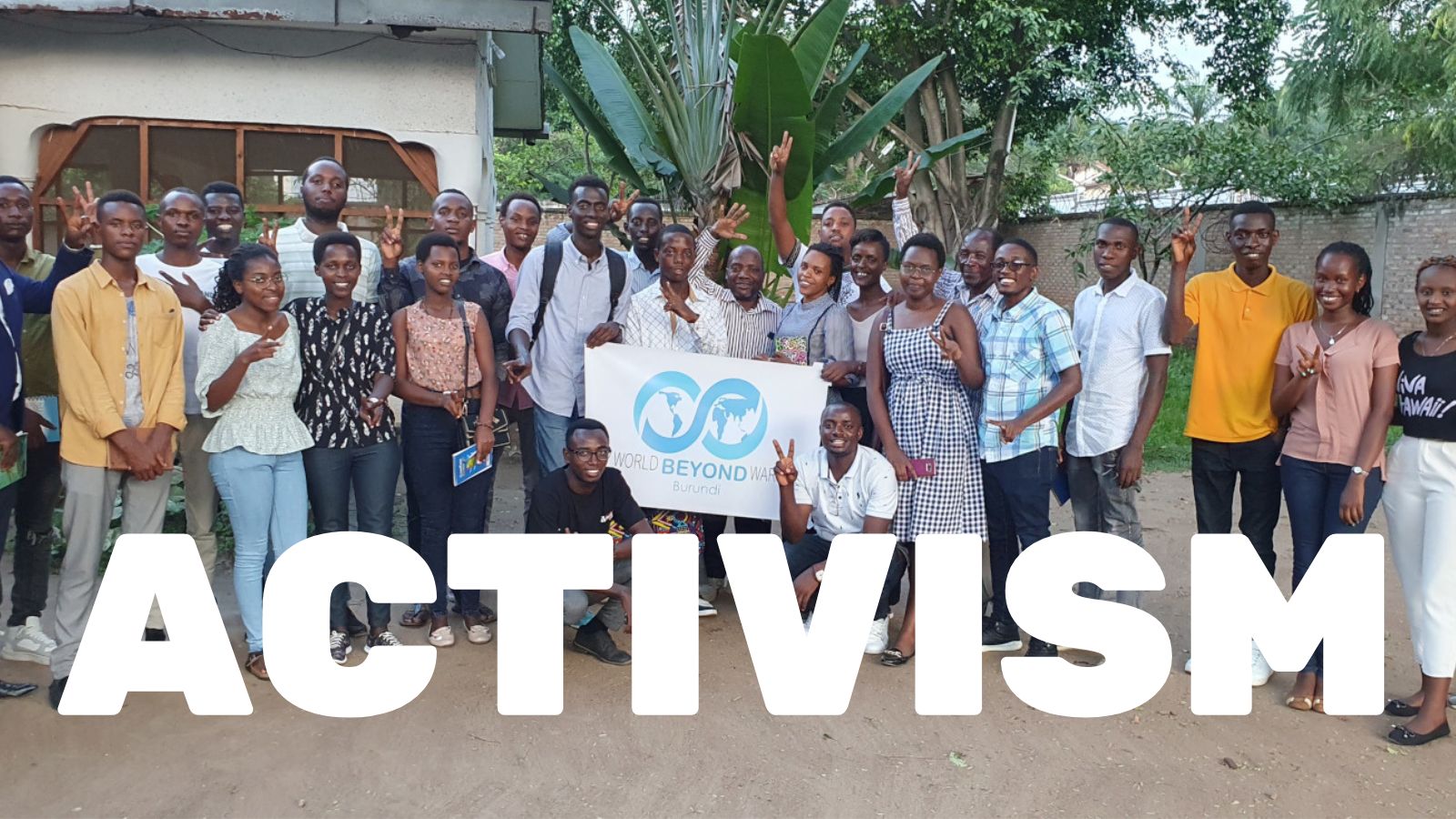
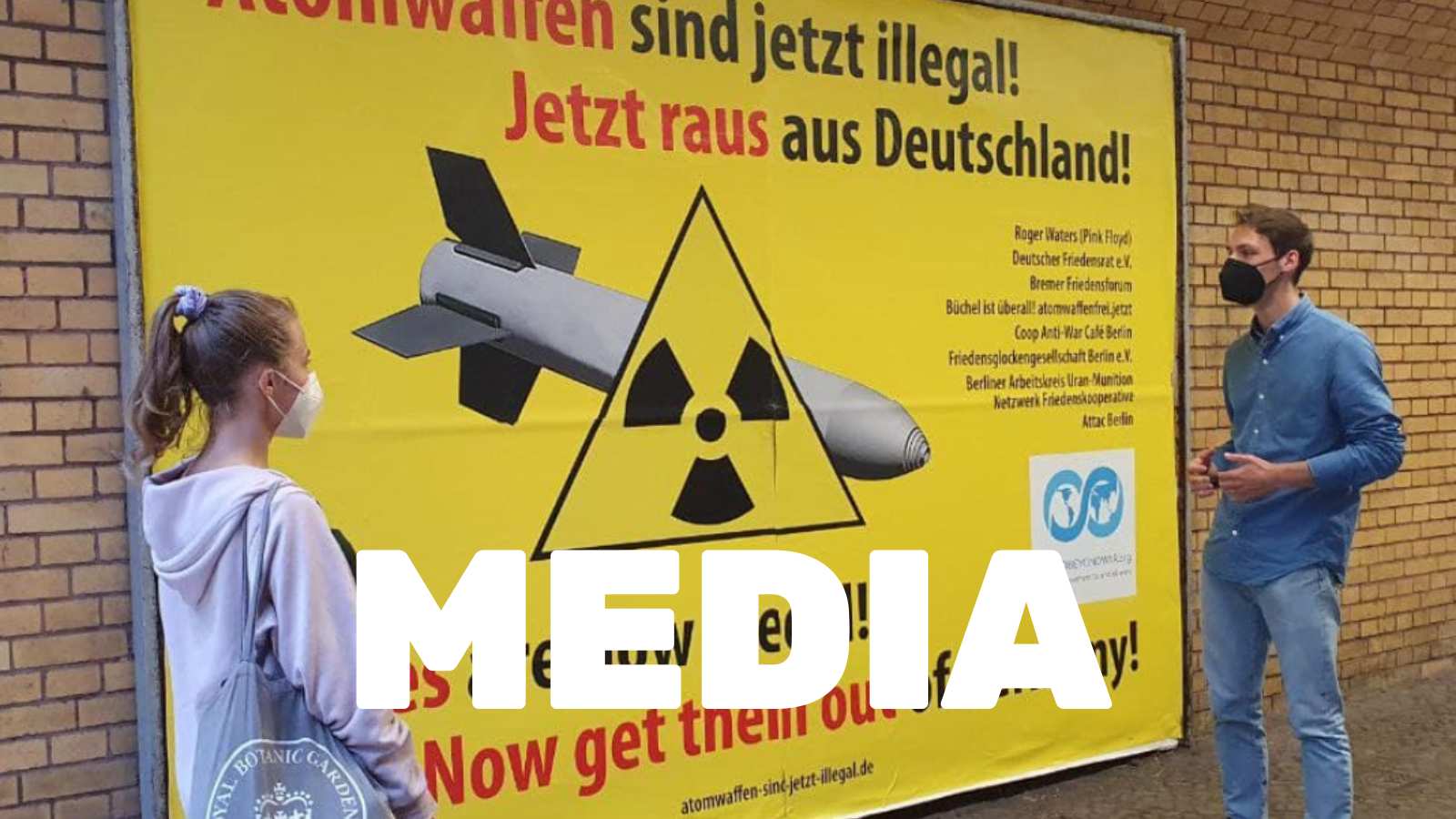
I think the human race is ready to say yes to all three or two of them or one of them, but I think the antiwar movement should be busy making all of these things happen. And mostly that’s what we do do. At World BEYOND War, we do amazing work in three areas, education, organizing, and media. Education includes running our own classes, which are great, so please join one. Education also includes partnering with college peace programs.
Organizing is a super busy area, which includes building chapters all over the world and working on regional initiatives, and also includes amazing protest work in places like Canada and conferences in Africa and Latin America and on the internet each year.
Media includes our social media, and we’re now on TikTok and Blue Sky and Threads, along with the usual suspects. Our media also includes our website, our research projects, our military base maps, and a whole lot of articles we publish every single day.
I believe humankind is ready to discover peace. Thank you for listening to my podcast episode, and send me your feedback in the comments on the podcast page on the World Beyond War website, okay? Really, please do. I want to know what you think about the questions I’ve raised.
See you next month. Keep believing in a world beyond war.
Musical excerpt: “The Revolution Will Not Be Televised” by Gil Scott-Heron.
The World BEYOND War Podcast page is here. All episodes are free and permanently available. Please subscribe and give us a good rating at any of the services below:
World BEYOND War Podcast on iTunes
World BEYOND War Podcast on Spotify
World BEYOND War Podcast RSS Feed


5 Responses
Discovering Peace! If there was a clear path to realizing world peace, it would no doubt have happened by now but that is not the case. The problem is not with the noble aspiration but with the limitations that evolution has imposed upon human nature itself! And that is the final frontier that needs to be crossed before mankind is able to ‘discover’ the source of ultimate peace. http://www.energon.org.uk
Here’s a helpful correction to this common misunderstanding: https://worldbeyondwar.org/inevitable/
I always admire your efforts but cannot completely agree with you on everything. Here is where I stand.
Where we agree:
– war is horrific and a central goal of humanity should be ending it
– nationalism and patriotism can be distasteful
– greed, corruption, unregulated capitalism, wealth disparity are central issues
– racism, bigotry, xenophobia is evil
Where we disagree:
1. You say war (Ukraine in particular) is being primarily caused by corruption/greed. I have not seen evidence for this, and you didn’t present any in this episode. I encourage that whenever you make this point, you present it alongside evidence. Otherwise it sounds conspiratorial. The common-sense idea is that the Ukraine war is caused by geopolitical and ideological struggles. This is the more straightforward view, and you can still be 100% against the war in Ukraine even if it is a geopolitical/idealogical struggle.
2. You seem to want everything all at once. Not just the end of war, but the end of nations and borders as well. I think you are shooting yourself in the foot here. Nations with enforced borders can coexist peacefully, and I think the best strategy for humanity is to achieve that first. I am with you in spirit in dreaming that one day our great-great-great grandchildren might have a shot at seeing the end of nations, and that will be a good day for humanity. I think trying to achieve the end of nations alongside the end of war is detrimental to the antiwar cause because it is less realistic and less urgent.
Also, it seems there’s a bug in this website with rendering comments of text. I had included in my last comment some empty lines, indentation, etc. but after clicking “Post Comment” and seeing my rendered comment, it is showing as all collapsed together. All the blank lines and indentation is gone so my comment lost its structure. Its seems as if my “ is getting rendered as a “ if you know what I mean?
Thanks for the comment, Matt Groth, and sorry for the slow response!
Matt, I’m glad you’re pointing out where you see that I’m not presenting evidence to back up my conclusions. When we’re discussing major historical events, of course there’s a lot to cover, so if I failed to explain why I think NATO was motivated by profit and greed to escalate towards a war in Ukraine, it’s simply because I can’t cover everything in a one-hour podcast. I’m happy to fill in the blanks now.
The tragedy of the Russia/Ukraine war began in 2014, and from 2014 to 2022 the rising tensions between NATO and Russia over Ukraine’s borders was a massive news story covered in all news outlets. You can still read this history now. To understand the motivation for both NATO and Russia to decide to go to war in Ukraine in early 2022, you have to review this entire history dating back to 2014. One important step here were the Minsk agreements of 2015 in which a reasonable compromise on many issues was worked out, and it looked like war would be avoided.
https://en.wikipedia.org/wiki/Minsk_agreements
After 2015, though, USA began entering a period of chaotic and erratic leadership under Donald Trump, who was known for ripping up peace agreements such as a similar peace deal between USA and Iran. Like the USA/Iran peace deal, the NATO/Russia Minsk peace deal over Ukraine did not survive the disaster of the Trump presidency. When Biden took over the Presidency, unfortunately USA’s foreign policy in Europe became dominated by a new aggressiveness, and it seemed that Biden’s foreign policy team wanted to rip up the Ukraine peace deal just like Trump had ripped up the Iran peace deal. There were three motivations for this. None of these motivations involve Putin lusting to restore the Soviet Union. All of them involve USA lying about it’s military objectives, as USA does.
1 – Ukraine loyalists dispute Russia’s annexation of Crimea in 2014
2 – Fossil fuel profiteers were eager to find a way to stop Russia from opening the Nordstream 2 pipeline, which would strengthen Russia’s oil sales at the expense of NATO-friendly oil sales
3 – Some very gullible Americans (including all mass media, including NY Times, Washington Post, CNN, MSNBC, Fox, etc.) believed that a war between Russia and Ukraine would result in regime change in Russia.
Reason #2 looks to me like the actual motivation for the war. Money talks. By escalating to war from 2020 to 2021, Chevron and ExxonMobil and Shell and BP were able to successfully disable Nordstream 2 in 2022. This was where the actual profit motive was.
Reason #3 was the one that fooled the American people into supporting the war, and we know it’s never very difficult to fool the American people.
NATO and Russia have survived the tragedy of the Ukraine war fine. The victims are the people of Ukraine, which neither USA nor Russia gives a damn about.