By Medea Benjamin, October 8, 2026
For the third week in a row, high school students across France are taking to the streets demanding more investment in their education. They want more teachers, smaller classes, decent school buildings and a public education system that works for poor and working-class students.
But their struggle comes at a moment when France faces mounting pressure to cut public spending while dramatically increasing its military budget. The question at the heart of this uprising goes far beyond education: Will France invest in its young people—or in missiles, weapons and war? Books or bombs?
What began in the Paris suburbs has spread to more than a thousand schools. On October 6, more than 250,000 people reportedly took to the streets in demonstrations supporting the students.
The government’s response has only deepened the anger. Instead of addressing students’ demands, authorities have unleashed riot police, tear gas, grenades and mass arrests. More than 6,500 people have reportedly been arrested since the protests began, most of them minors. Some young protesters have suffered horrific injuries, including a 15-year-old who lost his hand after a police grenade exploded. Amnesty International has condemned what it calls the “disproportionate” use of force against young people peacefully demanding their right to education.
The contrast is striking: Students are asking for teachers and decent schools, while the government deploys riot police against them—and finds billions more for its military.
The student movement is unfolding just as NATO is pressuring European governments to massively increase military spending. Under intense pressure from Washington, NATO leaders agreed in 2025 to a staggering new target: 5 percent of each member country’s GDP by 2035. At least 3.5 percent is supposed to go directly to military expenditures, with another 1.5 percent devoted to military-related infrastructure, cybersecurity and “resilience.”
This represents an enormous shift from NATO’s previous 2 percent target, which many members already struggled to meet. For countries facing growing deficits, heavy debt and deteriorating public services, such an increase comes at a steep price.
France provides a glaring example. The country has nearly $4 trillion in public debt—roughly 119 percent of GDP, one of the highest levels in Europe. To tackle its deficit, the government has proposed approximately $48 billion in spending cuts and tax increases, putting already strained public services under even greater pressure.
Yet even as the government demands belt-tightening, its proposed 2027 budget increases military spending by approximately $7.2 billion in a single year, compared with just $1.2 billion more for education. The education budget would also eliminate 1,588 permanent teaching positions.
Imagine being a 16-year-old sitting in an overcrowded classroom, with a leaking ceiling and no regular teacher, hearing that your government cannot afford better schools—but can somehow find billions more for weapons.
France’s own fiscal watchdog has pointed out that increases in central government spending are being driven largely by rising interest payments, contributions to the European Union and increased military expenditures.
NATO officials insist that this massive military buildup is necessary to protect Europe from Russia and other threats. But the notion that Russia is poised to invade France is absurd, and the push for ever-greater military spending raises a fundamental question: What kind of security is the French government actually providing if their schools, hospitals and other public services are left to deteriorate?
France is not alone. Students and teachers in Belgium, Spain and Portugal have also taken to the streets over education funding and working conditions, reflecting growing frustration across Europe with governments that claim there is not enough money for basic public services.
An entire generation is being asked to accept austerity while Europe embarks on one of its largest military buildups since the Cold War. Political leaders may insist that education and military spending are separate issues. But they compete for the same limited public resources.
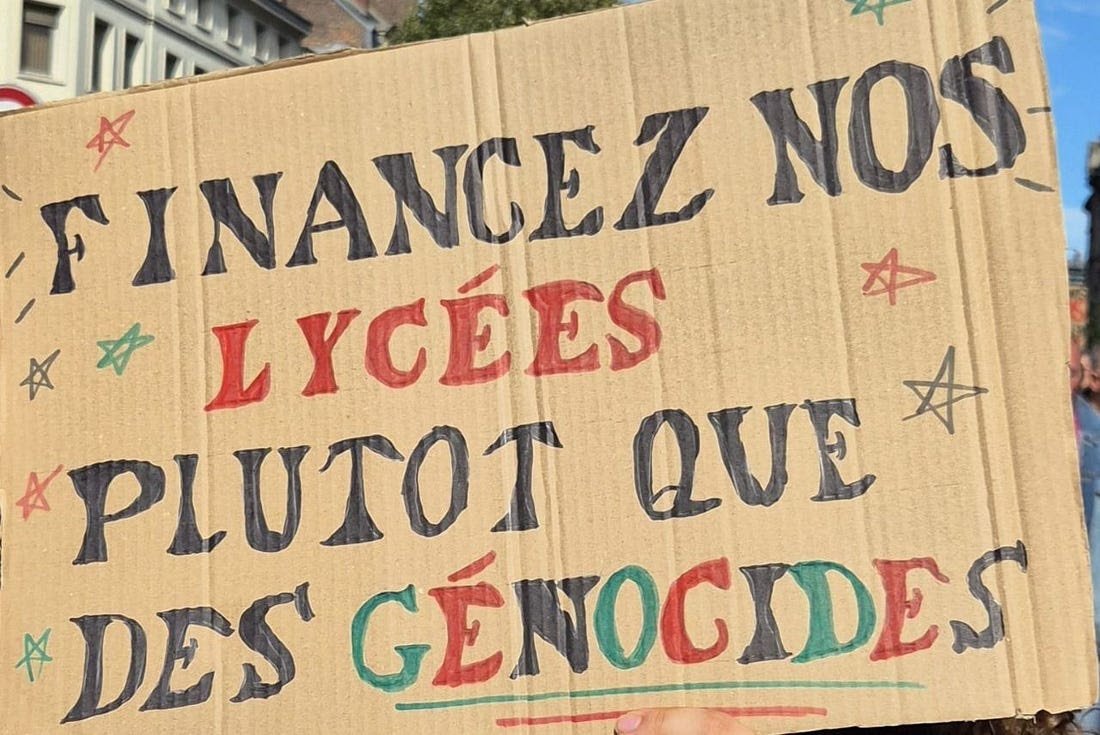
And some French students are already making that connection themselves. Protest signs have declared “money for schools, not war” and “fund high schools, not genocide,” linking their immediate demands to the broader question of what—and whom—the government chooses to fund.
These young people are challenging the very definition of security. NATO measures security in tanks, missiles, drones and ammunition. The students are demanding another kind of security: decent schools, equal opportunity, and a society that invests in their future instead of sacrificing it to an endless arms buildup.
Their demands should resonate throughout the NATO alliance, including in the United States, where public services are under attack while Trump seeks a staggering 54 percent increase in the military budget.
That’s why CODEPINK and allied groups are organizing a Taxpayer Uprising in Washington, D.C., November 10–12, bringing people into the halls of Congress to demand a fundamental reorientation of our national priorities. Instead of funneling ever more tax dollars into war and weapons manufacturers, our government should invest in healthcare, education, affordable housing, green energy and a sustainable future.
From the classrooms of France to the halls of Congress, the question is the same: Will our governments invest in life—or in war? Books or bombs?