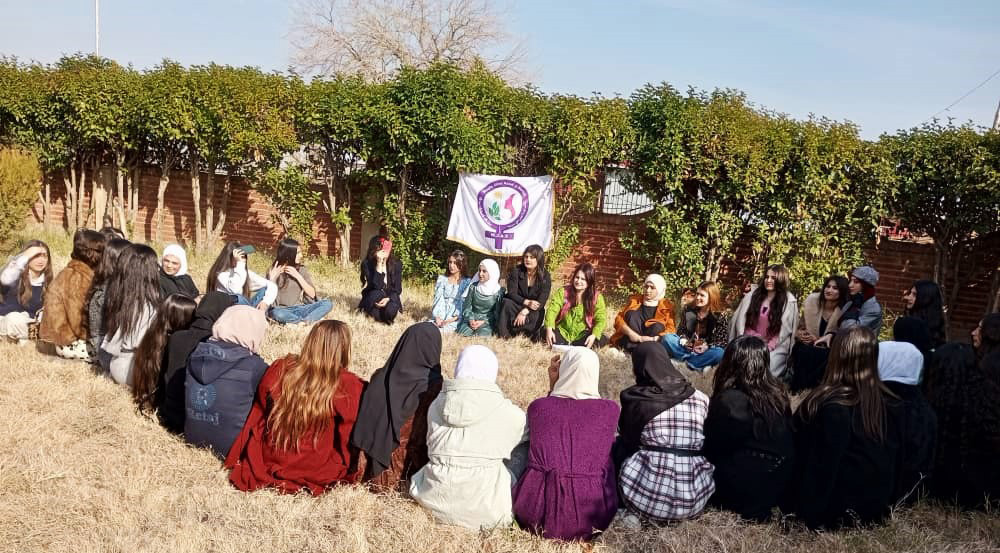
An example of a community-based women’s organization struggling for peace, equality and democracy in Syria
By The Free Woman Foundation in Syria, July 7, 2025
For many years, wars have been raging in the Middle East. Even after fourteen years of civil war in Syria, there is still no end to the violence in sight, with wars also in Israel, Palestine, Iraq, and Iran. Women and minorities live in a situation akin to war each day in Afghanistan. ISIS and other jihadist groups are still terrorizing the region. Global and local actors are involved in these wars, because the Middle East is a vital region for regional and global hegemony. Those who suffer the most are women and children. But women and children are not mere victims. They are also actors, striving for peace, democracy and a chance to live. This article focuses on the work of a local civil society organization, the Free Woman Foundation in Syria (WJAS), working mainly in the region of North and East Syria as well as Syria as a whole, seeking to build peace and democracy.
Syria is a multi-ethnic country that was governed by the Assad dictatorship of the Baath regime for more than 50 years. In the context of the Arab Spring, uprisings against the regime in Syria started in 2011. The Syrian Civil War then ensued, in which over 300,000 people were killed and 14 million displaced.
ISIS (Islamic State in Iraq and Syria) and other Islamist organizations gained power in the chaotic conditions of the civil war. Subsequently, ISIS occupied large parts of Syria. While the defeat of the so-called caliphate was announced in 2019, ISIS and other jihadist groups maintain a presence in the Syrian desert, still have a strong organizational capacity and sleeper cells continue to conduct attacks.
Under both the Assad regime and the rule of ISIS, women were heavily oppressed and excluded from the public sphere. ISIS maintained an openly misogynist regime that employed total social and gender segregation, with kidnapping, rape, and enslavement of women systematically committed. The jihadist ideology they espoused normalized violence against women, child marriages, and polygamy, and denied women’s rights. Under Assad, women were also excluded from leadership, could not secure autonomy over their political and economic lives, and were denied the right to create independent women’s organizations. In different ways, both ISIS and Assad persecuted Syria’s minorities, such as Kurds and Assyrians, and crushed any efforts to create a civil society or gender equality.
The establishment of the Democratic Autonomous Administration of North and East Syria (DAANES) in 2012 marked a promising shift both for oppressed minorities and the majority Arab population. The DAANES opened channels for civil society building, and sought to build a governance system underpinned by human rights, equality and civil freedoms. This facilitated the emergence of women’s organizations, whose work has led to significant political, economic and social gains for the women of the region, even as military attacks and jihadist persecution in the region were ongoing. Figure 1 presents the current map of the North and East Syria region, where the Free Woman Foundation in Syria (WJAS) is working.
WJAS operates in harsh conditions. The North and East Syria region has been under near-constant attack from its northern neighbor, Turkey. Turkey has funded, armed and trained Syrian mercenary fighters, and used them to occupy large swathes of Syrian territory, including the regions of Afrin, Shehba, Sere Kaniye, Tel Abyad, and Manbij, all of which were formerly governed by the DAANES. The Turkish army is also accused of using white phosphorus munitions during its 2019 invasion of Sere Kaniye, causing ecological damage and severe human suffering. In the Turkish-occupied areas, Human Rights Watch, the UN, Amnesty International, and other human rights organizations have documented systematic rights violations and criminal activity at the hands of Turkey’s mercenaries, directed primarily at the local Kurdish and Yazidi populations of Afrin and Sere Kaniye. Looting, extortion, kidnappings, gender-based violence, and the seizing of property are among the violations recorded. The forced displacement of Kurds has led to a marked change in the demography of those areas.
In November 2024, the Baath regime fell, and HTS leader Ahmed al-Sharaa – the veteran jihadist and founder of al-Qaeda affiliate Jabhat al-Nusra – formed an interim government. While al-Sharaa and the interim government have sought to present themselves as moderate, the veracity of their ideological split from HTS’ jihadist past is questionable. The recently drafted new constitution paves the way for a highly authoritarian government that does not recognize or protect Syria’s religious and ethnic diversity, while women’s rights and freedoms were outright excluded. The past few months have seen forces of the new Syrian army conducting massacres of the minority Alawite civilian population, while kidnappings of women across Syria have been on the rise.
Regional and global hegemonic powers are directly and indirectly involved in the war. Turkey continues to mount attacks on Syria both directly and through proxy groups like SNA, the Syrian National Army. The SNA attacked and occupied many areas in North and East Syria. Additionally, foreign mercenaries from Europe, Pakistan, Kazakhstan, Turkey, and elsewhere have joined ISIS and HTS (Hay’at Tahrir al-Sham). HTS is supported by Gulf states and the international community. The support goes beyond financial support, and includes political acceptance and one-sided media coverage that affects and strengthens jihadist groups. Meanwhile women’s- and community-based organizations are standing alone, continuing their works against all odds.
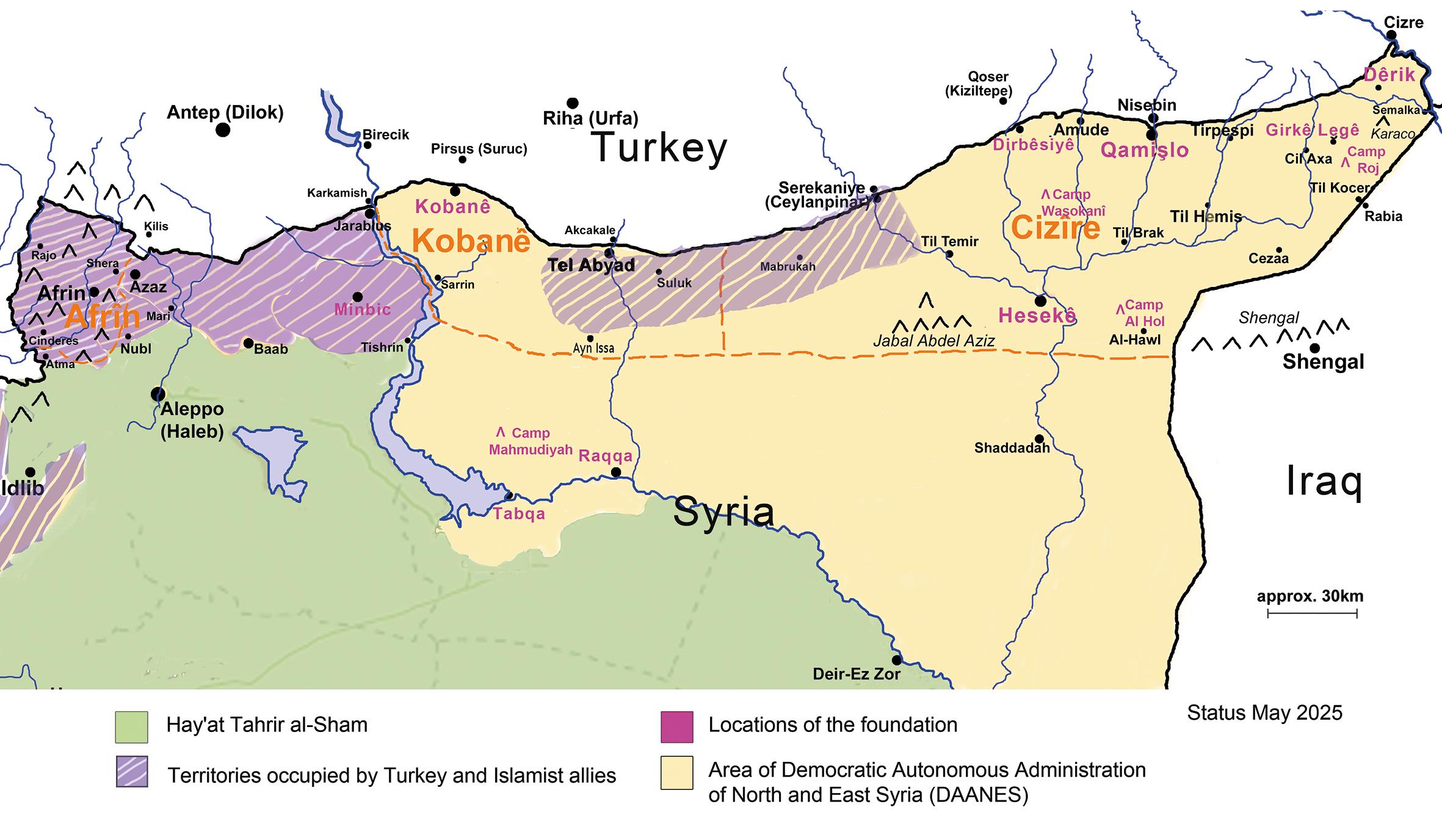
Figure 1. Northern Syria, showing the areas controlled by the DAANES, the new Syrian government (HTS), and the Turkish-occupied regions.
Operating in the midst of this hostile national context, WJAS established five key principles to guide its work: [1] the belief that true societal freedom is realized through the empowerment of women; [2] an inclusive approach to include all ethnic, cultural and religious groups to enable civil society to work on peace-building to prevent violent conflict and foreclose the spread of extremist ideologies; [3] considering the material, spiritual, and societal rights and freedoms of women as the groundwork that needs to be laid in order to engender prosperity and justice from the personal to societal levels; [4] a participatory approach to ensure that activities of WJAS are tailored according to real-life conditions, based on need assessments, reflecting their relevance and effectiveness to women; [5] promoting everyday empowerment through involving women in the planning processes, fostering ownership and dignity.
Formed as a response to the structural marginalization of women, the devastation wreaked on Syria during the civil war, the persecution and atrocities of ISIS, and Turkish military attacks, WJAS has become one of Syria’s pioneering civil institutions, cultivating community resilience, women’s leadership, and democratic culture. The work of WJAS is informed by a societal understanding of women’s diverse realities, recognizing that Kurdish, Arabic, Turkmen, Druze, Yazidi and Assyrian women in Syria face different cultural and social pressures. The work is thus tailored according to their specific needs and resources. An intersectional approach acknowledges the role of religion and tradition in shaping women’s lives. WJAS is challenging entrenched societal customs and patriarchal structures that justify gender and social inequality. It seeks to fight against ideological extremism, violence, and repression in Syria and engage in psychosocial support and trust-building with war-traumatized families. Everyday empowerment requires legal, psychological, and economic transformation, as well as women’s active participation as wives, mothers, and citizens.
Ways in which WJAS has advanced gender equality
Practically, the steps WJAS has made to advance gender equality include providing a rich variety of education to women, promoting women’s health, enhancing women’s economic independence, and supporting war-affected families. WJAS is also engaged in legislative work in building civic society by advocating for gender-sensitive laws and by participating in the process of writing a Social Contract of North and East Syria – a document that effectively acts as a constitution for the region. WJAS is now working to advance gender equality in the extremely challenging conditions of post-Assad Syria. Peace building, the inclusion of all ethnic and religious groups and democratic leadership practices are hence necessarily essential aspects of the work.
Education for general awareness-raising and development of practical skills
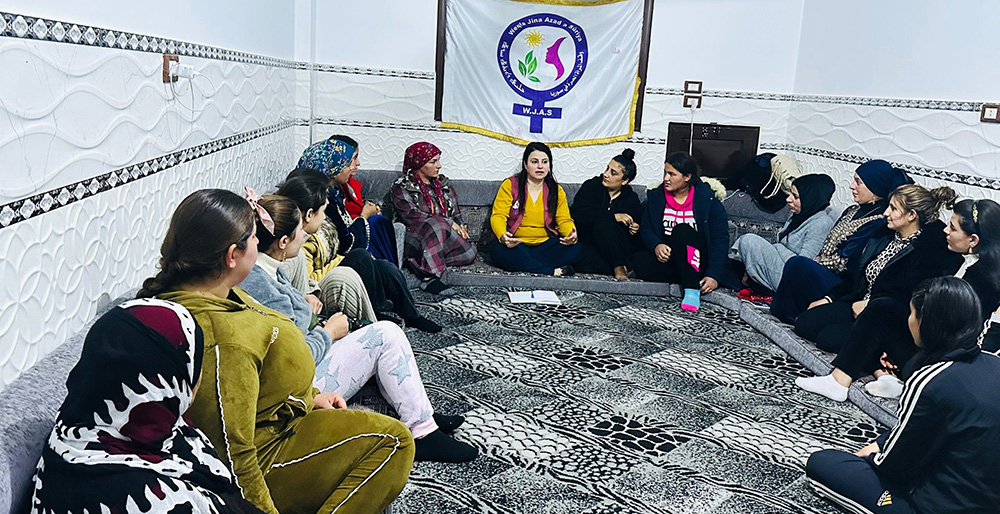
Educational activities run by WJAS include lectures geared towards strengthening women’s awareness, knowledge and empowerment, as well as courses for developing professional skills to enhance economic independence. WJAS works in a society where traditions on the one hand, and relentless military conflict on the other, have historically suppressed women’s roles. Thus, education has the potential to become a truly transformative force. WJAS believes that true societal freedom and peace-building are only possible through equal gender participation. WJAS organizes lectures and seminars aimed at transforming deep-rooted traditional, patriarchal, and religious attitudes toward women. These include topics like forced marriage, child marriage, gender-based violence, and women’s rights. They aim to reshape both how society perceives women and how women see themselves. Through participation, women get the chance to get to know themselves, identify their goals, and recognize their strengths and vulnerabilities.
The education of WJAS aims to challenge deeply-entrenched beliefs. The region of North and East Syria is heavily influenced by both conservative and extremist ideologies. This is particularly pertinent in areas such as Raqqa and Tabqa, which spent years under ISIS rule. WJAS actively promotes a more inclusive and progressive understanding of Islam, emphasizes freedom, and helps women overcome patriarchal attitudes. In this work, the conscious inclusion of men has turned out to be important. Recognizing that societal change must be holistic, WJAS began educational sessions for men in 2020 seeking to address oppressive gender dynamics within families and hierarchies in communities. This inclusive approach helps foreclose the possibility of community backlash and social conflict.
Education in practical and professional skills has been decisive in promoting women’s rights and economic independence. The training courses include sewing, tailoring, hairdressing, medical assistance, and first aid. For example, there are both short, general first-aid courses of one month and longer, specialist courses of six months. WJAS also offers language classes (Arabic, Kurdish, and English) geared towards young women, literacy courses for older women, and computer courses for all ages.
Healthcare access and women’s health in advancing gender equality
WJAS plays a vital role in promoting and improving girls’ and women’s rights by advancing access to healthcare services and health education. This is underpinned by a belief that guaranteeing women’s rights to health enables a sense of security. This topic is even more pertinent in Syria, where the healthcare system has nearly collapsed due to the destruction of health facilities during the civil war, combined with the mass out-migration of doctors and specialized health personnel.
WJAS operates five health clinics in the under-served areas of Tabqa, Qamishlo, Darbasiyah, Heseke, and Kobane plus a mobile clinic in the rural area around Derik. These clinics provide free treatment and medication to women and children. These services are crucial in places where cost, distance, or cultural norms prevent women’s access to healthcare. Education and training of medical assistants and first aid personnel is an integral part of building healthcare infrastructure.
To promote preventive medicine and a holistic approach to women health’s and well-being, WJAS also organizes seminars on key health topics, such as menstruation, pregnancy, hygiene, and reproductive health. Knowledge is also shared about infections, cancers (breast, ovarian, womb), and diseases that children are prone to. Women’s health issues are often seen as taboo or neglected in traditional communities, and therefore educating women helps break stigmas and empowers them to take control of their bodies. WJAS’ aim here is to shift healthcare from being reactive to being proactive, by giving women the tools to understand their health and prevent diseases.
Natural medicine such as seeds and herbal remedies are utilized in Middle Eastern holistic approaches to health. WJAS values this cultural inheritance and trains women in natural medicine involving physical, mental, and spiritual aspects. This knowledge offers an alternative in a region where chemical medications are either too expensive or unavailable. The development of natural medicine has empowered women as healers and caretakers and strengthened their self-reliance and cultural expertise.
In crisis-response campaigns, WJAS has worked to combat diseases like COVID-19 and leishmaniasis (an infectious disease caused by the sandfly parasite) by conducting house-to-house and village-based public health campaigns. These promote collective responsibility and equip communities with knowledge and agency during outbreaks.
In terms of emergency support, WJAS designs sustainable activities according to local women’s needs, reacting to urgent political and military upheavals and dangers. In emergency situations, WJAS organizes support, such as aid for refugees and displaced people. They hand out clothes, mattresses, blankets, medicines, food, and milk and contribute to meeting medical needs.
By educating women on health, WJAS affirms that healthcare and health knowledge are human rights, not privileges. In areas where military conflicts and poverty have destroyed health infrastructure, this knowledge becomes lifesaving and restores the dignity and agency of women. WJAS’s work emphasizes that the aim is not merely to treat illnesses but also to redefine women’s crucial roles in health, family and society.
Enhancing women’s economic independence
An important principle of WJAS is the recognition of financial autonomy as a basis of gender equality. To realize this, WJAS has initiated vocational training centers that equip women with skills in various trades, economic planning, and cooperation. Economic autonomy is opening women’s routes to mobility, activity in the public sphere, and escape from economic dependence on male relatives or traditional household roles.
Importantly, all activities to promote women’s economic rights are based on needs assessments and participatory methods to ensure that projects are tailored to real-life conditions and requirements. WJAS provides training courses on arts and crafts, sewing, tailoring, and hairdressing. To guarantee the establishment of women’s economic rights, it is important to bridge attained skills with working life. Women have established enterprises, opened shops, and started beauty care services. They serve as examples of women’s economic independence that is a basic human right and strengthen women’s position at home and in society. WJAS utilizes traditional structures of Syrian women’s collective action within its work, for example, in the establishment of cooperatives, while simultaneously developing new goals and forms of work.
Legal advocacy, preparation of gender-sensitive laws and constitution
Legal advocacy involves active participation in the preparation and enforcement of law. WJAS works together with other women’s organizations to support and promote gender-sensitive laws, creating a legal framework that protects and empowers women. WJAS participates in the legal council of North and East Syria, as well as in other regional boards and committees as an independent civil society organization, ensuring that women have a voice in formal decision-making processes.
This legal advocacy is crucial in a region where women’s legal rights have long been overlooked or denied entirely. WJAS brings grassroots feminist perspectives directly into the structuring of the legal system. The work involves, for example, campaigns for prohibiting polygamy, child marriage, and violence against women. These changes strengthen the legal protection of girls and women, marking a major shift from traditional laws that previously enabled or tolerated such repressive practices. Legal advocacy means also informing and educating women about their rights and potentials to have an impact on their legal positions in society.
By participating as a civil society actor, WJAS demonstrates how a non-governmental organization (NGO) can shape law and policy in urgent women’s rights issues. This is a powerful step toward gender justice in a Syria that is rebuilding its society.
Helping war-traumatized families in refugee camps and camps for ISIS-affiliated women
WJAS is working in regions where families have experienced intensive military attacks, forced displacement, and violent atrocities. Many displaced families live in refugee camps. WJAS works in Washokani and Sere Kaniye camps, providing essential social and health services to women and children. The aim is to help them cope with trauma and offer opportunities for education, employment, and empowerment. Additionally, psychosocial work addressing war trauma involves social support, discussions, and facilitating spaces for the sharing of experiences and knowledge. Trauma-informed work is vital, because many women and children experienced cruelties, exploitation and violence.
Al-Hol and Roj camps are inhabited by family members of imprisoned ISIS members, predominantly their wives and children. ISIS ideology is still espoused by some women in the camp, producing an environment that is extremely hostile towards women. Many women, who came from traditional, religious homes with patriarchal father figures, were married to ISIS men. These women carry a heavy psychological burden and are often severely traumatized. The international community has neglected these ISIS-affiliated women, and not sought to understand their aims or desires. Women and their children are very vulnerable and isolated in the camp, and they lack basic resources for mothering and womanhood. Although the work of WJAS is often dangerous in these camps, the aim is to rehabilitate women, help them recover their identity, gain skills, and reintegrate into peaceful society. WJAS also provides developmental enrichment to children living in the al-Hol and Roj camps, as part of supporting their mothers. This includes educational sessions on topics like friendship, respect and hygiene.
The courses and rehabilitation that WJAS offers to the ISIS-affiliated women are crucial for facilitating de-radicalization. The aim is also to reduce prejudices and treat the women with respect while conveying to them the values of a democratic society. This enables the women to gradually break away from jihadist ideology and strive for an equal, human, and respectable life for themselves and their children.
Democratic leadership within WJAS
Democracy, pluralism and inclusion are core values and principles of WJAS. They are reflected in the personnel management and leadership that is implemented in all activities of the foundation.
To ensure democratic leadership, the team gathers weekly and monthly to evaluate their work, identify shortcomings, and develop better practices. The members participate in the leadership process and organize internal educational sessions to strengthen their own consciousness, willpower and social responsibility. All members live in communities exposed to civil war, military attacks, and jihadists atrocities, and therefore trauma-informed consultation is an important part of their well-being.
Syria is a multi-ethnic country and the members of WJAS reflect this plurality. Women of all ethnicities and religions are involved in the work and participate equally in the decision-making process. The local administrations reflect the needs and customs of the communities that they serve. For example, the women who work in the Washokani camp for displaced people from Sere Kaniye are themselves displaced people from there. The administration in Raqqa consists of local women who have themselves suffered persecution and atrocities under ISIS’ rule.
Conclusion
The new constitution of the Syrian interim government engenders the exclusion of women and the normalization of traditional women’s roles as well as non-accountability for violence against women. This can be interpreted as a backlash against the achievements women have gained in North and East Syria. WJAS and other regional women’s organizations regard the constitution as problematic and will try to do what they can – together with all civil society actors – to push for a re-writing of the new constitution in an inclusive manner. Additionally, since the new interim government came into power, sectarian violence against Druze, Kurds, and Christians has risen. Syria is a pluralistic country: these different religions and ethnicities can live together. Seeking to reach out to all women, WJAS also gives seminars about mutual acceptance, respect and tolerance. WJAS considers the ethnic and sectarian divisions and violence seen in Syria as a result of global power systems fueled by the Western hegemonic forces.
The work of WJAS and other women’s organizations in North and East Syria represents a transformative shift in the socio-political landscape for Syrian women. It has comprehensively challenged deeply ingrained patriarchal systems and offered a new model for women’s autonomy and leadership in the Middle East. The work by WJAS has shown that women can organize, participate in governance, and greatly contribute to societal change and the establishment of mutual acceptance and peace. These historic achievements of women – being able to shape their own futures and to play a central role in their societies – are especially important in the current political transition in Syria. WJAS, together with other women organizations, has worked to reconstruct a new society based on gender, ethnic, and religious equality and democracy. It strongly opposes the authoritarian, jihadist, and women-hostile forces within the power transition in Syria. By promoting women’s rights, legal reforms, and economic independence, WJAS is playing a pivotal role in building a more inclusive, just, and democratic Syrian society.
Despite its achievements, WJAS faces severe opposition, threats, and dangers. Turkey’s Syrian mercenary groups, operating under the name of the Syrian National Army (SNA), attacked and captured the city of Manbij at the end of 2024, forcing many people to flee. WJAS’s work had to be suspended due to massive threats from jihadist forces, and the office was looted and destroyed. Three Arab employees of Zenobia, an organization for Arab women, were murdered in early spring 2025. The WJAS office in Damascus had to be closed for a few days due to the violent threats and worsening security situation.
The situation is tense in Tabqa and Raqqa, but WJAS’ work continues. Raqqa in particular is still dealing with the presence of ISIS sleeper cells. Meanwhile, the steps the new interim government have taken risk destroying achievements made in the field of gender equality; a prospect WJAS members are fearful of.
The work that WJAS is doing in the Al-Hol and Roj Camp is very dangerous. There are repeated, serious threats against the course leaders and camp residents who distance themselves from ISIS receive life threats. Work thus also involves protection of women, building trust, and cooperation. The work of rehabilitation and socialization is complex, but it promptly demonstrates the importance of fundamental attitude changes in North and East Syria that warrants every person human value and rights.
Voices of women working on the ground often do not reach the public. Mostly, only the voices of political leaders are heard and listened to. Peace in the Middle East is possible. It is local communities and women’s organizations which are tired of war and working towards democracy and peace. Meanwhile, hegemonic regional and global powers, striving only to secure their interests, utilize jihadist forces which destroy communities, inflame sectarian conflicts and see women as slaves.