

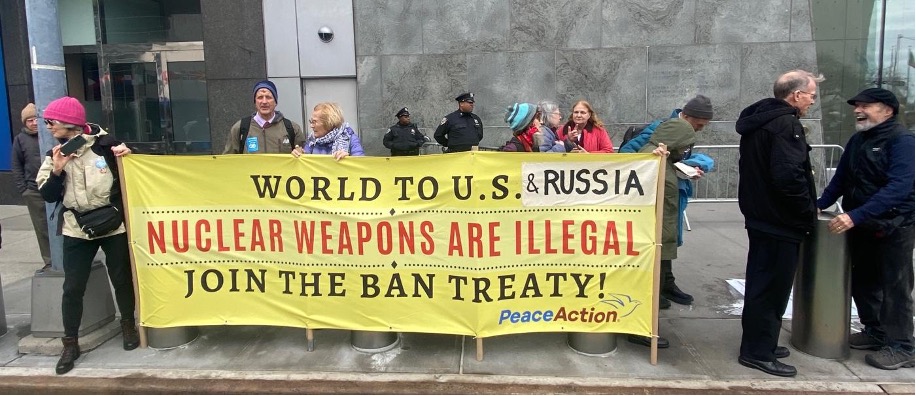
World BEYOND War Board Members John Reuwer and Advisory Board Member Ann Wright at the U.S. mission to the United Nations. Photo: Claire Schaffer-Duffy
By John Reuwer, World BEYOND War, March 10, 2025
I was fortunate to be able to attend the third Meeting of State Parties to the Treaty on the Prohibition of Nuclear Weapons (TPNW) at the United Nations in New York City on March 2 through 7. This treaty came into existence largely through the energy generated by the International Campaign to Abolish Nuclear Weapons (ICAN) which was birthed by International Physicians for the Prevention of Nuclear War (IPPNW – whose U.S. affiliate Physicians for Social Responsibility I was representing) in 2007. ICAN was awarded the Nobel Peace Prize in 2017 when 122 nations adopted the treaty. The Treaty came into force in January 2021 becoming part of international law now signed by 98 nations. As the fruit of a grassroots movement that rallied nations to recognize the human and ecological horror that nuclear weapons threaten, and act to eliminate that threat, the Treaty is a bright constellation in the sky for those of us who long for a just and lasting peace.
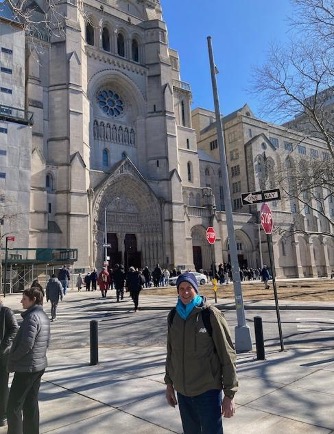
Allow me to share a few of the highlights I witnessed that were meaningful to me and the mission of World BEYOND War. The week began with the preparatory meeting sponsored by ICAN at the famous Riverside Church, with its magnificent edifice. Ivana Hughes, President of the Nuclear Age Peace Foundation, gave the opening address highlighting the role that this church and the upper west side of Manhattan played in the nuclear age. Some of the professors who worked on the Manhattan project were at nearby Columbia University including Enrico Fermi, who along with Albert Einstein, after helping create the atomic bomb, petitioned the government to use it as a demonstration explosion rather than to attack human beings. The church and neighborhood have given voice to many activists like Hughes; Thomas Merton, the great theologian and antiwar monk; Sister Megan Rice, the 82-year-old Catholic nun who spent time in jail for penetrating multiple layers of high security at the Y-12 uranium plant in Tennessee; and Martin Luther King when he gave his famous Beyond Vietnam speech in 1967.
Among the many inspiring speakers to follow were elderly Hibakusha (A-bomb survivors) whose organization Nihon Hidankyo received the 2024 Nobel peace prize for their lifelong work advocating for nuclear abolition. I was pleasantly surprised to learn that their mantra,
“No more Hiroshimas
No more Nagasakis,
No more Hibakusha”
now included a fourth line,
“No more War”
a plea which seemed to be embraced by more people than I have noticed at antinuclear gatherings in the past.
In the full room of several hundred were 1st, 2nd, and 3rd generation victims of radiation exposure from A-bomb testing and production who I would see and hear throughout the week as they told their stories. Though they were from widely separated places – the Australian outback (where the British launched their mushroom clouds), Kazakhstan (Soviet Union), Algeria (France), Polynesia (France), Nevada and New Mexico (U.S.), and the Marshall Islands (U.S.) – they all had similar stories to tell, including:
- Long family and neighborhood histories of diseases exceeding what would be expected in unexposed populations, and which are multigenerational.
- Almost none of the exposed populations were asked permission to be exposed to testing of weapons, or warned of the dangers.
- Their health concerns were ignored for decades and continue to be minimized. One of the articles of the TPNW calls for victim care and compensation.
- They are aware that the new nuclear arms race will create many more exposure victims. They beg the nuclear weapons states to sign the Treaty and stop their assault on humanity and our future.
The remainder of the week included twice daily meetings of government representatives on official business and dozens side events hosted by civil society activist and educational groups. There were profound insights provided by some of the greatest scientific and activists minds in the nuclear weapons field, whose work will be highlighted in detail in other places. I will share a few examples of the many that inspired me.
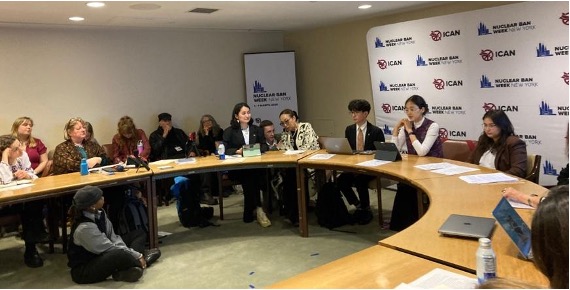
Seeing the strong presence of very bright youth from all over the world leading many of the sessions, indicating that the work for nuclear abolition will continue until the job is finished. In this photo are leaders from Kazakhstan and the western U.S. sharing their collaboration in the Nevada-Semey project.
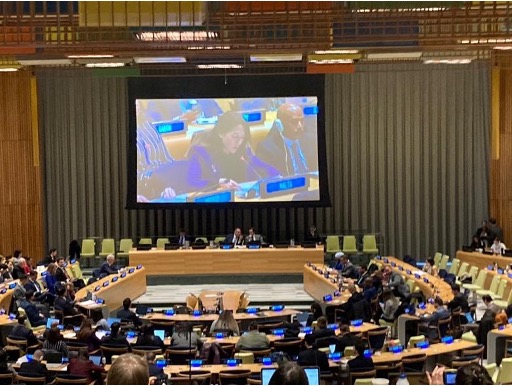
Listening to the representatives of dozens of nations share their perspective on why they believe this Treaty is necessary for the future of their country and the world. The majority of the world’s countries now support the TPNW, and their collective testimony covers most of the best reasons why – from the threat to humanity that nuclear weapons represent, the bullying that their possession allows, their sheer immorality, their illegality, and the guaranteed failure of the flawed strategy of deterrence.
Hearing Professor Zia Mann, a brilliant physicist at Princeton University, remind us that governments have been aware of the potential world-ending properties of these weapons at least since a memo was given to President Eisenhower in 1958, after a war game scenario using hydrogen bombs on five continents predicted most life on earth could be extinguished. Soon after, Soviet leader Nikita Khrushchev is credited with saying, “the living will envy the dead”. I remembered that the message given to me as a child watching my neighbor build a bomb shelter was that nuclear war was survivable and we better be ready to fight it. Education of the public remains a crucial part of our work.
Mann went on to say that there are now two ways of thinking about our place in the world. The first leads to nationalism, where state power trumps all other concerns, Vladimir Putin said it clearly when asked about the horrible consequences of nuclear war he was threatening over his invasion of Ukraine. Yes, it would be tragic for the whole world, but what is the world without Russia? His thinking is of course reflected in NATO’s willingness to threaten nuclear war right back. The other way of thinking is that we are part of a global community which needs to face its serious global problems with cooperation. This is part of World Beyond War’s work on creating a new story for human kind.
Participating in an information session about a multi-year grass roots tribunal led by legal experts, survivors, and advocates to determine if the use of atomic bombs on a captive population violated international law at the time, and whether compensation for the harm done to the victims is warranted. My remarks supporting their efforts are appended below.
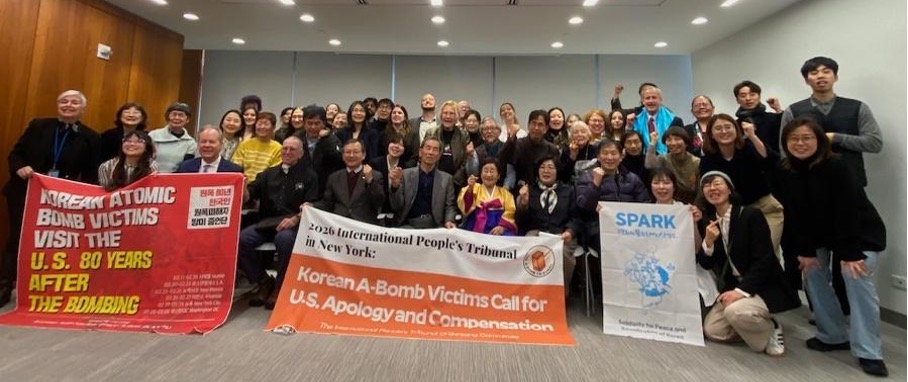
Participants of the People’s Tribunal for the rights of Korean victims of the atomic bombings. Photo: Claire Schaffer-Duffy
Meeting Activists and representatives organized by Warheads to Windmills, who focused on how to reach the US Congress most effectively to support a bill calling on the US to sign the TPNW and redirect nuclear weapons spending to meet US energy and human needs. Information on The Nuclear Weapons Abolition and Conversion Act of 2025 can be found here.
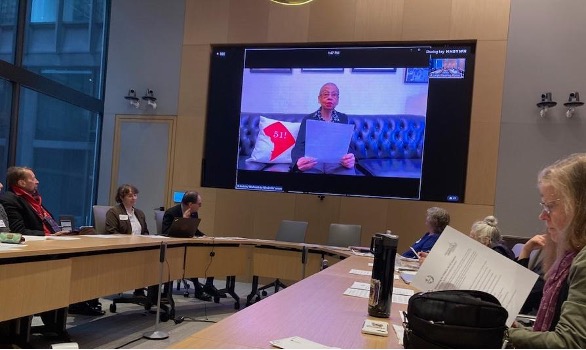
DC Congresswoman Eleanor Holmes Norton on zoom from Washington, DC, announcing her legislation for the 119 Congress.
A parallel effort to call the world Back from the Brink is underway in many localities around the U.S..
Attending a terrific session on divestment, the process of taking our personal savings, pensions, institutional government funds out of the 20 or so companies that dominate the nuclear weapons industries and financing. Over $4 trillion dollars has been divested globally so far. The bottom line here is to take advantage of the organizations who make this easier:
Multiple public demonstrations in front of the US Mission pleading for the U.S. to end the insanity of the new nuclear arms race by signing the TPNW.
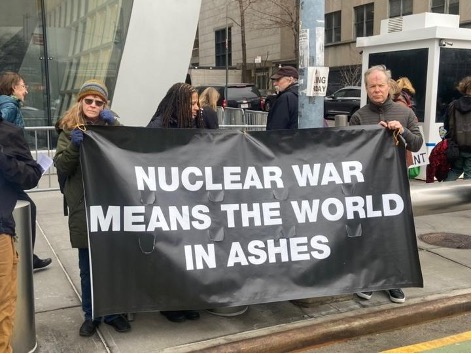
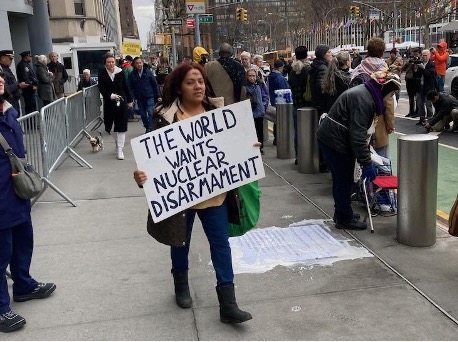
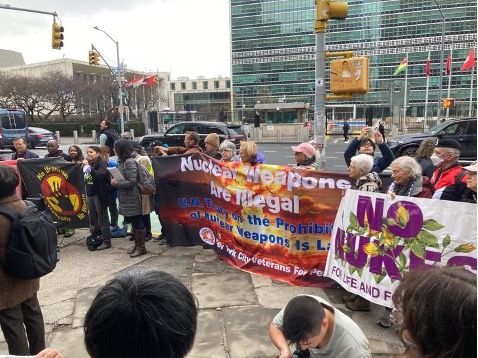
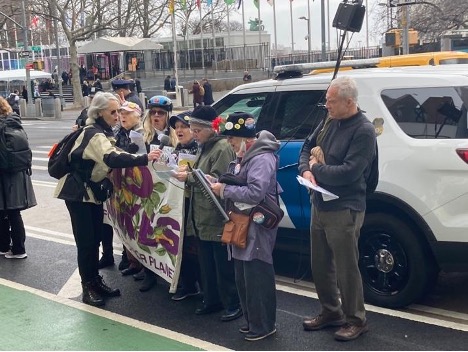
Raging Grannies singing for a peaceful world.
I will end for now mentioning three of the MANY incredible people dedicating their lives to saving our future from a nuclear end. They remind me of the goodness of humankind, and the story I choose to live by.
Ambassador Akan Rakhmetullin the First Deputy Minister of Foreign Affairs of the Republic of Kazakhstan and President of this meeting of states parties. He repeatedly stated that getting rid of nuclear weapons was a good move for Kazakhstan, even in the face of arguments of those who since the Russian invasion of Ukraine claim that Ukraine should have kept its nuclear weapons to prevent that invasion. This gentleman has had decades to consider this position, including three years of watching Russian behavior in its most recent war while his country borders Russia.
Archbishop John Wester of Santa Fe, New Mexico, stands out as the strongest voice among the Catholic Bishops supporting Pope Francis’ position that possession of nuclear weapons, even for deterrence is immoral. He does this in a state where the nuclear weapons industrial complex is one of the major employers in the state and the source of what little political power its congressional representatives have.
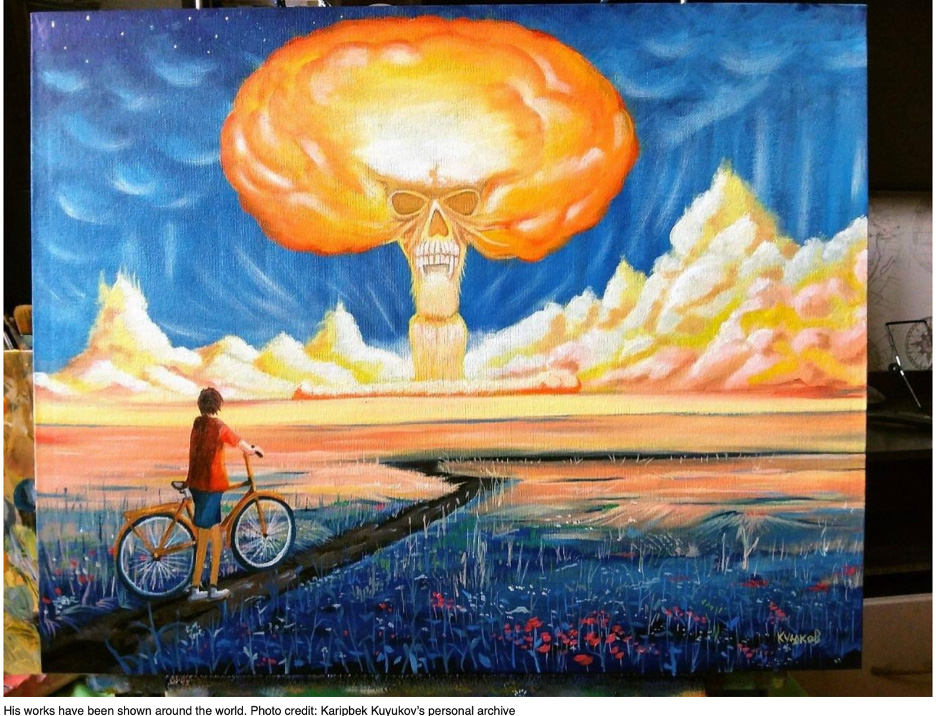
Karipbek Kuyukov: Born 100km from the test site at Semipalatinsk, Kazakhstan to a mother who lost his two prior siblings to still birth while he was born without arms. He is an internationally recognized artist, who devotes his life trying to prevent a new generation from suffering what his people suffered. He told many stories from his childhood seeing people collecting metal scraps from all around the test site to sell for income. There were no fences, no warnings of danger. Chinese buyers returned the scrap they had bought from them after it was found to be radioactive. He described how soldiers died after bathing in the “atomic lake” created after one of the blasts. They died horrible deaths. Here is a sample of his work.
Address to SPARK and the People’s Tribunal on Korean Victims of the Atomic Bombings, March 4, 2025
We at WBW would like to express our gratitude at these proceedings. Our appreciation is for you playing a major role in strengthening one of the most important mechanisms for preventing and eliminating war, and that is the rule of law. War is an obsolete institution that normalizes the suffering of countless human beings, destroys our environment, ensures domination of the strong over the weak, and threatens civilization with nuclear extinction. The survivors of the attacks on Hiroshima and Nagasaki know better than anyone just how terrible the further use of nuclear weapons could be. Massive blast, heat, radiation, and firestorms do not discriminate between combatants and innocents like the Korean civilians who were not at war with the US but suffered terrible losses with the U.S. decision to incinerate two cities after the outcome of WW2 was for all purposes already determined.
Yet too many people still think of war as, at some point necessary or inevitable.
The reason most people support war is because of endless repetition through biased news, TV, movies, and countless other cultural messages that war is needed, that we have no other choice. That propaganda is carefully curated to avoid people learning about two important aspects of conflict that make the choice for war much less appealing.
The first thing that makes war tolerable is that its full cost is mostly hidden. Those who support war may think of the soldiers who make a sacrifice by death or wounding, or the amount of money the war will cost, but almost never think of the hidden costs – the lifelong treatment of the physical and emotional trauma the veterans will suffer, the domestic violence, suicides, and mass shootings that veterans commit at a rate higher than nonveterans. There is also the destruction of the environment, and all the lives that could be saved by providing clean water, housing, and health care for countless people. Then too is the loss of moral authority that comes with the agreement to commit mass murder of human beings, including innocent civilians. The Korean victims of the atomic bombings are among the uncounted costs. Here were 70,000 people coerced into slave-like conditions and yet were killed by the atomic bombs. Koreans paid a terrible price for a war they did not ask for. Did anyone who ordered and delivered those bombs take time to think of the many innocent people that would be killed or whose lives were ruined ?
The second thing that makes war acceptable is ignorance of the alternatives that could prevent or greatly mitigate preparations and tendency to rush to war. There are many alternatives to war – diplomacy, including multitrack diplomacy, treaties, especially those that build trust or lead to disarmament. But there is nothing more powerful for creating a just peace than the rule of law, especially laws that are fair and equitable for everyone.
WW2 was a watershed in human history. After the horror of 80 million deaths, an horrific holocaust, and the use of firebombing and nuclear weapons against cities, for the first time in history a critical mass of leaders said, enough, we cannot let this happen again. The UN charter was written whose first purpose was to save succeeding generations from the scourge of war. This was followed by the conventions of 1948 to prevent further genocides. The International Court of Justice was set up to enforce these new conventions, and has had numerous successes, but now, in the face of increasing bellicosity by numerous nations around the world ignoring the rulings of the ICJ, we the people must step up an speak for humanity. Ultimately, I believe that legitimacy is more powerful than brute force in determining human affairs. With just laws comes legitimacy and less reliance on the brute force of war and its logical conclusion – our demise with nuclear weapons.
In a time when governments are squandering their legitimacy by ignoring the rule of law, this Tribunal asserts that ordinary people can stand by the rule of law and call leaders to uphold it. International law can help denuclearize and demilitarize the Korean Peninsula and eventually the world. The many hundreds of people participating in this Third Meeting of States Parties to the TPNW and you are making a great contribution. Please keep it up.
*****
SPARK(Solidarity for Peace and Reunification of Korea) is a grassroots movement organization established in 1994, during a time of heightened tension on the Korean Peninsula, following the spirit of the Korean peace movement. SPARK, which leads the A-Bomb Tribunal alongside Korean atomic bomb victims, is committed to five core values: sovereignty, peace, reunification, denuclearization, and disarmament.


One Response
Excellent article John on the TPNW Meetings at the UN!! Your really caught the Spirit of the people there from around the world committed to stopping the nuclear madness. Thanks very much for representing WBW and speaking strongly for the abolition of nuclear weapons and the abolition of war! Hope MANY WILL READ your report!