Video of Webinar: U.S. Military Spending and How to Stop It
About this webinar
A 90-minute live event recorded on October 13, 2026
- U.S. military spending is twice what we’re ever told and more than the rest of the world’s combined
- It’s over three-quarters of proposed discretionary spending and stripping funding from urgent needs
- It’s driving a global arms race, wars, and the risk of nuclear war
- We have the power to reverse its dramatic annual increases
Speakers:

David Vine is the author of a trilogy of books about war and peace including The United States of War: A Global History of America’s Endless Conflicts, from Columbus to the Islamic State. David is a founder and steering committee member of the Network to Dismantle the Military Industrial Complex, among other projects. David is a fellow at the Transition Security Project and a contributor to TomDispatch.com and Foreign Policy in Focus. David has also worked and published with the Quincy Institute for Responsible Statecraft, the Institute for Policy Studies, and the Center for International Policy. David was a professor of anthropology at American University in Washington, DC for 18 years before resigning with the rank of full professor in 2024.

Hanna Homestead (she/her) is a policy analyst and strategist with over a decade of experience spanning grassroots organizing, international development, and electoral and issue-specific campaign work. She served as a congressional staffer, a Global Health Corps fellow in Uganda, and worked on the intersection of climate crises and militarism at the Center for International Policy. In her current role at the Institute for Policy Studies, she researches federal budget priorities and the costs of war, with the goal of moving tax dollars from the Pentagon to beneficial public goods. Her work has been featured in The New York Times, The Washington Post, The Guardian, and Politico. She holds a bachelor’s degree from the University of Wisconsin-Madison and a master’s degree from Columbia’s School of International and Public Affairs (SIPA).

John Reuwer is Treasurer and a Member of the Board of Directors of World BEYOND War. He is a retired emergency physician whose practice convinced him of a crying need for alternatives to violence for resolving tough conflicts. This led him to the informal study and teaching of nonviolence for the last 35 years, with peace team field experience in Haiti, Colombia, Central America, Palestine/Israel, and several U.S. inner cities. He worked in South Sudan with the Nonviolent Peaceforce, one of the few organizations practicing professional unarmed civilian peacekeeping. He also serves on the Committee to Abolish Nuclear Weapons with Physicians for Social Responsibility educating the public and politicians about the threat from nuclear weapons, which he sees as the ultimate expression of the insanity of modern warfare, so blatantly displayed in the current war in Ukraine.

Sunjeev Bery serves as People Over Pentagon campaign director at Public Citizen, where he coordinates a coalition of hundreds of organizations, advocates, and scholars working to reduce wasteful Pentagon spending and redirect resources toward critical human needs. Over the course of his career, Bery has held a range of advocacy and campaign leadership roles focused on democracy, human rights, climate, and education. As a regional director for the American Civil Liberties Union, he organized and advocated on civil rights issues including post-9/11 government surveillance, immigrant rights, and police accountability. As executive director of Freedom Forward, he built and led international human rights and climate campaigns focused on ending U.S. alliances with repressive oil monarchies in the Middle East. As advocacy director for the Middle East and North Africa at Amnesty International USA, he lobbied U.S. and international officials, diplomats, and policymakers on foreign policy and human rights concerns during the Arab Spring. Bery has also worked as a lobbyist on college affordability issues and as a fundraiser and digital campaigner for environmental organizations. Bery holds a B.A. from UC Berkeley and an M.P.A. from the Harvard Kennedy School, where he was a Harvard Public Service Fellow. He is a recipient of the 2007 Asian Law Alliance Community Impact Award and has received commendations from the California State Senate and State Assembly for his human rights advocacy. He has spoken widely in national and international media, and his commentary on U.S. foreign policy and human rights has appeared in a wide range of newspapers and other publications.

Moderated by David Swanson. David Swanson is an author, activist, journalist, and radio host. He is executive director of World BEYOND War and campaign coordinator of RootsAction.org. Swanson’s books include War Is Still A Lie. He blogs at DavidSwanson.org and hosts Talk World Radio. On November 10, 2024, Swanson was awarded the Real Nobel Peace Prize by the Lay Down Your Arms Foundation in Oslo, Norway. Swanson was awarded the 2018 Peace Prize by the U.S. Peace Memorial Foundation. He was also awarded a Beacon of Peace Award by the Eisenhower Chapter of Veterans For Peace in 2011, and the Dorothy Eldridge Peacemaker Award by New Jersey Peace Action in 2022, and a Global Peace Leadership & Excellence Award in 2024. Swanson has been on the advisory boards of: Nobel Peace Prize Watch, Veterans For Peace, Assange Defense, BPUR, Military Families Speak Out, Fields of Peace, and Peace in Ukraine Coalition. He is an Associate of the Transnational Foundation, and a Patron of Platform for Peace and Humanity. He is on the Consultative Council of the SHAPE Project. He is on the International Coordinating Committee of No to War – No to NATO. He is on the Steering Group of Warheads to Windmills. He is on the board of the Charlottesville Center for Peace and Justice.
Resources discussed in this webinar
- David Vine’s slides as a PDF.
- Hanna Homestead’s slides as a PDF.
- John Reuwer’s slides as a PDF.
- Sunjeev Bery’s Action Kit.
- National Priorities Project Trade Off Calculator.
- National Priorities Project Tax Day 2026: Taxpayers Are Paying More than $4,000 for War.
- dismantlethemic.org.
- Dismantle the MIC: Cut the Pentagon Budget Now.
- Phonebanks to Stop the Deadly Merger.
- Letter from 289 Organizations.
- Militarization and Income Inequality in European Countries (2000–2017).
- NPP Fact Sheet: Trump’s Proposed $1.5 Trillion War Budget in Three Charts.
Action Days and Weeks
What we need to know:
“I didn’t guarantee no war. Why would I have built the strongest military in the world?” —Donald Trump
“It’s not possible for us to take care of day care, Medicaid, Medicare, all these individual things. They can do it on a state basis. You can’t do it on a federal. We have to take care of one thing: military protection.” —Donald Trump
U.S. military spending is a threat to the globe.
It has to be created by the U.S. Congress every year. Right now the so-called National Defense Authorization Act for Fiscal Year 2027 has passed the House and not the Senate but will require more votes in each.
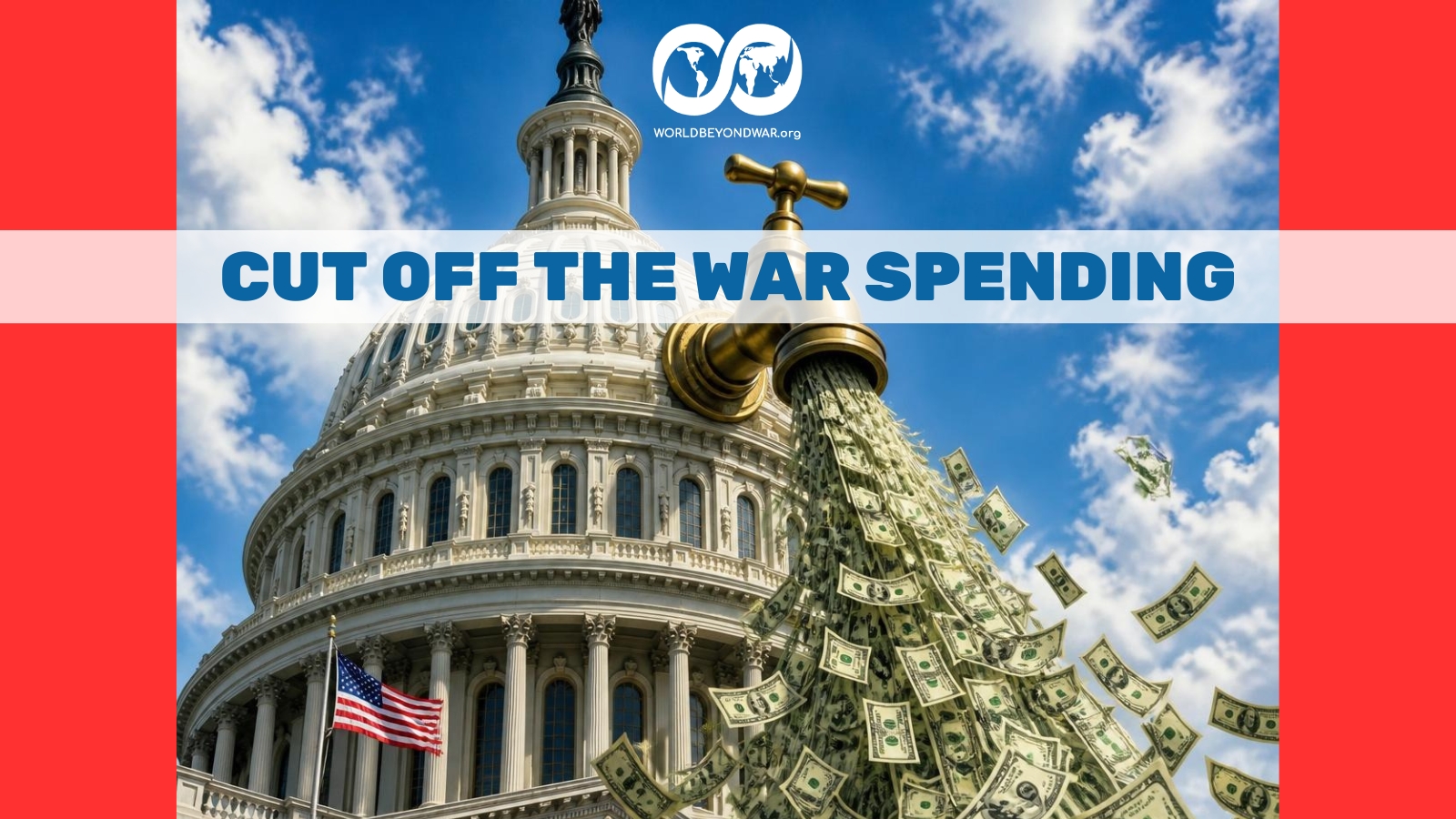
The legislation now moving through the U.S. Congress takes major steps to merge the U.S. and Israeli militaries into a single war and genocide machine, potentially eliminating any public notice of or possibility to block U.S. weapons shipments to Israel. The same legislation vastly increases U.S. military spending to a level far above the rest of the world’s military budgets combined. Part of U.S. military spending goes to aiding the militaries of other countries, part to pressuring other countries to increase their military spending, part to occupying other countries with U.S. bases, and part to producing propaganda for war and — in a deadly vicious cycle — to further increasing military spending the next year.
President Trump has threatened Iran with “levels of Military Terror, Strength, and Power not seen since World War II.” He has attacked numerous boats in the Caribbean and Pacific, the nation of Venezuela, and the nation of Iran, while supporting wars in Gaza, Lebanon, and Yemen, launching missiles into Nigeria, Somalia, and Syria, and threatening further violence in numerous other locations. This agenda is opposed by the people of the United States and the world in poll after poll. Candidates for the U.S. Congress are campaiging against it while failing to take the necessary steps to stop it.
The damage takes many forms.
Military spending does vast amounts of harm, first and foremost by taking funding away from areas where it could save and transform countless lives, but also as a leading cause of death, injury, homelessness, trauma, and environmental destruction, and as the leading cause of the violation of civil liberties, of government secrecy, and of the militarization of borders, policing, and culture. It concentrates wealth, fuels bigotry, impedes international cooperation, creates the risk of nuclear war, and increases the possibility of catastrophic climate collapse.
War spending is propped up by false beliefs that it is inevitable, justifiable, necessary, and/or beneficial — including the false belief that it creates jobs (see below) — but primarily by the false belief that we are powerless to stop it.
We need to focus.
We are not powerless to stop it. Fortunes are spent on making us think that, and on distracting us from our goal. Even should the entangling of the U.S. and Israeli militaries be stripped from the current legislation, the results of the massive spending increase would be catastrophic. Even if some significant number of U.S. Congress Members should support some other hopeless bill that would reduce military spending, the results of passing the actual military spending bill would be catastrophic. Even if the Congress should block spending or express it’s feckless wish to block spending for the war on Iran, and even if 18 positive reforms should be attached to the military spending bill, and even if the Pentagon should be required for the umpteenth time to pass an audit, and even if U.S. elections should become a day closer each day, the results of passing the military spending bill would be catastrophic.
Grasping that fact is our starting point. Now, we get to work.
Anywhere on Earth:
Sign the petition!
In the United States:
Email Congress!
And phone: (202) 224-3121
Now for some real-world events.
Ask World BEYOND War for help organizing a local event. Invite a speaker. Create or join an event on the International Day of Peace.
Build the movement by bringing a clipboard and sign-up sheets to an event. Flyers, fact-sheets, films, music, and presentations are here. Shirts and other gear are here.
If you’re far from the United States, send us a report/video/photo that we can pass along to the U.S. media and government!
In the United States, Congress members are back in their districts near you from July 24 – August 30, and Sept. 4-13, 2026, while Senators are back in their states August 8 – Sept. 13, 2026.
Ask for a meeting and meet!
Or protest the refusal to meet!
Or hold a vigil or a protest or a forum with an empty chair or a disruption of an event!
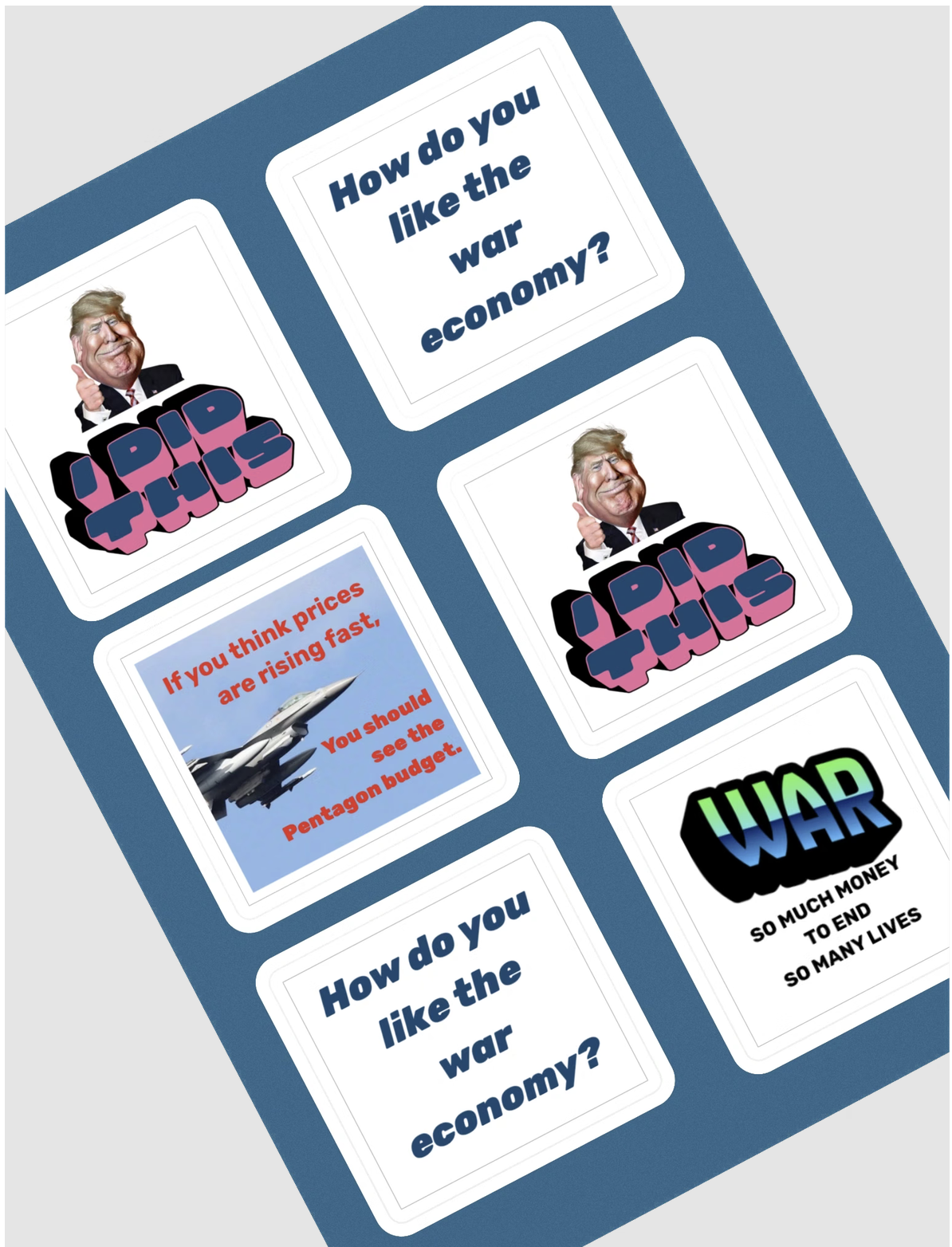
See something that costs too much? There's a sticker for that!
Go to a gas station or market with soaring prices. Print out and bring the 3 pages below. Or print the first page as a big poster and the next two double-sided on one sheet. Hand them out and talk to people. Invite media. Or print the first two pages double-sided on a single sheet and the third one as a sticker.
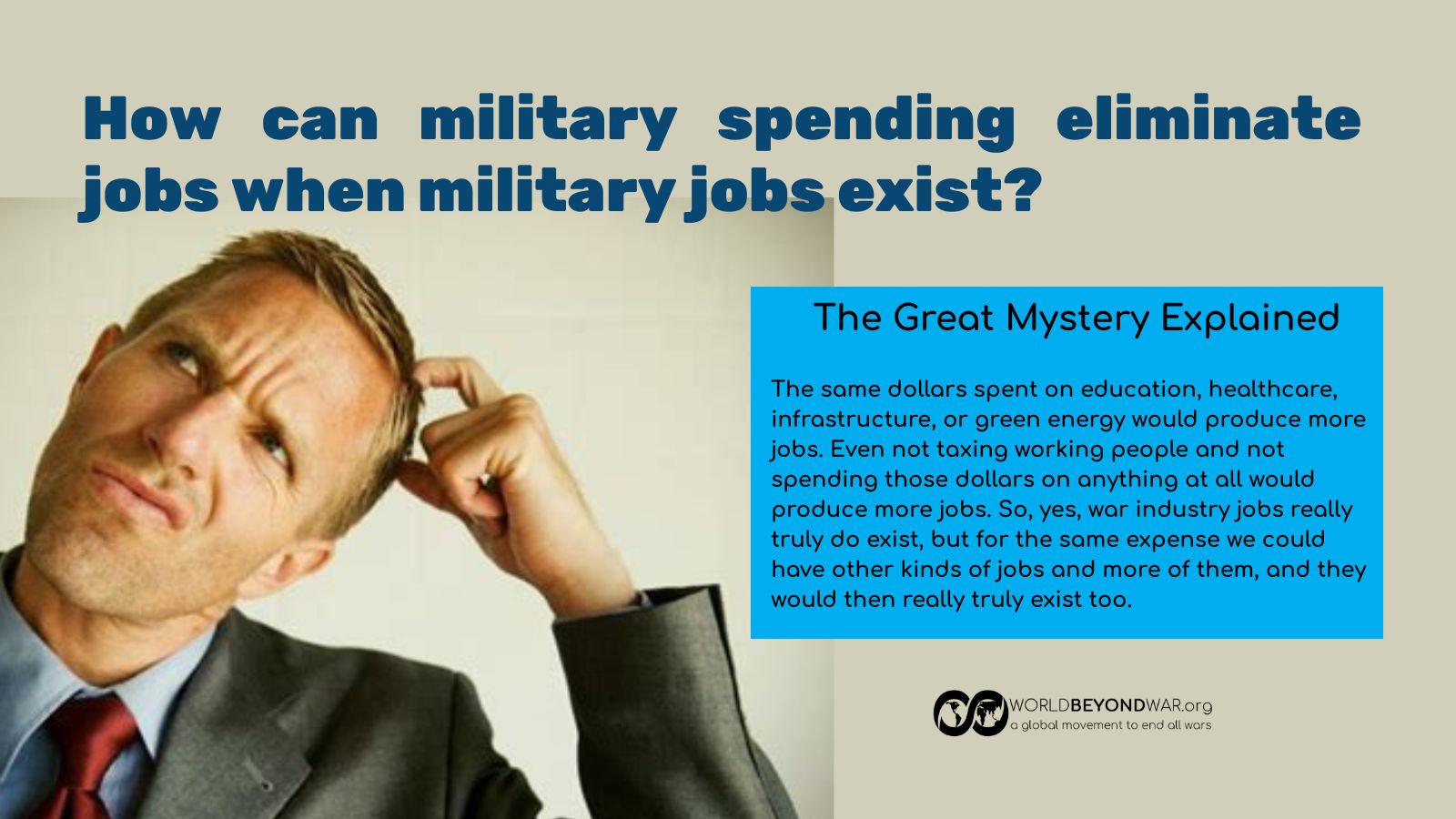
Military Spending Kills Jobs As Well As People
One of the big hurdles in persuading people in some parts of the world to oppose military spending is the “well at least it creates jobs” myth — hardly a decent excuse for a program of mass murder and destruction, but also false on its own terms. See:
Be Social With Your Media
The U.S. Congress is preparing to pour staggering sums into militarism, and its consequences won’t stop at the U.S. border. World BEYOND War is launching a GLOBAL campaign to stop the spending bill. Anywhere on Earth: sign the petition! https://t.co/lfJx39SJtJ pic.twitter.com/1XrV3LXtCk
— World BEYOND War (@WorldBeyondWar) August 14, 2026
What if we invested in Americans the way we invest in war? Ben Cohen, co-founder of Ben & Jerry’s, and Sully break down something every American deserves to understand: where our tax dollars go and what else they could accomplish. Using Oreo cookies, we show what a $1.5 trillion Pentagon budget looks like and what investing just a fraction of that money could mean for affordable housing, tuition-free public college, ending homelessness, childcare, healthcare, and better teacher salaries. This isn’t about weakening our military. It’s about questioning our priorities. We can have a strong national defense AND invest in the American people. The question isn’t whether we have the money. It’s what we choose to do with it.
— Ben Cohen (@YoBenCohen) October 15, 2026
The U.S. Congress is preparing to pour staggering sums into militarism, and its consequences won’t stop at the U.S. border. World BEYOND War is launching a GLOBAL campaign to stop the spending bill. Anywhere on Earth: sign the petition! worldbeyondwar.org/stop-us-war-…
— World BEYOND War (@world-beyond-war.bsky.social) August 14, 2026 at 11:38 AM
[image or embed]