

By Joseph Essertier, World BEYOND War, August 11, 2025
Freedom of Expression Under Attack in Japan
After going to Hiroshima on the 6th of August this year to remember and learn more about the crime that my government committed there 80 years ago, I feel that socially backward-looking forces here in Japan are weakening the right to freedom of speech, and that this will negatively impact the peace movement in profound ways in the future. Article 21 of Japan’s constitution reads, “Freedom of assembly and association as well as speech, press and all other forms of expression are guaranteed. No censorship shall be maintained, nor shall the secrecy of any means of communication be violated.”
But this year, the Mayor of the City of Peace, MATSUI Kazumi, called on police to violate this article of Japan’s constitution by preventing people from entering the Hiroshima Peace Memorial Park between 5:00 and 9:00 AM. on the very day when people were remembering and discussing what the U.S. did that day in 1945. Sometimes you might have a chance to speak, when it is convenient for government officials, but freedom of speech here is no longer guaranteed. You have it one day in one space, and lose it the next day in another space. I saw a huge sign on the riverbank near the Atom Bomb Dome that said, “Please be quiet” during the ceremony.
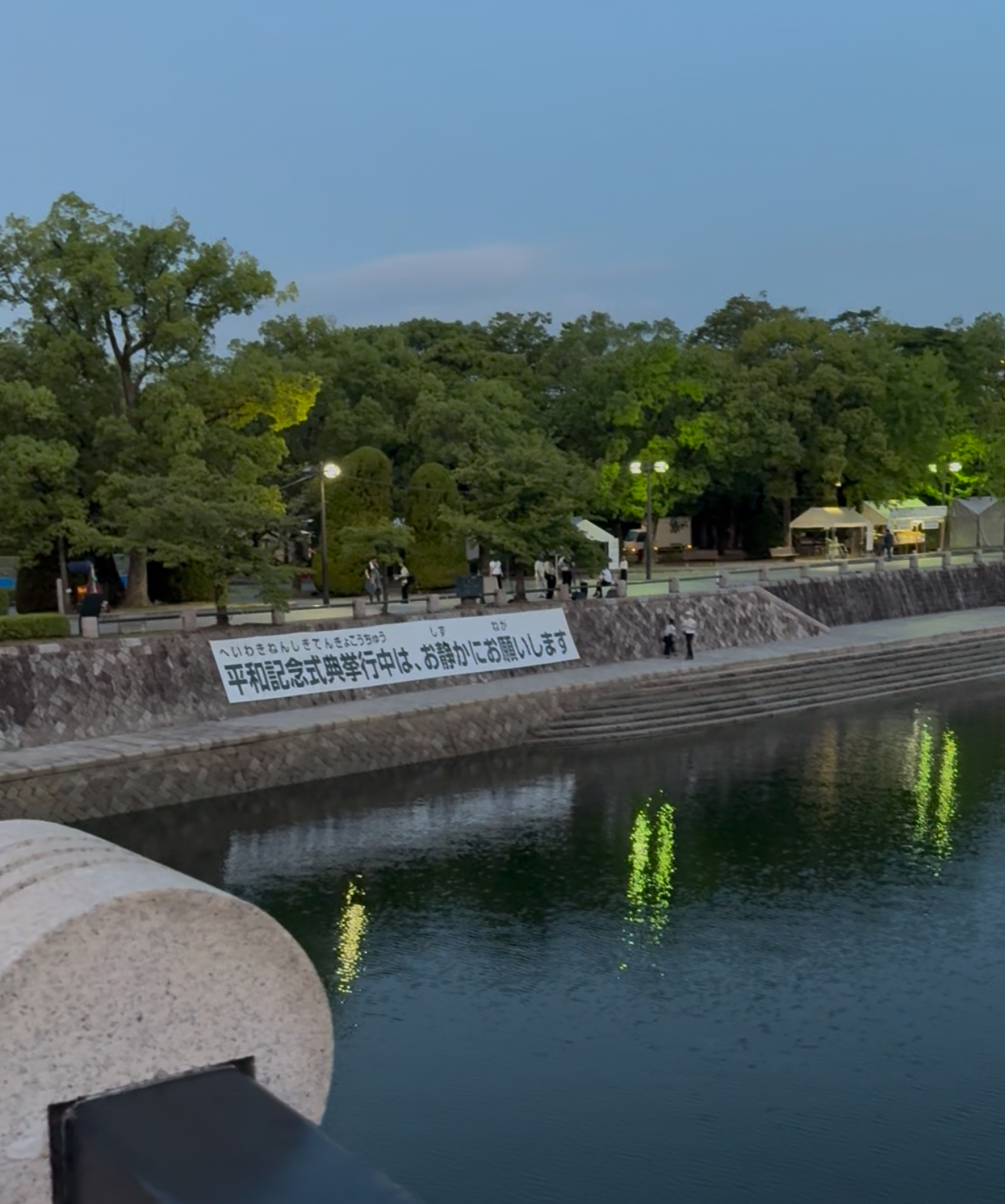
This “quiet” is just another way of keeping down the “riff-raff” or “undesirables,” who, if they are not silenced, might tell the world that not all is harmonious in this militaristic nation that is subservient to the U.S. empire. If allowed to speak freely, they might get in the way of the smooth functioning of the Japan-U.S.-alliance killing machine. Japan has a culture of silence, and that silence can, in fact, be deadly.
80 years ago at 8:15 AM on August 6th, U.S. Air Force personnel, flying a Boeing B-29 Superfortress bomber, dropped an atomic bomb on the city. Almost all the buildings in the epicenter of the explosion were destroyed. One exception was the “Hiroshima Prefectural Industrial Promotion Hall,” now known as the Atom Bomb Dome or Gembaku Dome in Japanese.
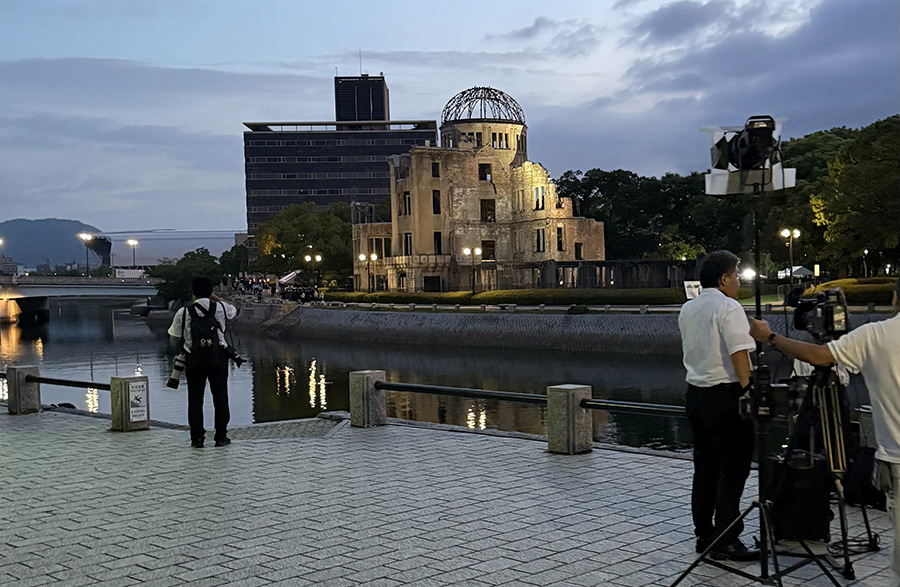
“Out of a population of 343,000 inhabitants, some 70,000 people were killed immediately, and by the end of the year the death toll had surpassed 100,000. Two-thirds of the city area was destroyed.” This is why every year at that time on that day, the City of Hiroshima has commenced a ceremony to pray for the dead, learn from the mistakes of the War, and call for peace.
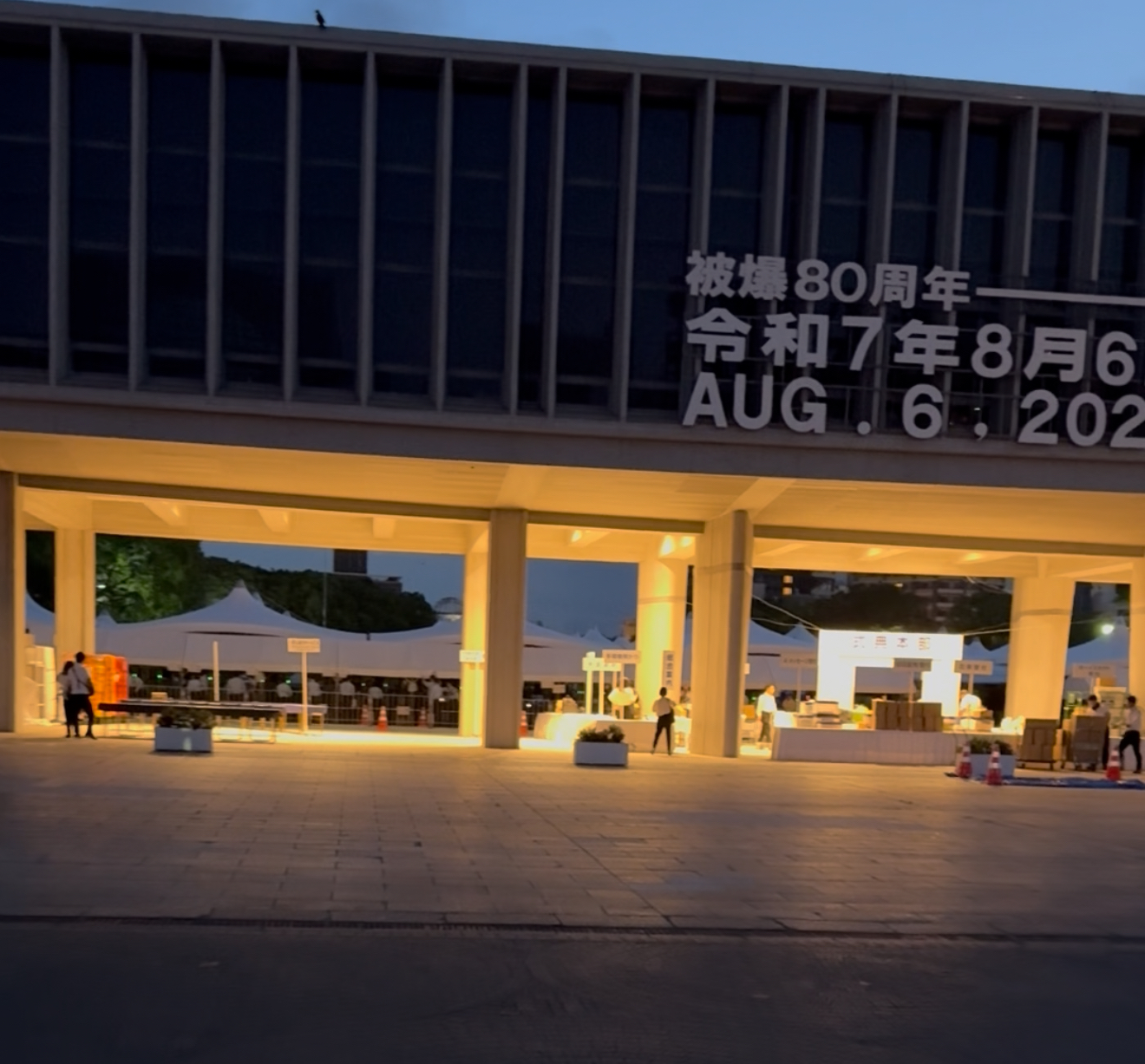
The ceremony is conducted in front of the Cenotaph (Ireihi):
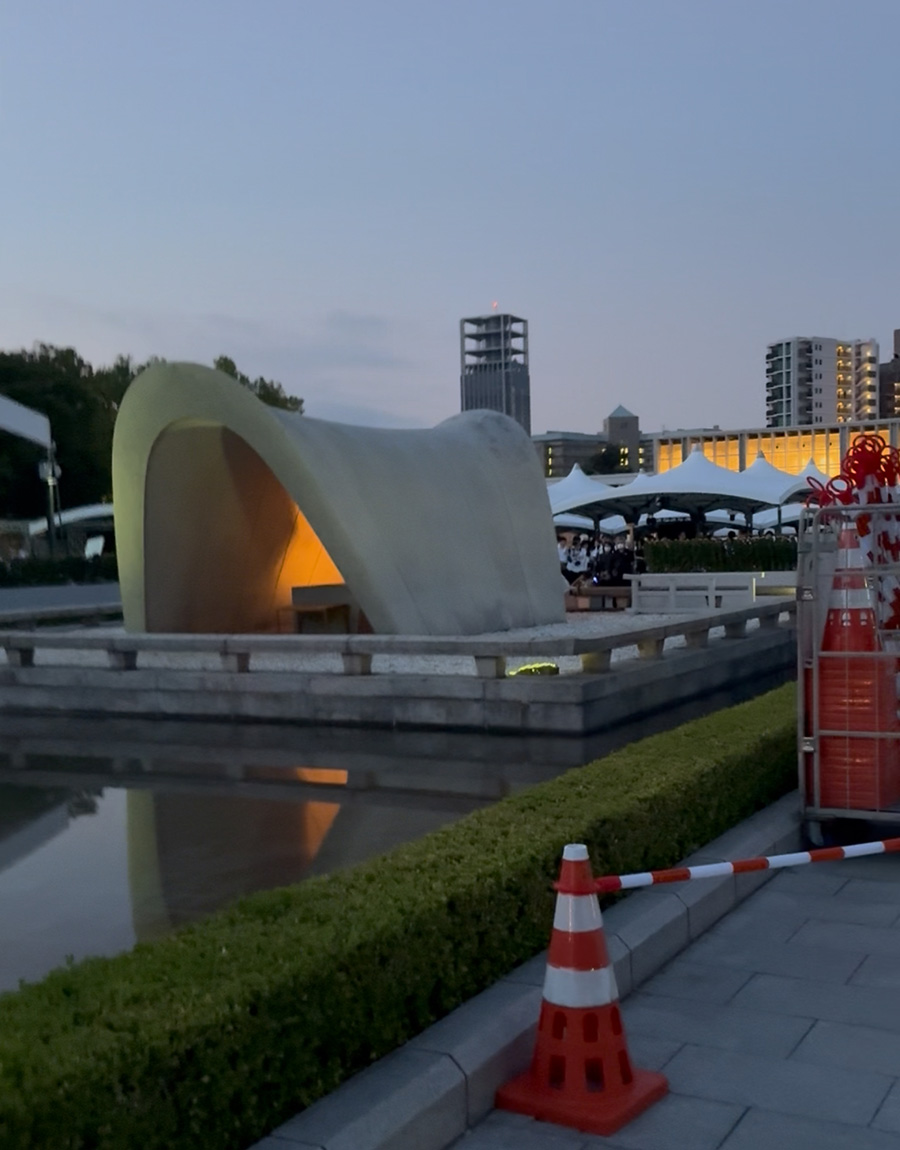
I walked through the above ceremony area before 5 AM, when the Park restrictions were supposed to begin. The Cenotaph is about 500 meters from the Atom Bomb Dome, where peace activists gathered freely each year on the 6th of August, for decades, to make their voices heard. It is a long walk from the Dome to the Cenotaph. (To get a feel for the distance, see the aerial view in this video). And even from where I was standing during the ceremony (on the road that comes from the bridge), which is roughly halfway between the Atomic Bomb Dome and the Cenotaph, I could barely hear the loudspeakers of angry protesters at the Dome, so the concern about noise seems groundless. (This is what it sounded like at the Dome:
Talking to locals, what I learned was that 6 August 2023 was, what I would call, the most recent “free” August 6th, when peace activists could still use the Park and participate in Atom Bomb remembrances. Up until that year, there had been no restrictions. The area around the Atomic Bomb Dome had been a place where various activist groups were able to express anti-war and anti-nuclear views, and to communicate messages in favor of peace. This naturally included criticism of the policies of the national government of Japan as well as of the City government. Some locals told me that the City of Hiroshima has conspired with ultra-nationalist politicians to shut down peace activism by portraying groups that resist their policies as “radical.”
Similar tactics of restricting the right of peace activists to speak and display banners, etc. were also employed earlier, during the G7 Summit in May of 2023, which I witnessed. I summarized the violation of the right to freedom of expression during our “Bicycle Peace Caravan” organized with World BEYOND War. A dozen or so of us participated in that effort to speak out about the way that the G7 exploited the City of Peace for advancing war, in particular their cooperation with NATO to provoke a war with Russia, a nuclear power.
The City of Hiroshima’s unilateral change restricting communication inside the Park is why there were protests. In response to their unfair policies, hundreds of protesters gathered in the Park at 9:00 at night on the 5th and made a commitment to defending that public space “to the bitter end.” What follows here is one person’s experience, one person’s understanding of what happened.
What Happened
A little after 4 AM, security personnel, riot police, and City of Hiroshima civil servants demanded that the protesters of this rally withdraw (taikyo) from the Park. At 5:30 AM, not at 5:00 sharp as expected, the riot police started pulling people out of the Park one by one. I myself entered the Park just before 5:00 and was able to walk about freely for awhile. Later, I witnessed some of the resulting commotion.
Around 5 AM, I noticed them setting up barriers to mark off their non-freedom-of-expression zone.
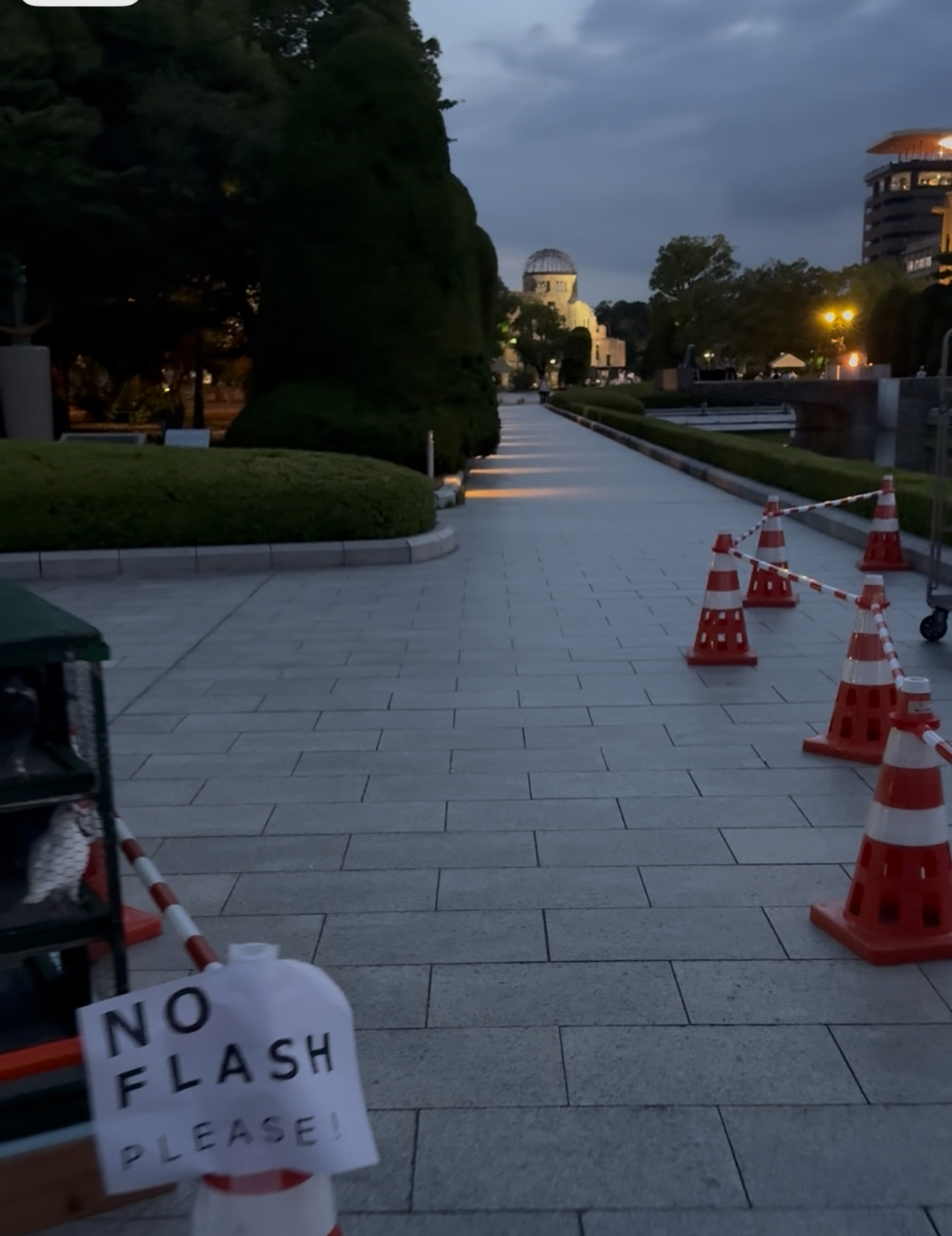
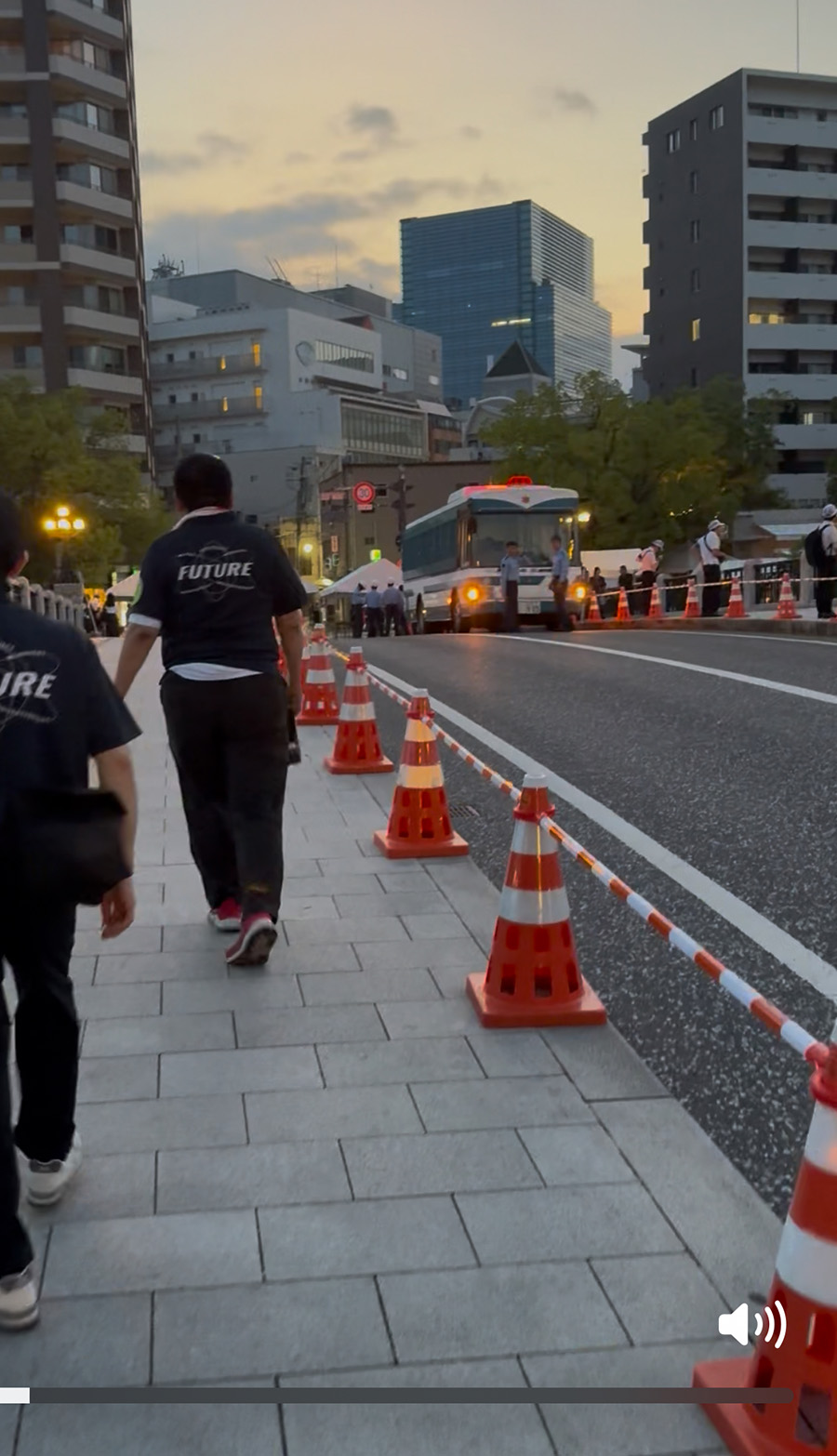
10 minutes later, I was asked to leave the Park by some official-looking person. Unlike the more committed, braver activists, I complied with this request and walked out. Then I walked to the main entrance to the Park, which is on the street corner very close to the Atom Bomb Dome (Gembaku Dome).
I did not walk around the entire perimeter of the Park, only from the bridge to the Dome, but I saw dozens of security personnel spaced about 10 meters away from each other along the perimeter, even where there were no protesters.
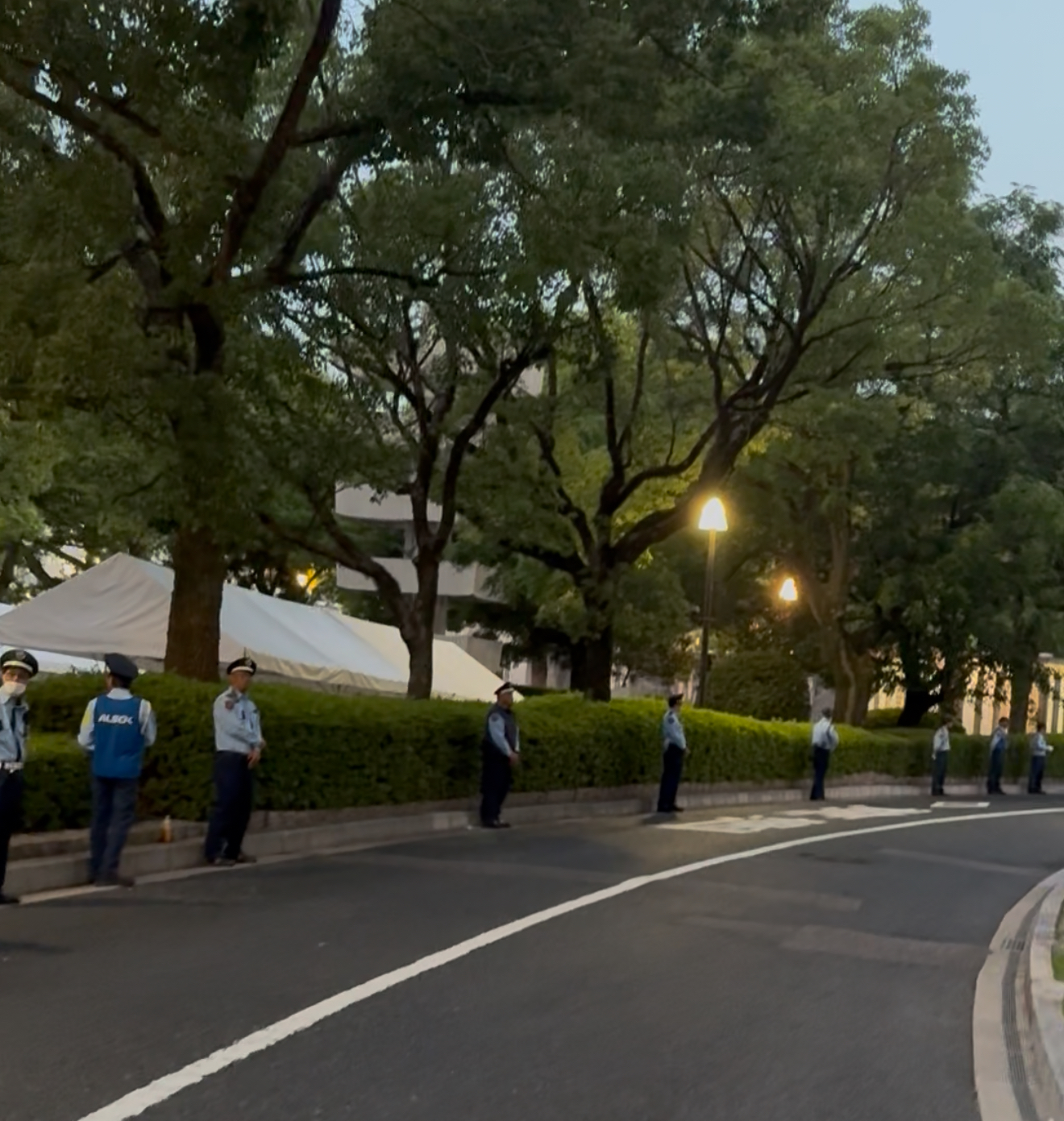
Around 5:20, when I reached the main entrance, I saw security personnel lined up along the sidewalk and well over 100 protesters, many or most of them “young” I would say, on the other side of retaining wall, inside the Park, chanting.
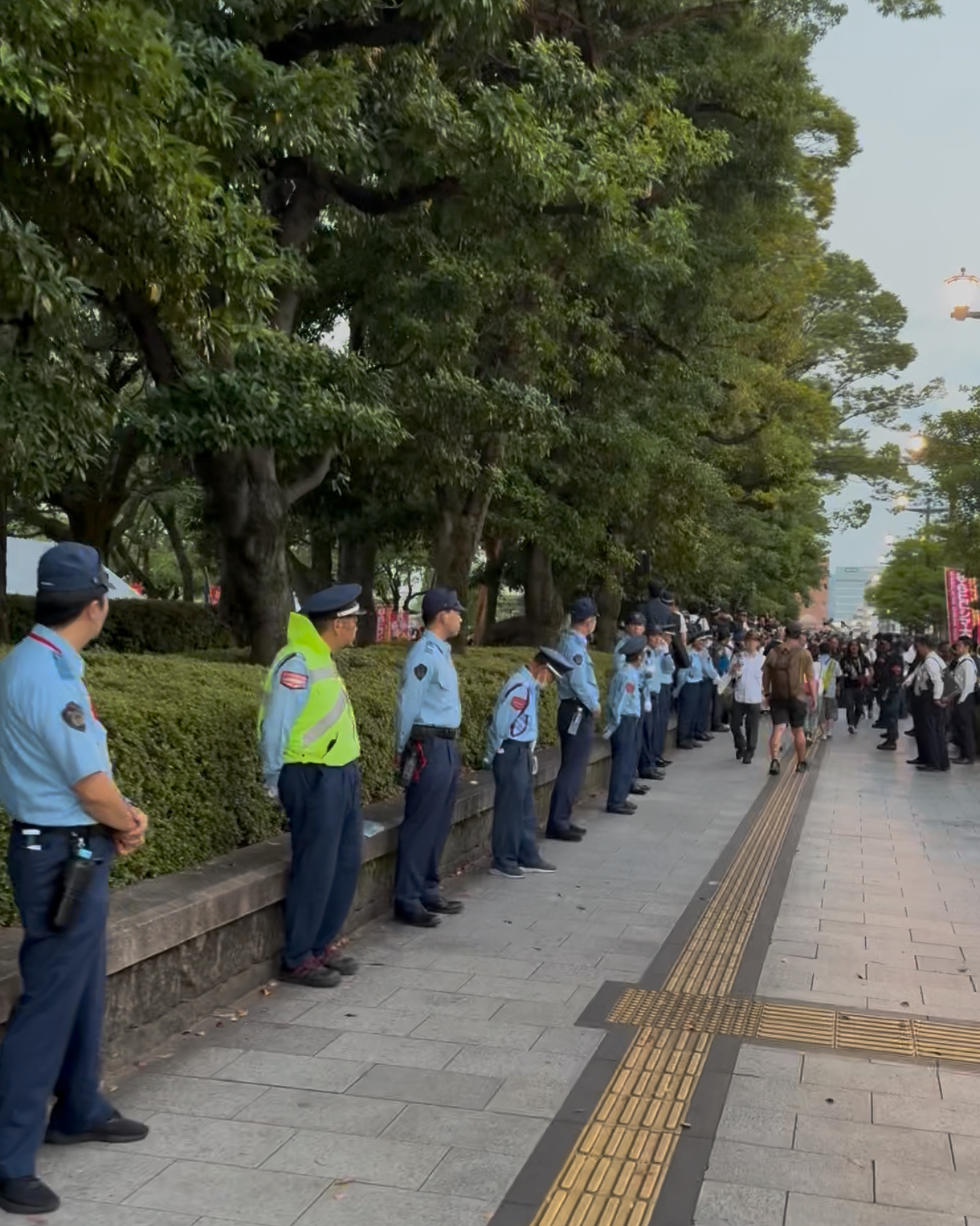
I could not see how many people there were, in fact, because there were so many riot police and other types of security personnel blocking the view from the sidewalk.
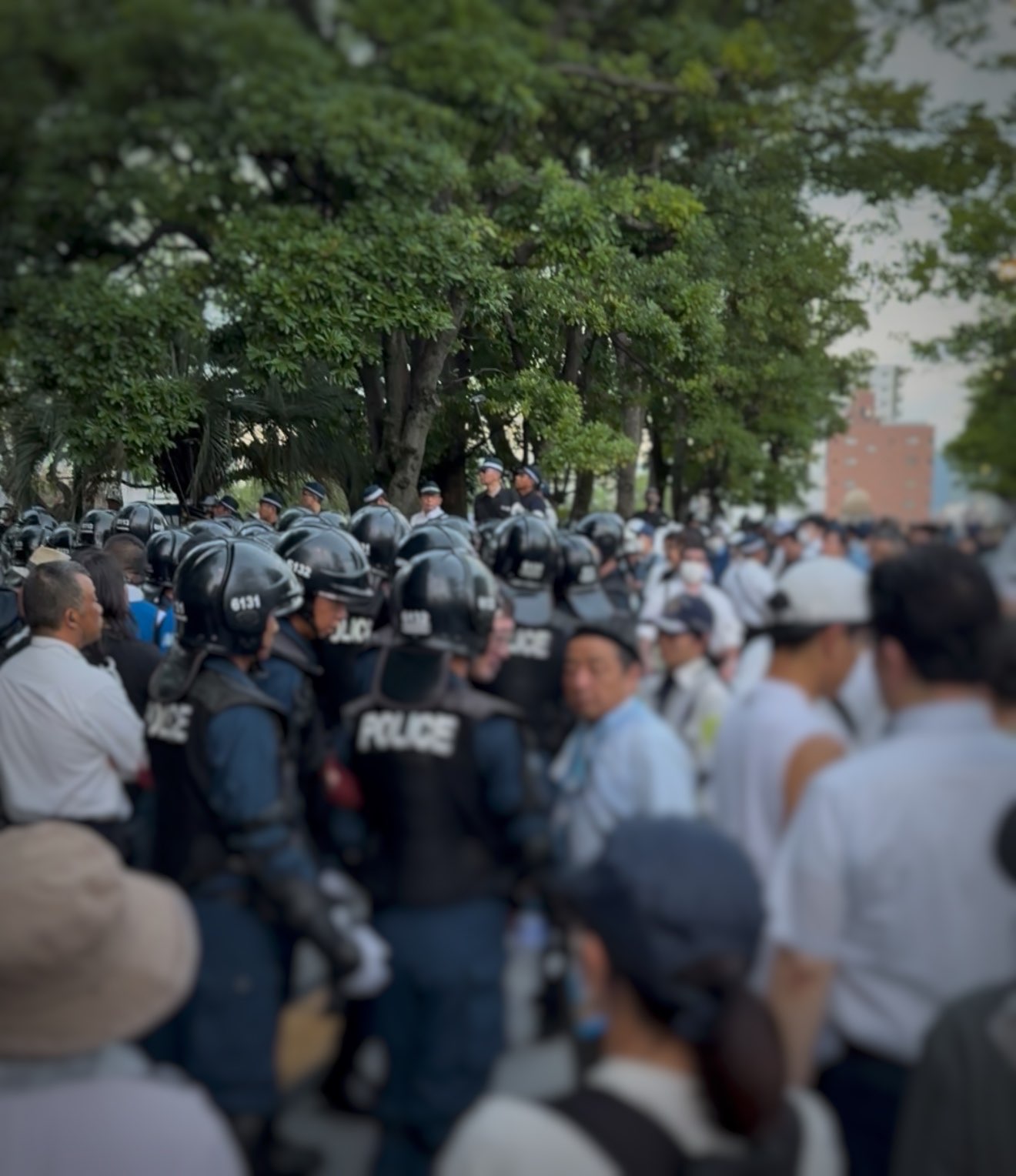
At that early hour, there were already a few people collecting signatures. One such man I talked to was gathering signatures for a peace campaign, and I assume that the others were doing similarly good work for democracy, freedom, peace, etc. along the sidewalk.
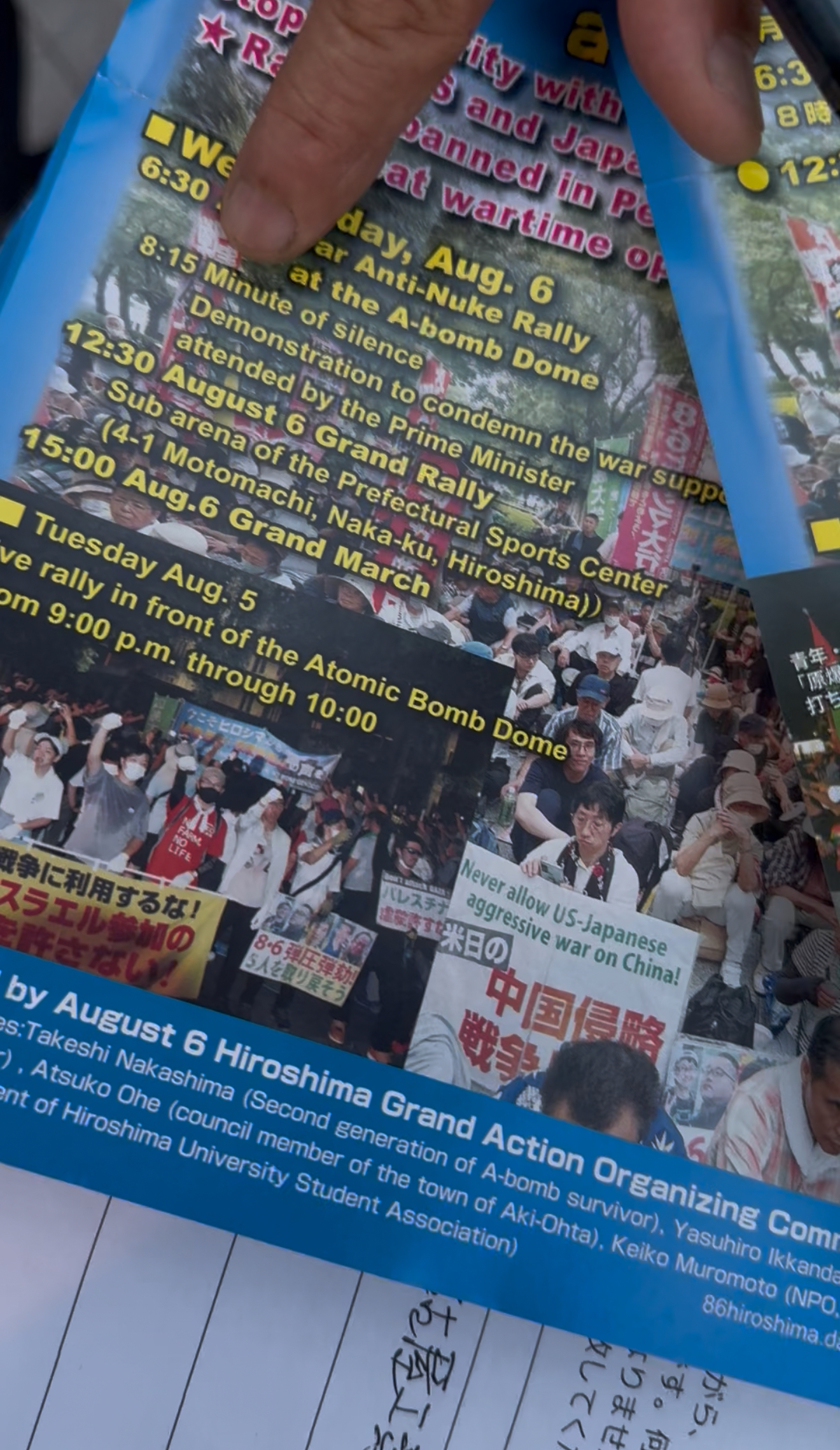
Around 5:30, one very angry man near me yelled to the security personnel, “Go ahead and arrest me!” And, “Today is August 6th!” The 6th in Japan is rich with historical significance, of course. His anger and that one sentence made me think; surely it made others think, too.
It was hard to see into the Park from where I was on the sidewalk, but I could make out the red flag of Nikkyoso, the Japan Teacher’s Union, which was once considered a core institution of Japan’s postwar liberal democracy, before they were attacked and dismantled. “Never again!” their members used to say loudly. Never again would they send their beloved students to a battlefield. I used to hear those words often.
A large pink flag on the sidewalk next to me read, “No Nukes, No War Hiroshima Great Action” in English, and in Japanese, “Eliminate nukes! Let’s bury war and the changes to the Constitution through the unity of the world’s workers and the people.”
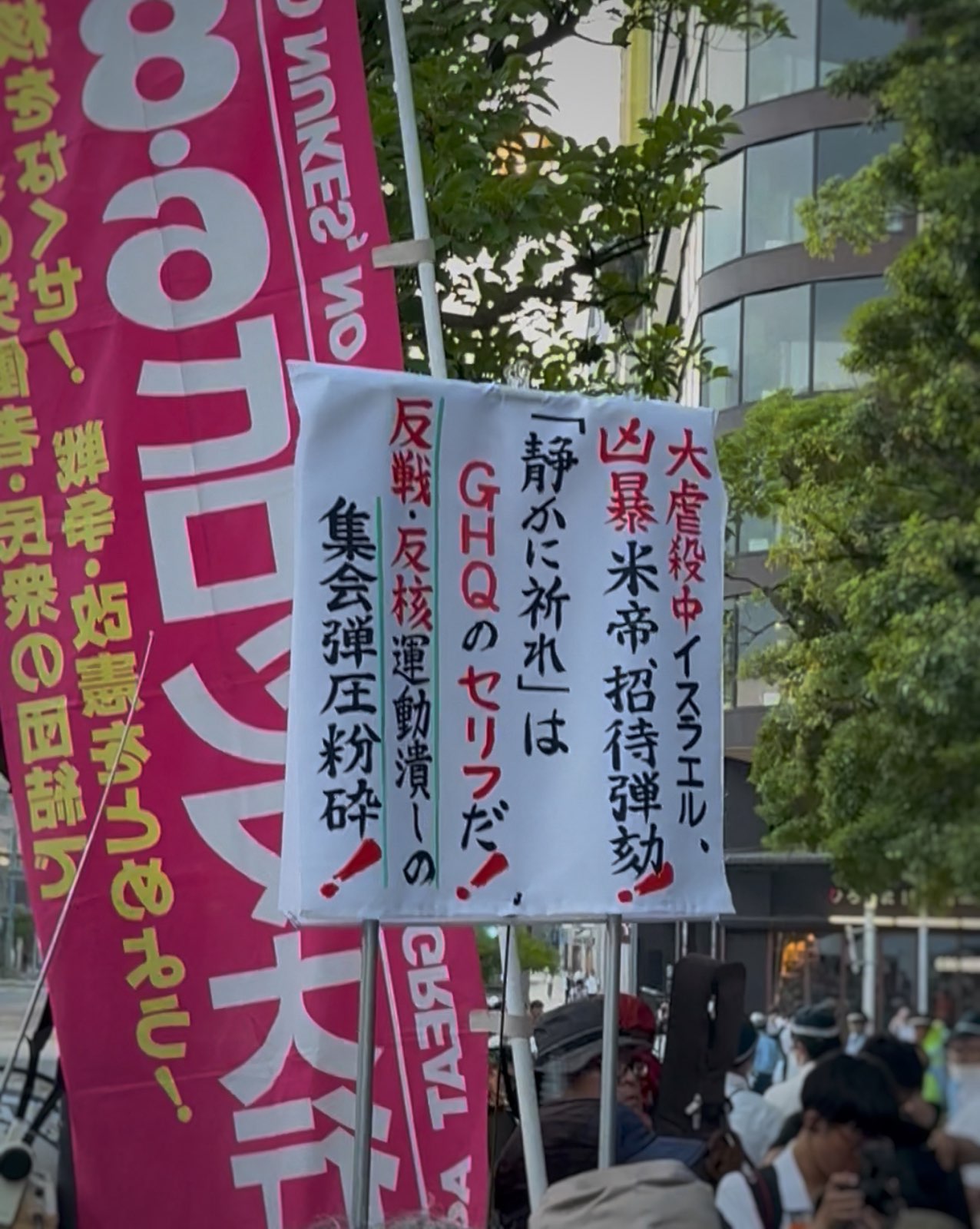
Another nearby flag, white with black and red writing said, “Denounce the invitation to Israel, now committing mass murder, and the invitation to the barbaric U.S. empire! ‘Pray quietly’ is a line from [Gen. Douglas MacArthur’s] General Headquarters! Disassemble the crackdown on assemblies by [those who] crush movements against war and nuclear weapons!”
Those of us standing on the sidewalk witnessing and documenting this state oppression have enjoyed decades of freedom in Japan. Both young and old, men and women, were on the other side of the retaining wall and shrubs, closer to the Dome, protesting very loudly. I saw zero violence, unless one includes the obstructions caused by the security personnel and riot police in one’s definition of violence. The approach of the government of Japan and the City of Hiroshima seemed way too heavy-handed, unless their goal was to portray peaceful protesters as terrorists, as the U.K. is doing to Palestine Action.
Excluding Responsible Citizens from the Park
As far as I could see, the protesters were completely non-violent. That is why there were so many passersby watching the commotion close up without any look of fear on their faces. They seemed to trust the protesters, as did I.
There is no legal basis for the action taken by the Mayor. The restraints placed on freedom of expression in the Park by civil society are “without legal basis,” as explained by the Hiroshima Bar Association (Hiroshima Bengoshi Kai) in January (in Japanese). The City of Hiroshima, under the authority of the Mayor, excluded certain persons from participating in the events in the park that day under the pretext of stopping “interference with the duties of authorities” (iryoku gyoumu bougai).
I heard that two people have been unjustly arrested, accused of “assault.” I am not a lawyer, but I will not be surprised if this notion is challenged in the courts, i.e., the notion that carrying a sign advocating peace interferes with the duties that police are called to carry out. The mobilization of all these riot police looked like a huge waste of taxpayer’s money to me.
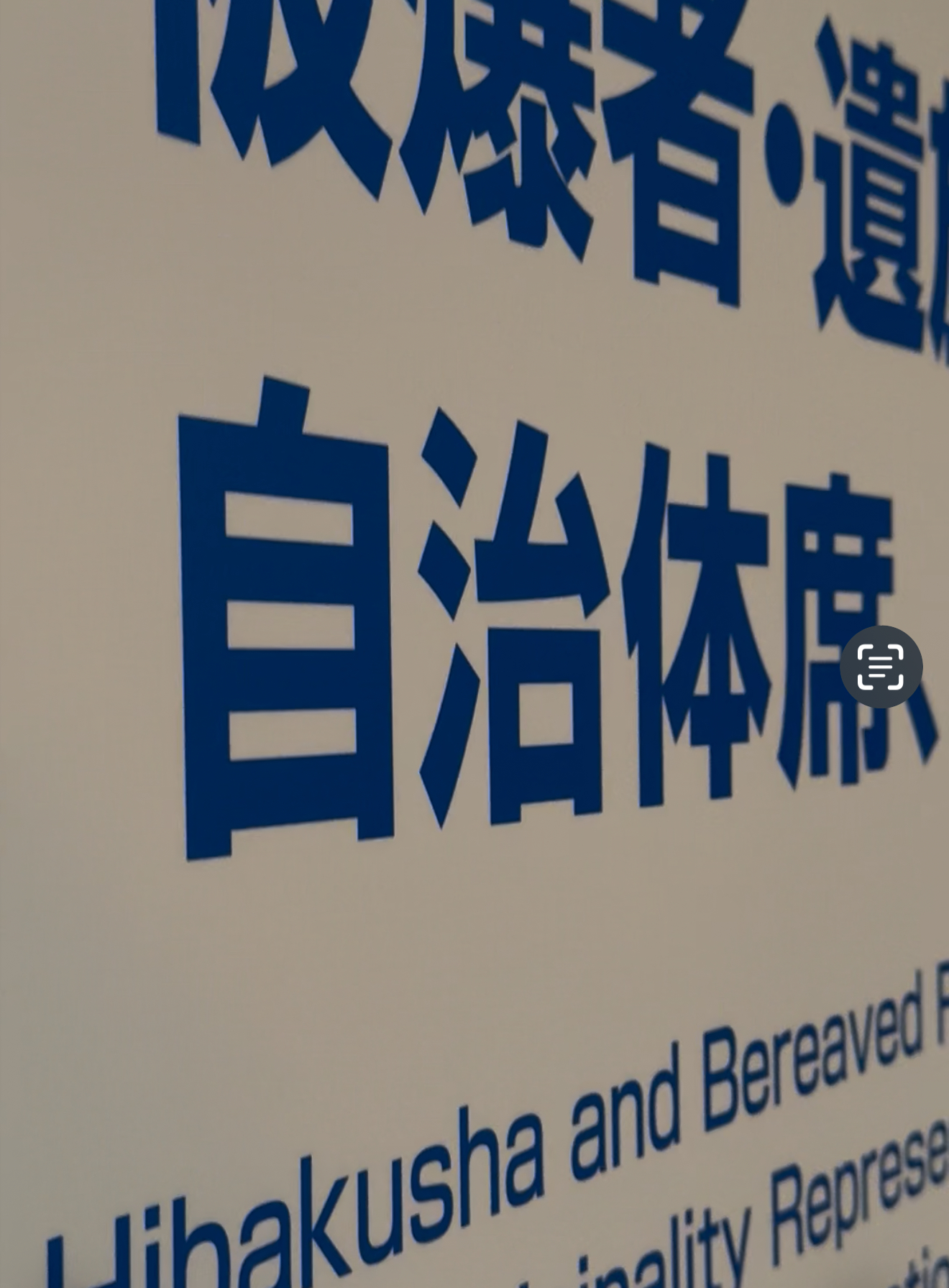
At 6:00 I saw more riot police coming to the Park from across the street. And soon after that, I moved to what I think of as the main entrance to the Park. It was labeled “Alternative Entrance 1” that day. I saw a sign posted on the sidewalk close to that entrance with the unconstitutional “rules” spelled out by the City of Hiroshima. I then tried to enter the Park peacefully with my banners and placards in my bag. I put my bag on a table and showed them what was in it. After looking at what was inside my bag, two men and a woman told me that I could not do that. They recommended that I put my bag in a locker in an underground shopping area across the street.
I said to them, “Now I understand that there is no freedom of speech here. I will not say anything if there is no freedom of speech. I will not say anything.” Pointing to my blue World BEYOND War scarf, I said, “This is a peace symbol,” by which I meant to say that if you are going to stop a sign that says “Sign the TPNW” from entering the Park, as if it will disturb the peace, then you must also prevent me from wearing my blue scarf. A man said, “Please wait a minute” and walked away. Soon he came back and said, “If you throw these things away, you can enter the Park,” and told me that I would not get my things back if I did that. I would literally have to throw my bag, with the 10 placards I had worked hard to make, in their garbage can. With the options presented to me this way, I decided to put my stuff in a coin locker and enter the park with no political statements on my person except my blue scarf. But I had another plan up my sleeve.
Militant Peace Activists
When I came back around 6:45, before I went into the Park banner-and-placard-less, a small group of anarchists wearing helmets came and tried to go into the Park through the main entrance (“Alternative Entrance 1”). They had helmets on, but it would be hard to argue that they themselves were violent. When they tried to enter the Park through that entrance, the riot police stopped them. They were trying to walk, and they were being prevented from walking. Thus one can say that they non-violently resisted this bogus rule set up by the City. This rule, one could say, was merely a request. But by enforcing the rule, the police were effectively obstructing the free exercise of the anarchists’ right to free speech. The police prevented their movement.
The anarchists seemed sophisticated. They came equipped and prepared. They held up some visually striking flags and after reaching the area in front of Alternative Entrance 1, they lined up as in a rugby scrum with their arms interlocked. On the U.S. side of their combination Israel-U.S. flag, someone had written the words “United Shit” on the U.S. flag and “Shitrael” on Israel’s flag.
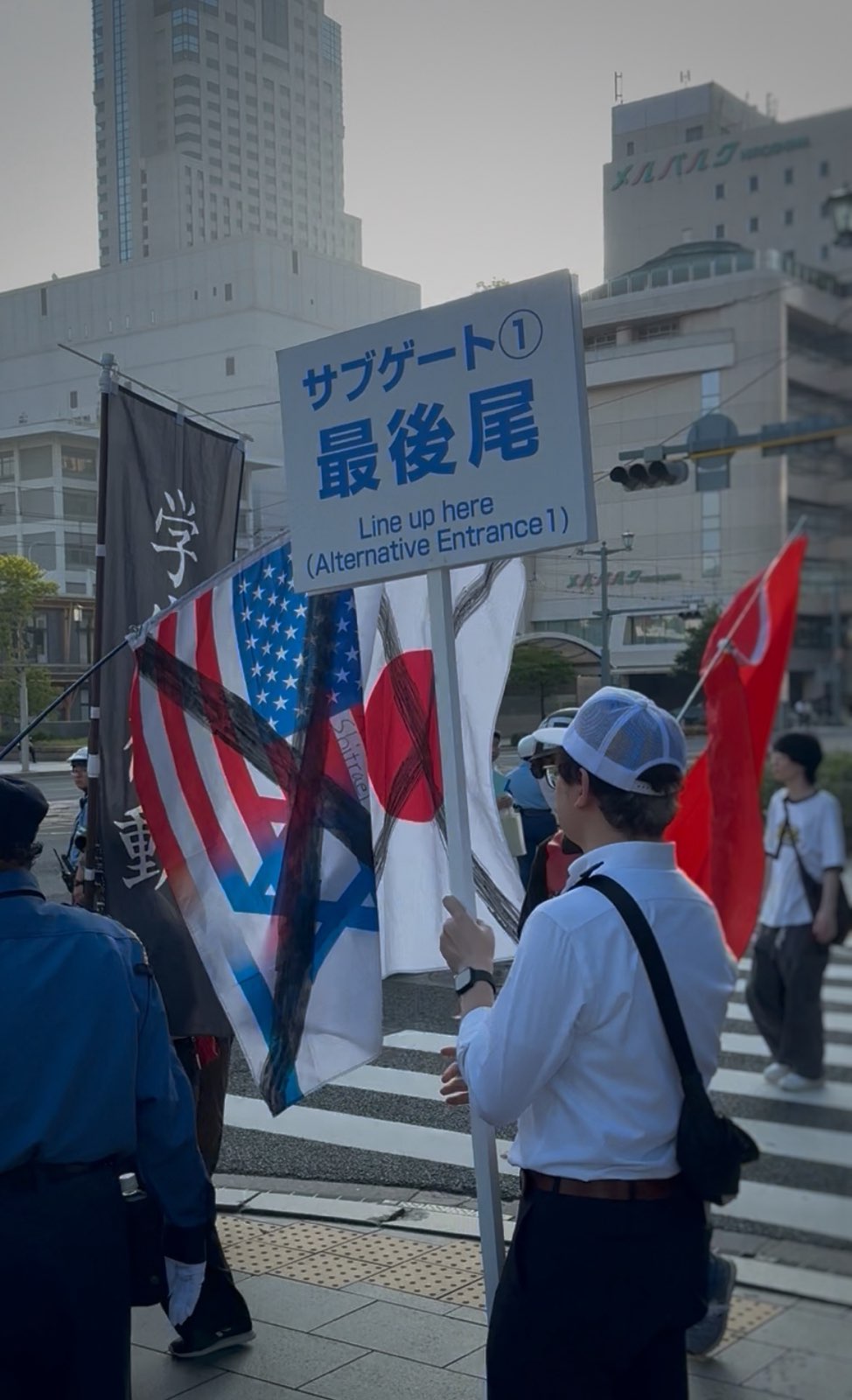
Their brown flag with yellow writing said, “Libertarian tax reduction.”
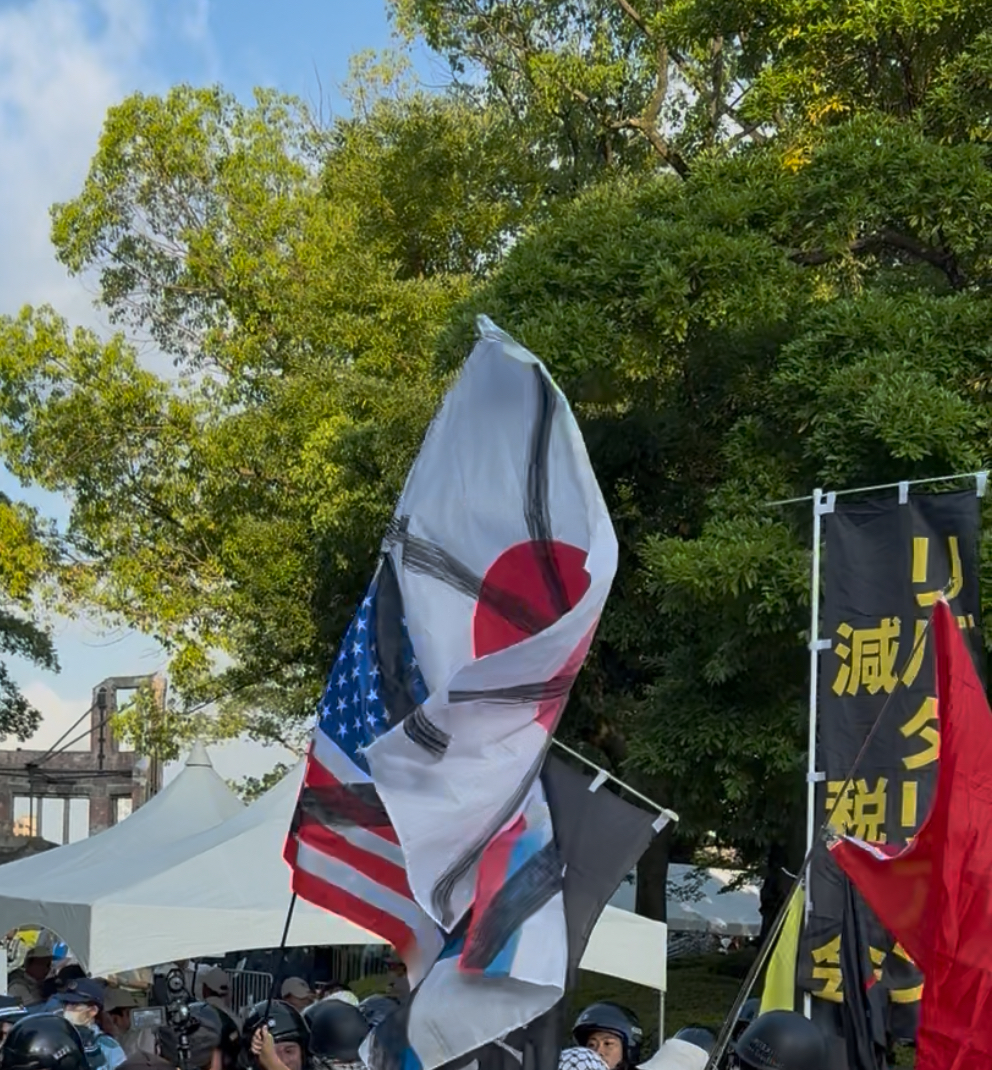
(Taxes are a hot issue right now when the cost of food is high and people lack surplus money). White writing on a black flag said, “Student movement.”
Around 7 AM in the Park, I saw two people sitting on the ground in the shade under a tree with several policemen surrounding them. One policeman looked flustered and frustrated as he argued with the two. They were arguing about the legality of the City of Hiroshima excluding people from this public park, I later confirmed. They were simply attempting to walk in the park. The police/security personnel made that impossible by swarming them and blocking their advance.
The one with the bag did consent to the police searching it, but they did not acquiesce with the request to leave the Park. On paper at least, they were being requested to leave. There was no legal requirement to leave. They were in the Park before 5 AM, before the request to leave, so they stood their ground and stayed in the Park. As far as I could see, the two were totally successful in their non-violent act of resistance. They demonstrated the illegitimacy and illegality of the City’s special regulations for the 6th of August.
In the 30 to 45 minutes of observing this interaction between police and the two citizens, I did not see any violence on either side. The two people did not seem to be wearing any clothing with political messages such as antiwar T-shirts, so there would have been no reason to suspect them of even violating the rules. What I witnessed were two people sitting in the Park at first and later standing up as their argument with the police progressed. No violence on either side, but this must have been an unpleasant experience as their movement was severely constrained. They had one or two meters in which they could move. I assume this continued for hours.
The City set up their special rules just for the four hours from 5:00 to 9:00 that one day, when the Park was filled with peaceful tourists and friends and family of hibakusha coming to mourn their loss, people paying their respects, some praying to their ancestors, others participating in a ceremony that has always been peaceful.
And for what? It seemed like a colossal waste of time and precious resources.
When the ceremony finally started, after 8 AM, I held up a blank piece of paper with two others, to mark this violation of freedom of speech. We did not seek out the media. In fact, I was surprised when I saw several professional-looking journalists set up their cameras in front of us. We stood facing the distant ceremony with our paper held up with both hands, and during the moment of silence, like everyone else, we bowed our heads and were quiet. I am not a religious person, but in my heart I prayed, just in case a god, or someone in the universe was listening to the words flowing in my mind, “Please, never again let these horrible weapons of mass destruction be used on a city.”
We were silent during most of the ceremony, I think, except when a few people came up and asked us what we were doing. Some of the Japanese mass media, at least a few newspapers, showed us in their photos, including the Yomiuri, the Mainichi, and the Chugoku, the local Hiroshima newspaper. Unlike the two people mentioned above, we were not surrounded or harassed.
Everyone with any experience observing peace activists and peace advocates in general in Japan knows that less than 1% of us ever become violent, that we are not trouble-makers. We might sometimes cause headaches for government officials and heads of corporations, but we are essentially problem solvers, not problem creators. In 2019 things were just fine.
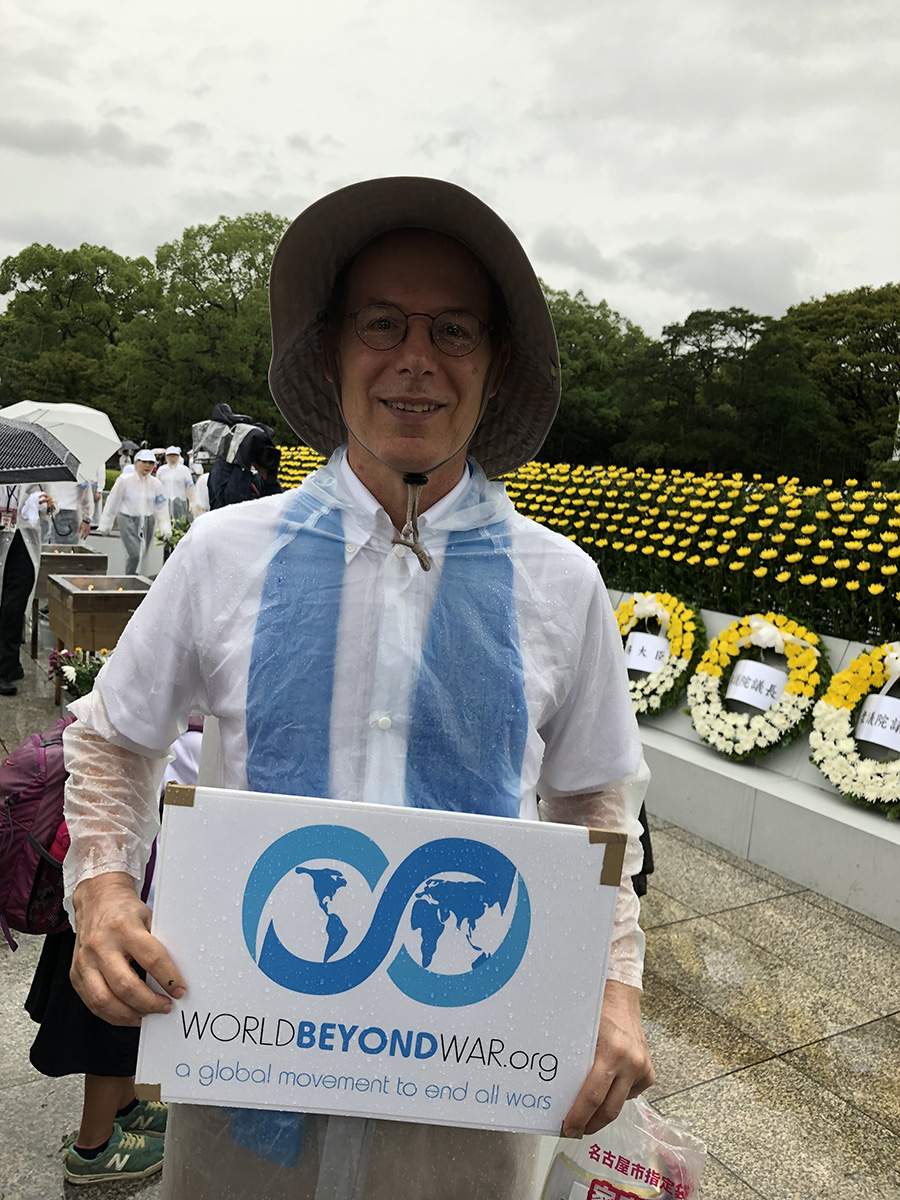
This photo shows me after the ceremony that year, when people were spontaneously walking up to the area on the stage where the yellow flowers and incense were to pay their respects, perhaps to enjoy a moment of silence, or to pause and take time out of their life to reflect on the War—this huge, stupid, collective mistake that thousands of U.S. soldiers and millions of people in East Asia participated in. “What was it all for?” Surely many were thinking.
The Peace Park in Hiroshima is a beautiful space today, a place of healing. President Harry S. Truman committed one of the most unforgivable acts of violence that day by using what Secretary of War Henry L. Stimson called “the most terrible weapon ever known in human history.” And Japanese people turned this space around the Dome of the church, one of the few buildings left standing, into a lovely park, where people can imagine a better future, where we can think, “Another world is possible.” So why shouldn’t everyone be allowed to enjoy the Park, even to share, teach, communicate, and connect with others, including about the question of, “How do we get to another, better world?”
I had originally hoped to spread the word in Hiroshima, both on the streets and at the 2025 World Conference against Atomic and Hydrogen Bombs, about the “International People’s Tribunal to hold the U.S. accountable for dropping A-bombs,” but with all the commotion and the lack of freedom of expression, I was unable to reach people at and around the Park. I was only able to talk to some people inside the Conference. I also wanted to show my placards with the famous photo of a child in Nagasaki in 1945 taking his dead baby sibling to be cremated, with the words on it, “Sign the TPNW.”

Surely there were hundreds of other activists, like me, advancing various other good causes who were unable to reach Japanese and many good-hearted people from around the world, people who went to Hiroshima to see and learn and think. Due to City’s obstruction of anti-war expression, many of us were unable to communicate with others, enjoy the Park, and receive healing. As someone said, the people will only evolve when they control their means of communication. On the 6th of August in Hiroshima this year, we the people clearly did not control the means of communication. That was a failure. But the fact that hundreds, maybe even one thousand, people resisted and made this oppression difficult for the central government in Tokyo obeying their masters in Washington, the fact that we were able to resist, to make the political statement that freedom of speech is under threat here—that does feel like a victory, however tiny.
I will write more later about the “International People’s Tribunal to hold the U.S. accountable for dropping A-bombs,” but in a word, it will be a “way to tell the truth about nukes,” as Elliott Adams of Veterans For Peace has said. Its purpose will be to hold the U.S. legally responsible and to restore the human rights of Korean atomic bomb victims, who were also victims of the colonialism of the Empire of Japan and thus mostly ignored for decades. The Tribunal will be the most effective way to hold the U.S. government responsible for its first use of nuclear weapons on major cities, to stop the nuclear arms race, to promote nuclear disarmament, and to deter a third use of nuclear weapons in the future. The Tribunal will be held in New York in November of next year. Americans, Koreans, and Japanese will stand together to demand that the U.S. government issue an apology to all the survivors, even to U.S. citizens who suffered as “downwinders.”
This year on the 23rd of July the Japan Confederation of A- and H-Bomb Sufferers Organizations (Nihon Hidankyo, who won the Nobel Peace Prize last year), the Japan Council Against Atomic and Hydrogen Bombs (Gensuikyo), and the Japan Congress Against Atomic and Hydrogen Bombs (Gensuikin) issued a joint statement. This was a rare and welcome moment of cooperation. Perhaps this new level of cooperation is due to the fact that as they wrote, the world “is at a critical juncture, sometimes described as ‘on the brink,’ with the danger of nuclear weapons use and growing reliance on ‘nuclear deterrence.’”
Many thanks to friends in Hiroshima for informing me about some of the background behind the Hiroshima City regulations and the history of the peace movement there, and to Satoko Norimatsu for helpful feedback and suggestions on this report.


One Response
Thank you Joseph for being there and for giving a description of both what happened and the political (warmongering) background.