By Robert Fantina, World BEYOND War, May 20, 2025
Good day. I’m honored to be among this distinguished panel. I’d like to start with a partial definition of settler-colonialism, from the Oxford dictionary. “Settler colonialism is an ongoing system of power that perpetuates the genocide and repression of indigenous peoples and cultures. Essentially hegemonic in scope, settler colonialism normalizes the continuous settler occupation, exploiting lands and resources to which indigenous peoples have genealogical relationships. Settler colonialism includes interlocking forms of oppression, including racism, white supremacy, heteropatriarchy, and capitalism.”
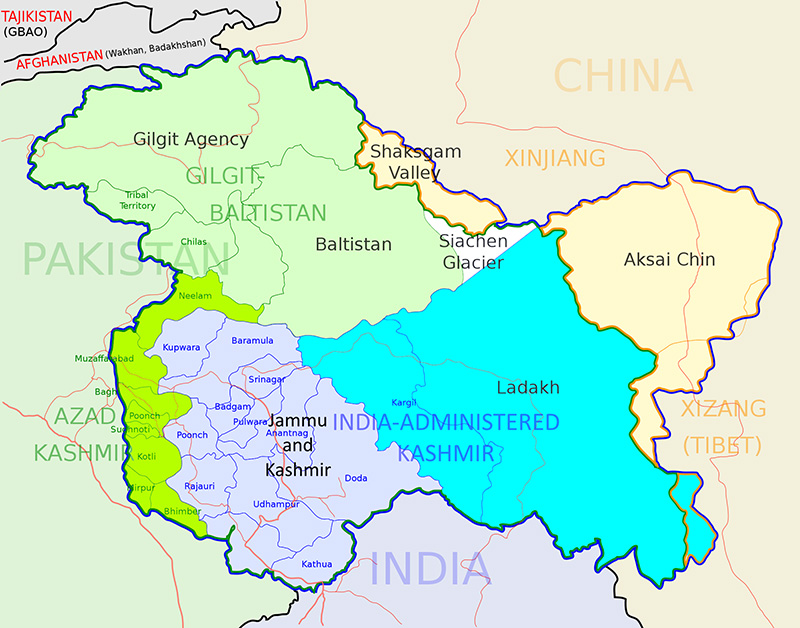
I would like to add to this, in addition to white supremacy, any kind of ethnic “supremacy.” That the Indian “project” in Kashmir is a settler-colonial one cannot be denied. The killing of Kashmiris in their own nation, the destruction of their means of livelihood, the replacing of Kashmiri government officials in Kashmir with Indians – these and other violations of international law and the human rights of the Kashmiri people demonstrate clearly the brutal settler-colonial project of India.
One might wonder how the Indian government has caused the people of India to accept this blatant brutality against an innocent and basically defenseless population. The teachings of Hindutva, which Prime Minister Narendra Modi and many other officials and citizens of India follow, is clear. Its goal is to make India a Hindu state. Sudha Ramachandran, writing in Counter Terrorist Trends and Analysis, described this ideology. She said this: “Hindutva is a modern political ideology that views India as a Hindu nation and defines Indian culture in terms of Hindu cultural values. Its goal is to make India a Hindu state.” We also have the words of Vinayak Damodar Sarvarkar who, in 1923, said that Hindus are the only true Indians as their pitrbhu (fatherland) and punyabhu (holy land) are in India. Muslims and Christians, he said, could not be considered Indian as their holy lands were not in India. His ideological successor, Madhav Sadashiv Golwalkar, one of the founders of the RSS, said that “’foreign races’ (that is, Muslims and Christians) in India “must either adopt the Hindu culture and language, must learn to respect and hold in reverence Hindu religion … must lose their separate existence to merge in the Hindu race, or … stay in the country wholly subordinated to the Hindu Nation, claiming nothing, deserving no privileges, far less any preferential treatment — not even citizens’ rights.”
In January of 1991, Su-manta Baner-gee, writing in Economic and Political Weekly, said that Christians and Muslims must prove their loyalty to India and the Hindu religion by joining with Hindus and demolishing the Babri Masjid and set up a Hindu temple. This mosque, over 450 years old, was in fact destroyed in the following year so a Hindu temple could be built on the site. Baner-gee referred to a statement by the right-wing Indian nationalist organization VHP’s leader at that time, As-hok Singh-al who said this: “If the Hindu sentiments sweep the whole country, the Muslims would realise that neither the police nor the government nor political
parties would be able to save them from the wrath.”
These quotations are foundational to Hindutva, and such sentiments are clearly in focus today. In February of this year, the India Hate Lab, based in Washington, recorded that instances of hate speech in India increased by 74% in 2024. 98.5 of those instances targeted Muslims. Among the people most frequently spewing such speech, according to this report, were Modi and Home Minister Amit Shah.
Referring back to the definition of settler-colonialism that I mentioned earlier, let’s consider the power differential between India and Kashmir. Kashmir is the most heavily militarily-occupied country on earth, with estimates ranging from one soldier for every 30 Kashmiris to one soldier for every 17 Kashmiris. Exact numbers are difficult to determine, but even with the “liberal” estimate of 1 to 30, Kashmiris are forced to live in constant fear. If I were discussing settler-colonialism, occupation, military and legal oppression of an occupied nation and a variety of other injustices, without naming India and Kashmir, one might easily think I was discussing Israel and Palestine. Hindutva and Zionism, that belief in Jews being God’s chosen people who are destined to occupy all of Palestine, are cut from the same ugly mold. The similarities are remarkable, but not surprising. We will look at just a few.
Both India and Israel repress free speech and freedom of the press. After the abrogation of Article 360 of the Indian constitution, India implemented a complete Internet blackout in Kashmir that lasted for nearly 18 months 2 . Israel, for the last 19 months, has targeted journalists, press vehicles and buildings, especially in the Gaza Strip, forbidding foreign journalists from entering , and killing at least 178 journalists as of February of this year.
The racist regimes of India and Israel both use indefinite detention, which enables them to arrest and detain, without charge, anyone “suspected” of what is loosely defined as “terrorist activity..” These victims are often held for years, and sometimes decades, without charge, and without access to families or lawyers.
Victims in Kashmir and Palestine who suffer from police or military violence at the hands of occupying soldiers have no real recourse. India and Israel grant their government-paid terrorists nearly complete impunity for any crimes they commit. India has the so-called Armed Forces Special Powers Act, which grants “special power” to members of the armed forces. The law includes this sentence: “No prosecution, suit or other legal proceeding shall be instituted, except with the previous sanction of the Central Government, against any person in respect of anything done or purported to be done in exercise of the powers conferred by this Act.” This basically grants Indian soldiers the right to commit any act without consequence.
Among the abuses these soldiers and their Israeli counterparts commit is torture. This includes, for both men and women, beatings while hanging from the ceiling, scalding with water, being chained hand and foot, sleep and food deprivation, extended period of nakedness and many others. Both India and Israel routinely arrest and torture Kashmiri and Palestinian children. Both India and Israel commit what might be called health terrorism on their victims. An article in TRTWorld from 2021, said this: Gaza was already suffering from a shortage of medical equipment after more than a decade of a deadly Israeli siege leaving hospitals without vital
equipment needed to cope with a pandemic.”
In Kashmir, Human Rights Watch reported that less than two weeks after the August 5, 2019 abrogation of Article 370, a group of doctors raised the alarm. “In an August 16 letter in the medical journal BMJ, 19 doctors from across India asked the government to ease restrictions on communication and travel, saying they were ‘a blatant denial of the right to health care and the right to life’ because they made it difficult for patients and staff to reach hospitals without hindrance.”
Despite the violence perpetrated on oppressed people, there are many forms of effective, peaceful resistance; these include various forms of civil disobedience, work and school strikes, work slowdowns, demonstrations and other related methods. They may be viewed as “terrorism” by oppressors, yet they are the most valuable tools oppressed people have, and those of us who have a voice must support them in their struggles. As they resist, whether in Palestine or Kashmir, we who can speak, must speak. We must not rest until the people of Kashmir, and of Palestine, are free.