


Course Syllabus/Process:
1) Six-week Online Course:
The course consists of six core modules, covering the following:
Module 1: Unarmed Civilian Defense: What is it?
Explore the foundations, features, and benefits of UCD, and question dominant assumptions about security — including the belief that militaries are essential for peace. Reflect on the nature of power and how to move from the traditional practices of “power over” towards more collaborative approaches of “power with” in building cooperative, people-centered defense.
Module 2: What Has UCD done thus far, and what potential does it have?
Examine the growing body of evidence showing how UCD has worked — from preventing coups in Asia to resisting occupation in Europe, achieving reforms in Latin America, and toppling dictatorships in Africa. Analyze what made these movements effective and what lessons can inform today’s conflicts, including in places such as Ukraine, Palestine, and beyond. Understand the conditions under which civilian resistance can protect lives, defend democracy, and transform societies.
Module 3: What can individuals and organizations do?
Reflect on your journey toward being and becoming a peacebuilder. Explore practical frameworks for planning, implementing, and evaluating UCD interventions. Gain tools for effective nonviolent strategy, from community organizing to monitoring and assessing impact, and consider how individuals and groups can act decisively in times of crisis.
Module 4: What can governments do?
Explore how some governments — including Costa Rica and Iceland, which maintain peace without militaries, and the Baltic states, which developed unarmed defense plans after Soviet occupation — have advanced UCD principles in practice. Examine how governments can enable, invest in, and collaborate on nonviolent strategies for national defense. For balance, analyze shifting neutrality in countries such as Sweden and Finland, and consider how public pressure and civic engagement can counter trends toward re-militarization.
Module 5: What is the role of communications and media in effective UCD?
Examine how communications and media shape public understanding of war and peace, exposing common myths such as the idea that military alliances or armed strength make us secure. Gain tools and strategies for effective storytelling, writing, digital engagement, and public advocacy. Learn how to counter propaganda, convey complex information clearly, and amplify peace-focused narratives that engage and inspire diverse audiences.
Module 6: Putting it all together
Review the ideas and insights from across the course and plan next steps for applying UCD principles in your context. Consider the future of nonviolent defense, and explore ways to sustain and strengthen your engagement in the global movement to end all wars, after the course finishes.
This course is 100% online and interactions are not live or scheduled, so you can take part whenever works for you. Weekly content includes a mix of text, images, video, and audio. Online discussion forums provide spaces for mutual learning and exchange, where facilitators and participants can ask questions, share challenges faced, and explore issues relevant to the weekly content. Facilitators also provide feedback on optional assignment submissions.
Time commitment/expectations: How much time you spend and how deeply you engage is up to you. At a minimum, you can expect to spend between 1-2 hours a week if you only review the weekly content. We hope you’ll engage in the online dialogue with peers and experts, as this is where the real richness of the learning occurs. Depending on your level of engagement with the online discussion you can expect to add another 1-3 hours a week. Finally, participants are encouraged to complete all six optional assignments (required to earn a certificate). This is an opportunity to further engage with and apply the ideas explored each week. Expect another 2 hours a week if you pursue these options.
2) Three Interactive Live Sessions:
The three 1-hour optional Zoom calls are designed to facilitate a more interactive and real-time learning experience:
· Zoom Call #1: Introductions
Thursday, February 12 at 10:00 am ET / 3:00 pm UK
· Zoom Call #2: Reflections on the course thus far
Thursday, February 26 at 10:00 am ET / 3:00 pm UK
· Zoom Call #3: Course Reflections. What next?
Thursday, March 12 at 10:00 am ET / 2:00 pm UK
👉 Please use a time zone converter to check the equivalent time in your country: https://www.timeanddate.com/worldclock/converter.html
3) End-of-Course Strategy Game
Apply your learning in an immersive three-hour online strategy simulation. Working in small groups representing key societal actors — from governments and media to unions, educators, and UCD forces — you will navigate a crisis scenario and test nonviolent defense strategies in real time. This interactive exercise is designed to explore and apply a range of pro-peace and anti-war skills, including active listening, teamwork, strategic planning, problem-solving, negotiation, and conflict transformation.
Earn a certificate. To earn a certificate, participants must complete optional weekly written assignments. Instructors will review the assignment and provide feedback. Submissions and feedback 2can be shared with everyone taking the course or kept private between a student and the instructor, at the student’s choice. Submissions must be completed by the conclusion of the course.
The cost of the course is the same for someone completing all, some, or none of the assignments.
Questions? Contact: Phill Gittins at education@worldbeyondwar.org
To register by check:
1. Email Phill Gittins and tell him.
2. Make the check out to World BEYOND War and send it to World BEYOND War 513 E Main St #1484 Charlottesville VA 22902 USA.
Registrations are not refundable.
- Build Capacity. Improve your knowledge and impact as a peacebuilder, and learn how UCD can be used instead of war and armed conflict.
- Scholarly Rigor. Ground your work in evidence, drawing upon empirical research, theoretical works, and real-world practices from across the globe.
- Practical Application. Apply your learning through online learning experiences, hands-on participatory activities, and experiential practices.
- Build your network. Engage and exchange ideas and practices with a globally diverse cohort of peers who are connecting around issues of peace and war.
- Expert-guidance. Learn with and from distinguished guest facilitators, as well as World BEYOND War staff and board members, who bring decades of experience in peace and anti-war education, activism, and communications.
- Network Expansion. Join a vibrant global community dedicated to ending war, including access to the 2900+ strong alumni network whose members meet regularly in spaces for dialogue, learning, and professional growth.
- Stay Informed. Access an extensive array of peace and anti-war resources to inform and guide your present and future endeavors.
- Create Content. Leverage diverse communication methods – including written, digital, audio, and video – to amplify your work and engage with a broader audience.
- Reflective Practice. Discover frameworks and tools to reflect on your developmental process of becoming a peacebuilder.
- Recognition. Earn a certificate as evidence of your learning and achievements from an award-winning anti-war organization.
- Future opportunities. Become involved in the broader work of World BEYOND War by creating/joining WBW chapters and affiliates around the world, where you can access additional support to inform your anti-war work.
Course Hosts/Facilitators:
Module 1: Unarmed Civilian Defense: What is it? May 12 – May 18
Facilitator: John Reuwer, MD (USA)

Dr John Reuwer is Treasurer and a Member of the Board of Directors of World BEYOND War. He is a retired emergency physician whose practice convinced him of a crying need for alternatives to violence for resolving tough conflicts. This led him to the informal study and teaching of nonviolence for the last 35 years, with peace team field experience in Haiti, Colombia, Central America, Palestine/Israel, and several US inner cities. He worked in South Sudan with the Nonviolent Peaceforce, one of the few organizations practicing professional unarmed civilian peacekeeping. He also serves on the Committee to Abolish Nuclear Weapons with Physicians for Social Responsibility educating the public and politicians about the threat from nuclear weapons, which he sees as the ultimate expression of the insanity of modern warfare, so blatantly displayed in the current war in Ukraine. John has been a facilitator for World BEYOND War’s online courses “War Abolition 201” and “Leaving World War II Behind.”
Module 2: What Has UCD done thus far, and what potential does it have? May 19 – 25
Facilitator: Karen Kennedy, PhD (Australia)
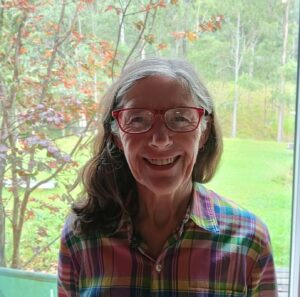
Dr Karen Kennedy is an agroecology farmer and an academic. She has an MA(Res) from the Centre for Peace and Conflict Studies, University of Sydney Australia (2012) and a Doctorate from the University of New England (2022) in arts and social sciences that focuses on alternatives to war. Karen has taught on a range of social science subjects including political theory, communications theory and ideas in history. She has been involved in various nonviolent movements and research groups including Schweik Action, https://www.bmartin.cc/others/SAW.html and XR. Since 2014 she has been co creating a sustainable off grid farm in regional NSW.
Module 3: What can individuals and organizations do? May 26 – June 1
Facilitator: Tareq Layka, MSC (Syria)
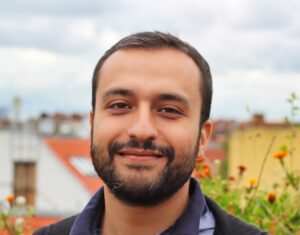
Tareq Layka is a Syrian researcher, lecturer, and consultant with a multidisciplinary background in peacebuilding, global public health, and cross-cultural education. Currently based in London, he is a Fellow at the School of International Futures and serves as the Fundraising & Partnerships Lead at the Peace Leadership Collaborative. Tareq has spent years working at the intersection of conflict, health, and human rights. In Syria, he practised dentistry and led grassroots initiatives in health, education, and community resilience. He launched and steered numerous locally driven projects to empower communities and promote nonviolent change. A TEDx speaker and experienced facilitator, Tareq frequently lectures internationally on conflict, trauma, and health. He holds a Doctor of Dental Surgery and earned an MSc in Global Health, Social Justice, and Public Policy from King’s College London.
Module 4: What can governments do? June 2 – 8
Facilitator: Marcellina Priadi, MSc (UK/Sweden)
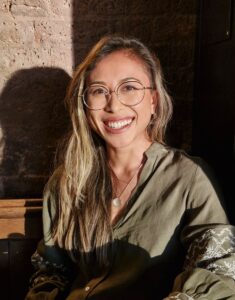 Marcellina Priadi is Coordinator of the Unarmed Civilian Protection and Accompaniment (UCP/A) Community of Practice. Marcellina has an MSSc in Peace and Conflict Studies from Uppsala University and is a PhD candidate there with the Department of Peace and Conflict Research, investigating the effects of international interventions on civilian self-protection. As a practitioner of UCP/A, Marcellina has worked side-by-side with communities in Sudan and South Sudan, as well as in national and global positions as part of Nonviolent Peaceforce (NP). In her current role, Marcellina supports the strengthening and spreading of knowledge, understanding and the effective use of UCP/A for preventing, mitigating and resolving violence.
Module 5: What is the role of communications and media in effective UCD? June 9 – 15
Facilitator: Katherine Hughes-Fraitekh, MA (USA)
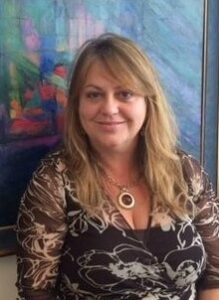 Ms. Hughes-Fraitekh is an expert on peace building and social justice movements, having worked in more than 80 countries, focused mainly in the Global South. She co-founded and currently serves as Executive Director for Solidarity 2020 and Beyond (S2020B), https://solidarity2020andbeyond.org/, an international network of grassroots peacebuilders, activists, journalists and scholars in 85+ countries working on over 100+ movements for justice, freedom, women’s rights, indigenous and land rights, self-determination, anti-corruption and environmental justice. Ms. Hughes-Fraitekh also serves as Vice President of the board for DAY-Africa, an innovative employment and small enterprise/farming training and placement program for vulnerable women in Kenya.
Katherine is active in the Rotary Peace Fellow Alumni Group, completing the 2020 mid-career program at Chulalongkorn University, Thailand. She has ongoing expertise and experience with Unarmed Civilian Defense and Protective Accompaniment initiatives including with Peace Brigades International, International Solidarity Movement, and the Western Sahara protective accompaniment project.
Her past positions include Director of Global Field Initiatives at the International Center on Nonviolent Conflict, faculty member of the Fletcher Summer Institute on nonviolent action at Tufts University, Rutgers University course on Nonviolent Action and Civil Resistance, the Inclusive Global Leadership Institute at the University of Denver, Sie Center and Peace Initiatives in Nigeria, Kenya, Thailand, Cameroon, Palestine, Israel and Lebanon. She served as Executive Director of Peace Brigades International-USA and the Commission on the Status of Women Teamwork’s Women Empowerment program. She was also a member of US Congressional staff and House Committees and has extensive advocacy and lobbying experience at the state and national levels. She consults for the EU Peace Initiative in Palestine/Israel, Palestinian Youth Advisory Panel, and the Global Fund for Women.
Ms. Hughes-Fraitekh earned her MA in International Development with a specialization in Peace and Conflict Resolution at the American University in Washington, DC, in addition completing the Arab Studies coursework at Georgetown University. She earned her BA with honors at the University of Texas at Austin. She is an ongoing guest speaking about peacebuilding and nonviolent action on international podcasts and classrooms and is also a local, national and international activist working on rights and justice in Israel/Palestine and the Middle East, immigrant rights, women’s rights, racial justice, and indigenous rights.
Module 6: Putting it all together, June 16 – 22
Facilitator: Yurii Sheliazhenko, PhD (Sweden)
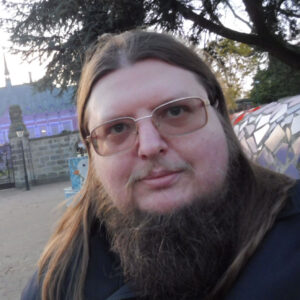 Dr Yurii Sheliazhenko is a Member of the Board of Directors of World BEYOND War. He is based in Ukraine. Yurii is executive secretary of the Ukrainian Pacifist Movement, a board member of the European Bureau for Conscientious Objection, and a council member of the International Peace Bureau. He obtained a Master of Mediation and Conflict Management degree in 2021 and a Master of Laws degree in 2016 at KROK University. In addition to his participation in the peace movement, he is a journalist, blogger, human rights defender, and legal scholar, an author of academic publications and a lecturer on legal theory and history. He has been a facilitator for World BEYOND War’s online courses. Yurii is a winner of the International Peace Bureau’s 2022 Sean MacBride Peace Prize.
This course is for anyone interested in exploring the role of unarmed civilian defense in advancing a more non-violent and peaceful world. It is particularly ideal for:
- Educators who wish to teach about peace, non-violent social change, and alternatives to war and militarism.
- Activists and organizers seeking to deepen their understanding of civil resistance movements, including the design, implementation, and evaluation of such work.
- Researchers and scholars keen to delve into the philosophy, theory, and empirical evidence relevant to the study and practice of non-violence.
- Consultants wishing to stay informed about the latest trends in peacebuilding and to offer guidance on matters related to peace, war, and security.
- Communication experts responsible for creating and disseminating engaging content and materials to inform, educate, and inspire others. This includes content creators, writers, journalists, and other media specialists.
- Students who wonder whether a less insanely self-destructive world might actually be achievable.
- Citizens trying to figure out whether to support politicians who back “defensive” wars.
Whether you’re new to peace and anti-war work or aiming to expand your knowledge and expertise, you will come away from this course with new knowledge, tools, and networks to advance your professional and personal goals. Participants come from diverse backgrounds and disciplines including NGOs/INGOs, academia, civil society, government, think tanks, the private sector, media outlets, and the broader public.