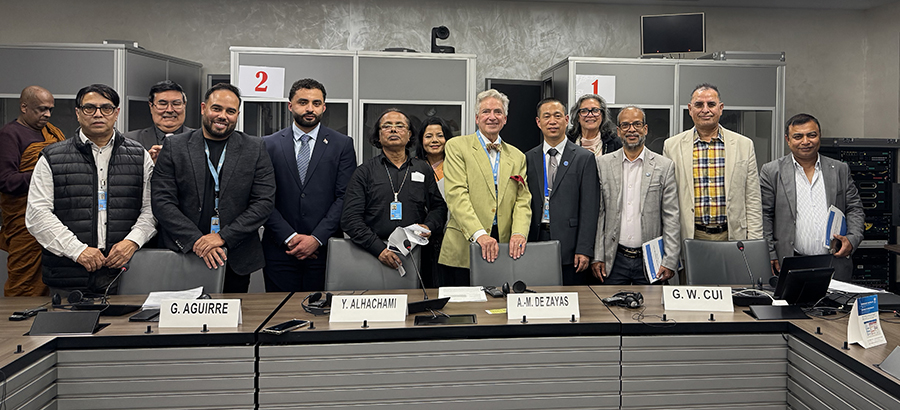
By Gabriel Aguirre, World BEYOND War, October 1, 2026
Remarks in Geneva.
First, I would like to express my gratitude to the organizers of this side event, held within the framework of the 63rd session of the United Nations Human Rights Council. We find ourselves at a critical juncture where international law is being openly disregarded by various States, through conduct that places international stability and order at grave risk.
I firmly join the voices of the colleagues who spoke before me regarding the urgent need to defend human rights in every corner of the globe, without selectivity or double standards. We are witnessing a progressive weakening of the United Nations with every action that violates the most fundamental norms of global coexistence.
War, the arms race, and militarism are prevailing over diplomacy, negotiation, and peaceful coexistence. For our organization, it is alarming that the world currently allocates 2.87 trillion dollars to military spending, representing 2.5% of global GDP. In the last year alone, military spending in Europe grew by 14%, while the United States remains the country with the largest global military budget, reaching 954 billion dollars.
These figures confront us with the painful reality of a world preparing for armed conflict, while the primary victims remain the most vulnerable populations—those denied the enjoyment of their economic and social rights.
I come from Latin America, a region endowed with vast wealth in strategic, energy, mineral, and water resources, as well as biodiversity. It is a continent that has suffered centuries of exploitation and plunder, and where the vestiges of colonialism persist.
Our region hosts numerous United States and NATO military bases. The growing deployment of U.S. troops, coupled with the signing of new military agreements and treaties, is deeply alarming. It is precisely the communities where these facilities are located that have repeatedly reported human rights violations committed by U.S. military personnel—individuals who, shielded by immunity and impunity, are not held accountable before the law.
We are equally concerned about the continued application of extraterritorial laws and unilateral coercive measures against countries such as Venezuela, Cuba, and Nicaragua, the impact of which is devastating for the civilian population. In the case of Venezuela, more than 1,080 unilateral coercive measures have been applied since 2014, directly affecting the daily lives of its people; as civil society, we emphatically demand the immediate and unconditional lifting of all such measures.
Likewise, Cuba continues to suffer under a severe and unjust blockade. In recent months, energy supply shortages have triggered a deep electricity crisis, with blackouts lasting over 72 hours in various communities; this prevents adequate medical care for critically ill patients and exacerbates shortages of medicines and basic supplies. We are witnessing a systematic and ongoing violation of the fundamental rights of an entire people—a situation to which the international community and human rights defenders cannot remain indifferent.
Finally, we express our deep concern regarding the more than 200 people who have died in the Caribbean as a result of extrajudicial and summary executions attributed to U.S. military forces—actions that constitute an open violation of the presumption of innocence.
It is unacceptable that, in the twenty-first century, the “law of the strongest” prevails, or that constitutional authorities are abducted through unilateral military actions based on false accusations and in defiance of international law—as occurred in Venezuela on January 3 of this year. Such events set a negative precedent for international relations; it is therefore crucial that this forum, and others dedicated to human rights defense, speak out emphatically to reject such actions, whether in Latin America or anywhere else in the world. We reaffirm our faith in the principles of dialogue and diplomacy.
We call upon all international actors to return to unwavering respect for the United Nations Charter, ensuring that human rights—alongside and with the active engagement of civil society—remain at the heart of government action.