

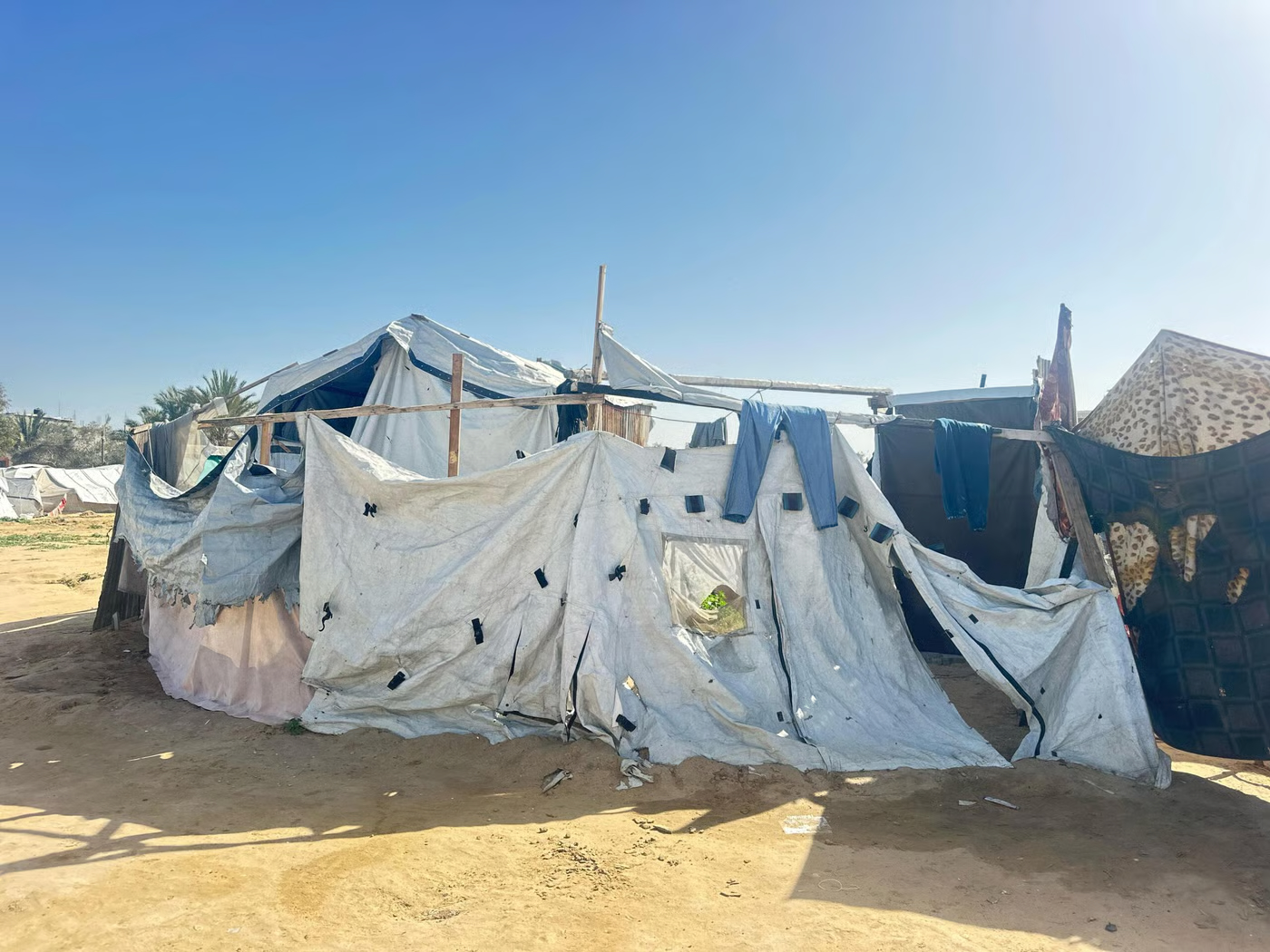
Displaced Palestinians staying in flimsy tents. Photo by Zyad Abu Mariam, courtesy of Norwegian Refugee Council.
By Kathy Kelly, World BEYOND War, September 15, 2026
Over the past two years, World BEYOND War members have been grateful to ally with a coalition called Global Solidarity for Peace in Palestine. In weekly online meetings, Palestinians living in the West Bank update our coordinating committee about their experiences amidst ongoing, U.S. provisioned Israeli genocide against Palestinians. They speak with anguish about people in the West Bank and Gaza enduring siege, hunger, disease, forcible displacement, bereavement, poisoning, contamination, and the frustrations of an Occupying force that constantly wages pogrom-style attacks.
Our Palestinian coalition members living in the West Bank long to extend a helping hand to people trapped in Gaza. They recently raised the dilemma of Gazan children who have already lost years of education. Many live in wretched tent encampments, lack adequate food and medicine, and struggle with psycho-social traumas because of having lost their loved ones.
In June of 2026, the Norwegian Refugee Council estimated that 170,000 households in Gaza, equivalent to nearly one million people, were living in tents. “Another 5,000 households sleep outdoors,” they reported, “while 52,000 households live in overcrowded shelters.” As Gazans enter the rainy and cold months of winter, they still lack emergency shelter items. They need plastic sheeting, plywood, and rope. Genocidal war and siege drive the crisis they face as the Israelis continue destroying Gazan homes and shelters and imposing restrictions which block desperately needed relief.
A Palestinian NGO, PYALARA, (Palestinian Youth Association for Leadership and Rights) suggested that our coalition could assist with practical measures to assist Gazan children who are eager to learn but who lack basic school supplies. The children are bereft of paper, pencils, pens, books, desks, and bookbags.
Recently, for UN News, an interviewer spoke with Julia Dicon, the Director of Education for UNRWA (United Nations Relief and Works Association). Dicon described what education means for Palestine refugee children and why sustained support is critical. She expressed deep respect for the many ways that Palestinians maintain capacities to educate their children, even in dire times.
The interviewer asked her to tell a story about Palestinian young people who represent courage in the face of unspeakable adversity as they continue efforts to learn and teach.
Dicon talked about two Gazan sisters, 17-year-old Tala Mousa and her 15-year-old sister, Farah Mousa, who were recently named winners of the 2026 Middle East Earth Prize. The young women regularly looked at rubble surrounding their home which Israel had bombed. They longed to rebuild, but how? Together, using their scientific knowledge, they developed a practical way to transform rubble into reusable blocks for garden beds, pavement, and partitions.
Tala and Farah represent the potential of Gazan youth to make a significant difference in their community’s lives and futures. We have an opportunity to assist Gazan youth through supporting their education, in practical ways. In doing so, we can also help build community among Palestinians living in the West Bank and those who are under siege in Gaza.
We are living in harsh, dark times. Daily, we witness Israel’s war crimes, imposing siege, pogroms, and vicious attacks that traumatize Palestinians. PYALARA, conscious of how children are suffering, encourages us not to turn away. Their guidance and testimony are indispensable.

One Response
Where is the world, when Israel is allowed to perform such atrocities ?