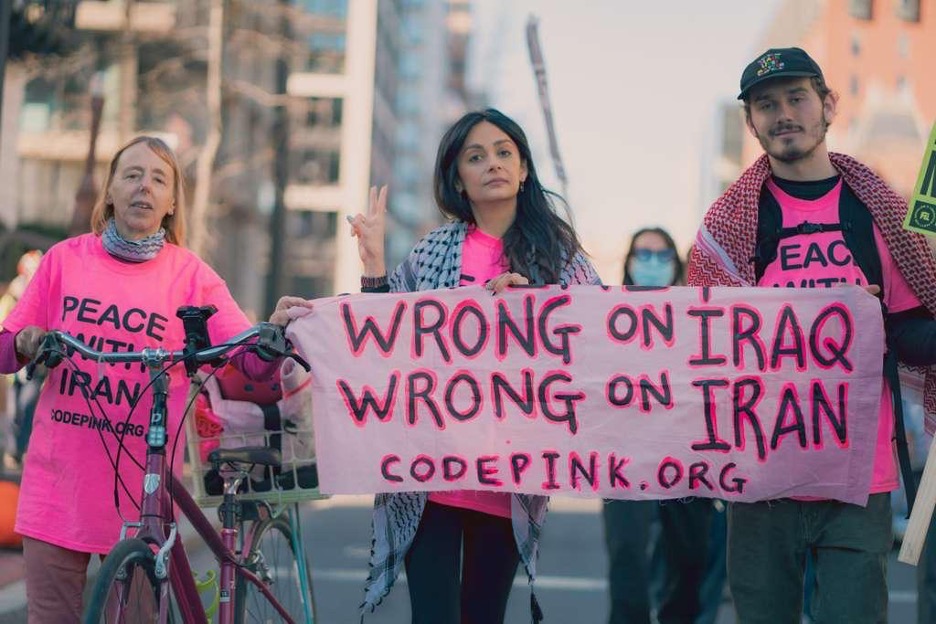
Photo credit: CODEPINK
By Medea Benjamin and Nicolas J. S.Davies
The lesson of 9/11 should be that war is not the answer to any of the problems facing the United States. After inflicting violence and chaos on country after country for twenty-five years in a “global war on terror” that has evolved into a Zionist genocide and a revived Cold War against Russia and China, the widespread public opposition to Trump’s war on Iran suggests that most Americans have finally learned that lesson.
Unfortunately, powerful sections of our corrupt business and political elites have not.
Most Americans old enough to remember September 11, 2001, can still recall the horrifying images played endlessly on our TV screens as the scale of the mass murder became clear. But we also remember something else: the sinking feeling that the hopes and dreams of billions of people, in the US and around the world, would be pushed to the back-burner for the foreseeable future, as our leaders and corporate media all too predictably embraced a new agenda of revenge, fear-mongering, jingoism and military violence.
We found out later that only hours after the attacks—less than six hours after the first plane struck the World Trade Center and barely five hours after the Pentagon was hit—the planning for America’s military response to the 9/11 massacre was already under way.
At 2:40 p.m., Defense Secretary Rumsfeld convened a meeting at the Pentagon. Notes taken by Undersecretary Stephen Cambone, later obtained by CBS News, recorded Rumsfeld demanding the “best info fast. Judge whether good enough hit S.H.” – meaning Saddam Hussein – “at the same time” as Osama bin Laden. Then came the chilling instruction: “Go massive. Sweep it all up. Things related and not.”
Twenty-five years later, we can look back and see how the US government used September 11 to unleash a crusade of violence, war crimes and chaos across the world. Experts like Nuremberg prosecutor Ben Ferencz and military historian Michael Howard warned from the beginning that declaring a “war on terror” made no sense and would make matters worse.
They were right, of course. But when the State Department’s annual Patterns of Global Terrorism report for 2004 showed an unprecedented increase in global terrorism following the US invasion of Iraq, Secretary of State Condoleezza Rice simply cancelled and discontinued the report, replacing it with a new one with different criteria to prevent comparison with previous years.
But, as Rumsfeld made clear to his subordinates from the outset, the 9/11 crisis provided an open-ended pretext for endless wars against enemies who had nothing to do with the attacks, and for the remilitarization of the United States after the small reduction in its military spending after the end of the Cold War.
Total US military spending for the past 25 years has exceeded $21 trillion (in 2024 dollars), surpassing the combined spending of the other 18 largest military powers in the world. During that time, China has built a whole new civilization and infrastructure, and leapfrogged the US economy to become the world leader in clean energy, high-speed rail and technological sectors in which the US was once preeminent.
Both Democrats and Republicans are responsible for these counter-productive choices, and the appalling human costs of these wars on the countries the United States has attacked, bombed or invaded make this an especially atrocious way to squander our nation’s wealth.
The history of the United States during this period calls to mind an old Greek myth. Croesus, the famously wealthy king of Lydia, asked the Oracle at Delphi what would happen if he invaded Persia. The Oracle told him, “If you cross the Halys river, a great empire will fall.” Encouraged, Croesus launched the invasion. But he lost the war, and the empire that fell was his own.
In pursuing their global imperial ambitions, our leaders and ruling classes have discounted and betrayed the real sources of America’s prosperity and security: the well-being of the American people and peaceful relations with our neighbors around the world.
They have led us into war, poverty and extreme inequality, and hollowed out a system of government that was slowly becoming more democratic. At home, decades of political struggle by labor, civil rights and other social movements produced enormous advances, including Social Security, Medicare and Medicaid, major investments in public infrastructure and education, and a highly progressive tax system—with the top income tax rate at 91% until 1963—that helped finance those public goods and narrow the gap between rich and poor.
Contrary to the “End of History” theory embraced by many policymakers after the Cold War, and Margaret Thatcher’s famous insistence that “there is no alternative” to the extreme neoliberal capitalism that she and Ronald Reagan ushered in, societies always have political and economic alternatives. It is only a transparently self-serving choice by America’s corrupt ruling classes that saddles us with a system that keeps all decision-making power in their own hands in order to build their own wealth to the detriment of the country we all share.
We can see one alternative today in New York City, where Mayor Zohran Mamdani is pursuing a different set of priorities: expanding free childcare, making major investments in affordable housing, improving public transportation, and freezing rents for tenants in rent-stabilized apartments. Electoral politics can be part of the solution, but only if it reflects what ordinary people really want, instead of limited choices between oligarchic “lesser evils.”
Americans are demanding a renewal of social progress, with universal healthcare, quality public education, and all the things we need but can’t afford as long as this bloated, destructive war machine remains our government’s top priority. As Martin Luther King lamented in 1967, “I knew that America would never invest the necessary funds or energies in rehabilitation of its poor so long as adventures like Vietnam continued to draw men and skills and money like some demonic, destructive suction tube.”
Twenty-five years is a long time to keep moving in the wrong direction, especially when that direction involves endless war and the destruction of other countries. We are a long way from where most Americans would like our country to be. But we have a pretty good idea of what is wrong and what we need to do:
Stop throwing money at a broken, destructive war machine. Stop threatening and blockading our neighbors. Close overseas bases and bring our troops home. Tax the wealthy. Start rebuilding our country, and replace war and militarism with cooperation and problem solving. Take public ownership and responsibility for things we all need and use, like education, healthcare, housing, infrastructure, and utilities. Abolish ICE, and other militarized institutions that waste our national resources and do not serve the public good. Insist that the military be scaled back to its legitimate role of defending the United States against a possible, but very unlikely, foreign military attack.
If we have truly learned the lesson of the past twenty-five years, then we must translate it into policies that reflect that. The real test is not whether we can finally see what went wrong after 9/11. It is whether we are able to change course.
Medea Benjamin and Nicolas J. S. Davies are the authors of War In Ukraine: Making Sense of a Senseless Conflict, now in a revised, updated 2nd edition.
Medea Benjamin is the cofounder of CODEPINK for Peace, and the author of several books, including Inside Iran: The Real History and Politics of the Islamic Republic of Iran.
Nicolas J. S. Davies is an independent journalist, a researcher for CODEPINK and the author of Blood on Our Hands: The American Invasion and Destruction of Iraq.