By Norman Solomon, World BEYOND War, September 3, 2026
A quarter-century has passed since the terrorist attack that killed almost 3,000 people in the United States on Sept. 11, 2001. During the first seven years after that mass atrocity, Pentagon spending doubled. The aftermath of 9/11 was also a huge boost for “the intelligence community.” Despite – and because of – their failure to prevent the carnage on that day, the CIA and the National Security Agency as well as 14 smaller spy agencies boomed with enormous jolts of funds.
Along the way, some line items paid for torture that persisted during the George W. Bush presidency under the euphemism of “enhanced interrogation techniques.”
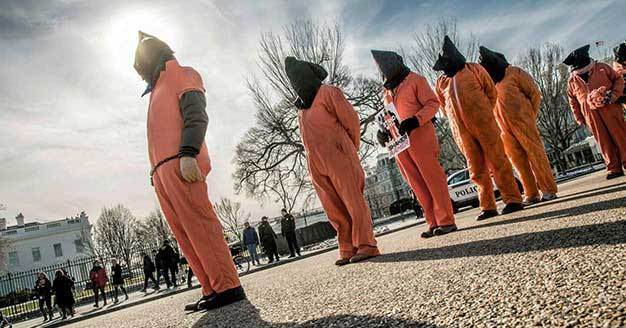
The most publicized location was Guantánamo on the island of Cuba. There, “the U.S. opened the offshore detention facility in an attempt to evade the rule of law,” the London-based organization Freedom From Torture reports. “In the name of the U.S.’s ‘War on Terror,’ people deemed by the U.S. to be ‘enemy combatants’ were detained at the facility. Many were tortured and denied basic human rights and due process… Since the first detainees arrived in 2002, Guantánamo Bay has imprisoned 780 men and boys from 48 countries…. Yet only 16 detainees have ever been convicted of a crime – just 2 percent.”
Despite public pressure, Bush vetoed a version of the Intelligence Authorization Act in March 2008 that would have required CIA interrogators to adhere to Army Field Manual regulations. As soon as Barack Obama became president, he issued an executive order rescinding the free hand for the CIA director on interrogations that Bush had reaffirmed in a July 2007 order. Obama’s directive removed the CIA’s detention power and required the agency to follow Army Field Manual rules.
Yet five and a half years went by before President Obama acknowledged, in his notable words, “We tortured some folks.” He told a news conference: “When we engaged in some of these enhanced interrogation techniques, techniques that I believe and I think any fair-minded person would believe were torture, we crossed a line.”
The acknowledgement came four months before the long-awaited release of a report in December 2014 by the Senate Select Committee on Intelligence. While heavily redacted, it was a political indictment of torture. “CIA personnel, aided by two outside contractors, decided to initiate a program of indefinite secret detention and the use of brutal interrogation techniques in violation of U.S. law, treaty obligations, and our values,” wrote the committee’s chair, Senator Dianne Feinstein. Among the report’s conclusions:
- “The CIA’s justification for the use of its enhanced interrogation techniques rested on inaccurate claims of their effectiveness.”
- “The interrogations of CIA detainees were brutal and far worse than the CIA represented to policymakers and others.”
- “The CIA has actively avoided or impeded congressional oversight of the program.”
- “Two contract psychologists devised the CIA’s enhanced interrogation techniques and played a central role in the operation, assessments, and management of the CIA’s Detention and Interrogation Program.”
Months later, the New England Journal of Medicine summed up aspects of the Senate committee’s findings: “Medical professionals, primarily private contractors, filled four basic roles at the black sites: clearing terrorist suspects as ‘medically fit’ for torture; monitoring torture to prevent death and treat injuries; developing novel torture methods; and actually torturing prisoners. All these actions were taken only after CIA and U.S. Department of Justice attorneys assured the medical professionals that they had immunity from prosecution and would not be held legally responsible for violating U.S. and international law against torture as long as they used the techniques approved in legal memos (since withdrawn) written to justify their actions. Lawyers agreed to provide immunity assurances that specific torture techniques were legal ‘enhanced interrogation’ methods only if the physicians assured them that they would be present to prevent permanent harm to prisoners. The CIA opened more than a dozen black sites around the world after 9/11, in which at least 117 prisoners were held; 39 of these prisoners were subjected to one or more torture techniques.”
At least hundreds more “suspected terrorists” who’d been captured by the U.S. were turned over to ruthless governments. “If you want a serious interrogation, you send a prisoner to Jordan,” former CIA officer Bob Baer said. “If you want them to be tortured, you send them to Syria. If you want someone to disappear – never to see them again – you send them to Egypt.”
When shocking photos emerged of vile mistreatment of Iraqi prisoners by U.S. soldiers at Abu Ghraib prison near Baghdad, a media uproar caused an official probe by two-star Army General Anthonio Taguba. His report, issued in 2004, concluded that “numerous incidents of sadistic, blatant, and wanton criminal abuses were inflicted on several detainees.” Taguba’s candor got him pushed into early retirement. In the preface to a Physicians for Human Rights report in 2008, he addressed the matter of accountability by flatly declaring that ”the Commander-in-Chief and those under him authorized a systematic regime of torture.”
But in spite of the voluminous evidence that documented high-level approval of methodical torture, not a single U.S. official went to prison as a result. Foreshadowing such impunity was a comment by Obama nine days before he became president in January 2009. On national television, he voiced “a belief that we need to look forward as opposed to looking backwards.” The words that came next were even more telling: “And part of my job is to make sure that for example at the CIA, you’ve got extraordinarily talented people who are working very hard to keep Americans safe. I don’t want them to suddenly feel like they’ve got to spend all their time looking over their shoulders and lawyering.”
The lack of accountability set a template. As president, Obama continued with his theme of governance without a rear-view mirror. On October 25, 2012, he tweeted: “We don’t look backwards, we look forward.” Career outlooks were bright for top CIA officials who’d been implicated in Bush-era torture.
“Much has been made of President Trump’s disregard for rules and norms – boundaries delineated by ethics and morality if not written laws themselves,” Adam Serwer wrote in March 2018. “But transgressing laws, rules, and norms isn’t the only way to destroy them. Another way is simply not to enforce them. In that regard, the 44th president, Barack Obama, bears a measure of responsibility for the recklessness of his successor, in particular Trump’s decision to appoint Gina Haspel, the Central Intelligence Agency’s deputy director, to run the agency itself.”
Haspel became the CIA’s director in 2018 when confirmed by the Senate despite her key role in the CIA’s torture program. Citing declassified documents, the National Security Archive at George Washington University explained that she “personally supervised the torture of a CIA detainee in 2002 leading to at least three waterboard sessions, subsequently drafted the cable that ordered destruction of the videotape evidence of torture, and served as a senior CIA official while the Agency was lying to itself, Presidents George W. Bush and Barack Obama, the Congress, and the public about the effectiveness of torture in eliciting useful intelligence.”
The Center for Victims of Torture points out that “architects and operators of the CIA torture program have risen to prestigious positions in government, the private sector, the federal judiciary and academia.” And so it was after president-elect Joe Biden nominated Avril Haines to be Director of National Intelligence. As Obama’s CIA deputy director, she had worked to impede the Senate committee investigation into torture.
“In 2015, Haines had to decide what to do about CIA officials who had hacked into the computers of Senate intelligence committee staffers who had been compiling a comprehensive report on torture, and even drummed up spurious criminal cases against them,” the Guardian reported. “She overrode the advice of the CIA inspector general and recommended against disciplinary action.” The lead researcher for that committee, Daniel J. Jones (who was portrayed by Adam Driver in the movie “The Report”), warned against Biden going through with the nomination, saying: “This is about the continuing cover-up of the torture program, the long legacy of that. And I wish I could say Haines wasn’t a part of that, but she was.” The Senate confirmed Haines to the DNI job with an 84-10 vote. She remained in the position throughout Biden’s presidency.
Three months ago, the Carnegie Endowment for International Peace announced that its next president will be Avril Haines. The organization declared: “One of the most respected national security leaders of her generation, Avril brings a deep commitment to public service and the values at the heart of our mission.”
____________________________
Norman Solomon is the national director of RootsAction and executive director of the Institute for Public Accuracy. The paperback edition of his book War Made Invisible: How America Hides the Human Toll of Its Military Machine includes an afterword about the Gaza war. His new book, The Blue Road to Trump Hell: How Corporate Democrats Paved the Way for Autocracy, is free in e-book formats.