

By Cymry Gomery, Coordinator, Montreal chapter of World BEYOND War, February 6, 2025
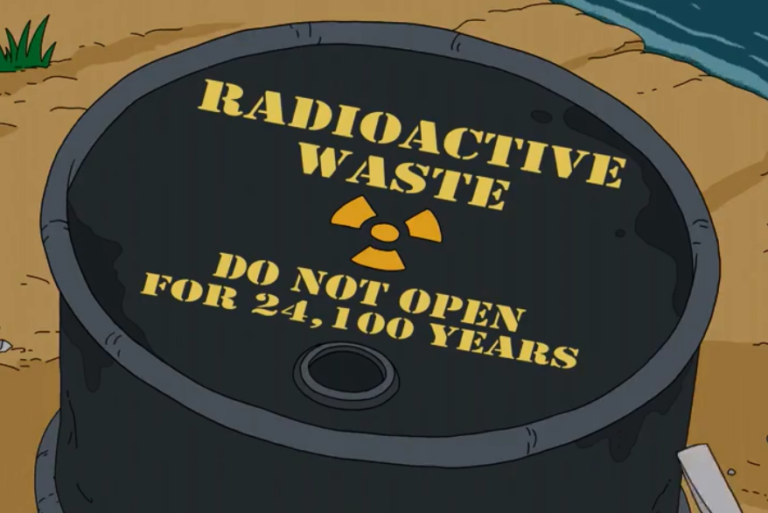
On February 5th and 6th in Ottawa, the third legal challenge to the construction of the nuclear waste disposal facility (NSDF) will be heard in Federal Court at the Supreme Court of Canada. These legal challenges were launched by Kebaowek First Nation, Concerned Citizens of Renfrew County and Area, the Canadian Coalition for Nuclear Responsibility and the Sierra Club Canada Foundation, who argue that the Minister of Environment and Climate Change Canada should never have issued a permit for the NSDF, and ask that it be withdrawn. Montreal for a World BEYOND War would like to submit this statement to the Court on this occasion.
Species at risk would lose their habitats and possibly their lives
The proposed dump is perilously close to the Ottawa River, Perch Lake, and its surrounding wetlands, but Environment and Climate Change Canada nonetheless issued a permit for clear-cutting, draining, and blasting the forested hillside. Independent field studies by the Kebaowek First Nation revealed the presence of black bear dens on the proposed site–not at all surprising considering that the sandy soil, secluded forest and sloping ground make it prime real estate from a bear’s perspective. What is surprising is that the permit was issued, even though Ontario provincial regulations prohibit the destruction of bear dens, and even though the slope would have disqualified the site based on the CNL’s own criteria (which CNL simply changed sometime in 2016 after they targeted the Chalk River site).
CNL seems unconcerned that the entire Chalk River Laboratories property — with its proximity to the Ottawa River, high groundwater table, uneven terrain, and fractured bedrock — is a very poor location for permanent radioactive waste disposal. Kebaowek First Nation also documented the presence of Eastern Wolves – a distinct species found only in Canada and threatened with extinction; deer, moose; three endangered bat species; Blanding’s turtles; and many species of at-risk migratory birds, such asWhip-poor-wills, Golden-winged Warblers, and Canada Warblers.
A case of the fox guarding the henhouse
In early 2024, the Canadian Nuclear Safety Commission (CNSC) approved a construction license for the NSDF. We share the opinion that CNSC is “a captured regulator that promotes the projects it is supposed to regulate.”.
Chalk River Laboratories is owned by the Government of Canada. Cleanup of the site was originally estimated to cost $8 billion in 2015 when a multinational consortium called “Canadian National Energy Alliance” was contracted by the Harper government to manage the Chalk River site and clean up the radioactive waste there and at other federally owned facilities.
Since the consortium took over, costs to Canadian taxpayers for the operation and cleanup at Canada’s nuclear labs have ballooned to over $1.5 billion per year. Current members in the consortium are: AtkinsRéalis (formerly SNC-Lavalin,) which was debarred by the World Bank for 10 years and faced charges in Canada of fraud, bribery and corruption; Texas-based Fluor Corporation, which paid $4 million to resolve allegations of financial fraud related to nuclear waste cleanup work at a U.S. site; and Texas-based Jacobs Engineering, which recently acquired CH2M, an original consortium member that agreed to pay $18.5 million to settle federal criminal charges at a nuclear cleanup site in the U.S.
The crown has no jurisdiction over this land
The people of the Algonquin Nation have lived in the Ottawa River watershed since time immemorial; they never signed a treaty with the Crown or Government of Canada. At the final licensing hearing on August 10, 2023, Kebaowek, Algonquins of Barriere Lake and Kitigan Zibi Anishinabeg First Nations clearly stated they do not consent to construction of the NSDF on their unceded territory.
Even if the Court were to disregard the wishes and rights of First Nations, these wishes and rights are echoed by more than 140 municipalities, including Pontiac County, Ottawa, Gatineau and Montreal.
Why?
“A repository is an admission that you cannot do anything serious about radioactive waste—you cannot make it go away—cesium, tritium, carbon-14, strontium-90, plutonium and other radioactive materials are not actual things that existed in the Earth before 1945—before the nuclear arms race. So these are brand new hazardous wastes—the nuclear fuel cycle is the only thing that produces new hazardous waste.”
–R.V. Ramana in an interview with Counterpunch
This proposed NSDF is a classic case of public subsidizing of private profits. In the case of the Chalk River NSDF, the Crown is not even pretending to bury the hazardous waste, it is just leaving it to pile up seven stories high. How can the government be so brazen in its disregard for human life, for animal life, for future generations, and for its own laws? The sad answer may be that our government and its agencies are offloading their responsibility, Western civilization’s legacy of poor judgment and hubris that created this mess–onto those who have the least agency in our colonial society—First Nations peoples, wild animals, and plants.
However, in this case, if the Crown does not cancel this permit, we are only kicking the can down the road, leaving this problem, which will never go away, for others to deal with. All of us will eventually pay the price. We are putting off the inevitable in a very evolutionarily immature and irresponsible manner.
We call on the Courts to use this moment in time to break with colonial habit and tradition, and disallow a nuclear dump on the Chalk River site. Where this radioactive waste could be dumped, and how to deal with it, is a challenge that must be faced, squarely and responsibly. Perhaps this would be a first step in a process that would ultimately lead to laws prohibiting the production of nuclear waste altogether. That is our hope.


2 Responses
There are 3 problems with nuclear energy, but one saving grace. It is clean energy from an environmental perspective.
Firstly, like fossil fuels, uranium is not a renewable resource. However, given the world’s ever-increasing population, wealth and consumption and urgent need to hold back our burning of fossil fuels, nuclear energy may be a reasonable, short term solution until we build a solar energy infrastructure.
Secondly, disposal of nuclear waste is a problem, but given Canada’s vast land mass, it’s mostly a problem of NIMBYism.
Finally, it results in fissionably material for building bombs.. One would think that this would not be an issue in Canada, but unfortunately, we’re so obedient to the US that we can’t even dare to sign onto the 5 year old UN initiative to ban nuclear weapons. Shame on us.
Right about three of the many problems anyway. One of them however constitutes part of the reason the supposed saving grace is nonsense.