By World BEYOND War, August 14, 2025
Sponsors
- Convention for Pan-Africanism and Progress (CPP)
- International Peace Bureau
- Southern Anti-Racism Network
- World BEYOND War
This webinar, hosted on August 13, 2025, helped to shed light on the impact of AFRICOM, militarization, and war across the African continent, fueled by imperialism and extractivism.
Why are we concerned about the militarization of Africa by AFRICOM?
The U.S. military established AFRICOM on October 1, 2008. They claim that combat operations in Africa are to counter violent extremist organizations which they say are finding safe haven throughout African countries. However, the truth is that the U.S. uses military force to impose control of African land, resources and labor to service the needs of U.S. multi-national corporations and the wealthy in the United States.
When AFRICOM was established in the months before Barack Obama assumed office as the first Black President of the United States, a majority of African nations—led by the Pan-Africanist government of Libya—rejected AFRICOM, forcing the new command to instead work out of Europe. But with the U.S. and NATO attack on Libya that led to the destruction of that country and the murder of its leader Muammar Gaddafi in 2011, corrupt African leaders began to allow AFRICOM forces to operate in their countries and establish military-to-military relations with the United States. Despite the Pentagon’s claims that AFRICOM has a “light footprint,” recent documents reveal that the U.S. has 49 military bases in 21 countries across the continent.
AFRICOM has recently been at the center of controversy. Its Chief Commander, General Michael Langley, accused without evidence Captain Ibrahim Traore, President of Burkina Faso, who has undertaken reforms to ensure his country’s economic sovereignty, of using his country’s gold reserves for his personal security. The AFRICOM Commander’s unsupported accusations were met with an uproar emanating from multiple circles of peace activists.
Speakers

Gnaka Lagoke
Gnaka Lagoke is an Associate Professor of History and Pan-Africana Studies at Lincoln University (PA). He is promoting a new vision of Pan-africanism that stands upon the Ubuntu Philosophy. He is the author of Laurent Gbagbos Trial and the Indictment of the International Criminal Court: A Pan-African Victory and of Le Panafricanisme d’Hier à Demain et la Philosophie Ubuntu.

Aloys Mahwa
Aloys Mahwa is the Living Peace Institute Country Director based in Goma (DRC). He manages Living Peace implementation activities in North and South Kivu, Ituri and Kinshasa provinces of the DRC, playing a key role in coordinating stakeholder working sessions in the promotion of positive masculinity to end SGBV and Community Based Mental Health Interventions at Living Peace Institute, documenting and building upon the program’s lessons learned and best practices, supervising monitoring and evaluation of the initiative, and managing the allocation of Living Peace resources. Aloys is an active actor in ending sexual gender based violence in DRC across the 12 Great Lakes Region member states. He is a co-founder of the Interdisciplinary Genocide Studies Center to prevent mass violence and genocide through research and education. Aloys Mahwa is also a fellow of Salzburg Global Seminar for Prevention of Holocaust and Genocide. Aloys Mahwa is Equimundo’s focal Resource person in the DRC. Aloys holds a master’s degree in Project Management and Anthropology and a master’s degree in Managerial Economy from the Catholic University of Central Africa, and he holds a BA in Philosophy from Jesuit Faculties of Paris.

Manal Taha
Manal Taha is an anthropologist and conflict analyst with over 20 years of experience in conflict mediation and women, peace, and security. Her expertise in different conflict zones includes Sudan, South Sudan, Libya, Niger, Tanzania, and Bangladesh. She is leading Women, Peace, and Security and civilian inclusion in Sudan peace processes.
Manal carried out security and studies analysis in different countries including Burkina Faso, Central Africa Republic, Uganda, Sudan, Cameroon, and Chad. She is member of the network of peace builders and Indigenous people mediators.
Manal has two Masters’ degrees from School of International Training SIT in Vermont and from University of Khartoum in Sudan.
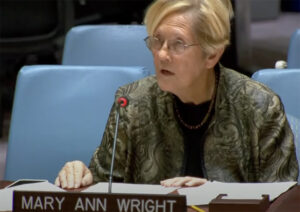
Ann Wright
Ann Wright serves on the CODEPINK Board and is an advisory board member of Veterans For Peace, International Peace Bureau, World BEYOND War, Gaza Freedom Flotilla, NO to NATO, Hawaii Peace and Justice, Pacific Peace Network and Women Cross DMZ.
She was in the US Army/Army Reserves for 29 years and retired as a Colonel. She was also a US diplomat and served in US Embassies in Nicaragua, Grenada, Somalia, Kyrgyzstan, Sierra Leone, Micronesia, Afghanistan and Mongolia. She resigned from the US government in March 2003 in opposition to Bush’s war on Iraq.
She was on the 2015 Women Cross DMZ trip to North Korea and South Korea. She speaks and writes frequently on US militarism in Asia and the Pacific. She lives in Honolulu, Hawaii. She is the co-author of “Dissent: Voices of Conscience.”